Admit rate has ranged 43%–93% over the last 5 years — notably volatile. Source: IPEDS via Urban Institute.
Acceptance & SAT from Common Data Set / IPEDS; net price, earnings & graduation from the U.S. Dept. of Education College Scorecard. Figures lag ~1–2 years — verify with the school.
The Academy of Interactive Entertainment (AIE) in Lafayette, Louisiana, is a niche, private non-profit institution that operates more like a focused trade school than a traditional liberal arts college. It stakes its reputation entirely on delivering practical, hands-on skills for the games, 3D animation, and visual effects industries, with a curriculum built by and for industry professionals. The school's identity is defined by its singular vocational mission, an admissions process that is less selective than most universities, and a cost structure that places a significant financial burden on students and families.
Admission requirements
Test-blind — scores not considered
Required
High school transcript
Demonstrated competencies
Source: IPEDS Admissions survey (2022) via Urban Institute. Covers formal factors only — it does not reflect essays, extracurriculars, or other holistic criteria.
More details
Undergrad enrollment
89
In-state tuition
$24,600
Out-of-state tuition
$24,600
Top Majors
Computer & Information Sciences, Film & Television
Campus Setting
Urban
Degrees Awarded
2 Year
Institution Type
Private, Non-profit
Median Earnings (10 yrs)
$39,209
Graduation Rate (On-Time)
100%
Outcomes & value
Outcomes & value
Median debt at graduation
$12,000
Pell (lower-income) share
46%
First-gen share (among federal-aid recipients)
47%
Earnings = median of students working ~10 years after entry; debt = median of graduates. Value divides 10-yr earnings by one year’s net price — read it as earnings per dollar of annual cost, not a full lifetime ROI; it favors lower-cost schools. Source: U.S. Dept. of Education College Scorecard. Figures lag ~2 years and reflect all students, not your intended major.
Financial health
2.2 / 3.0Meets the federal financial-responsibility standard
U.S. Dept. of Education Financial Responsibility Composite Score (FY2022-23). Scale −1.0 to 3.0; ≥1.5 meets the standard. Reported for private nonprofit & for-profit institutions only — public universities are state-backed and not scored, so this is a stability signal, not a ranking.
Campus & location
Campus safety
On-campus violent crimes (2024)
0
On-campus criminal offenses classed as violent (murder/non-negligent manslaughter, rape, robbery, aggravated assault) for the most recent reported year. Source: U.S. Dept. of Education Campus Safety and Security (Clery Act). Counts reflect what’s reported to the school, and urban campuses often report more partly due to non-student incidents nearby — read alongside campus size and setting, not as a standalone safety verdict.
Climate
Pleasant days / yr
107
Summer high
90°F
Winter low
48°F
Annual rain
62"
Natural-hazard risk
Relatively High
Pleasant days counts days per year with a mean temperature of 55–75°F, a high at or below 90°F, a low at or above 45°F, and little precipitation — a transparent comfort measure, not a weighting we invented. Computed from Open-Meteo ERA5 daily history (2019–2023). Natural-hazard risk is the county’s composite rating from the FEMA National Risk Index.
Quick answers
What is the acceptance rate at Academy of Interactive Entertainment?
Academy of Interactive Entertainment's acceptance rate is approximately 43% (Lafayette, LA), based on the most recent figures we compiled from public and primary sources.
How much does Academy of Interactive Entertainment cost?
At Academy of Interactive Entertainment, the average net price (after aid) is about $32,888 per year. Actual cost varies with financial aid and residency.
How many undergraduates attend Academy of Interactive Entertainment?
Academy of Interactive Entertainment enrolls approximately 89 undergraduate students.
Where is Academy of Interactive Entertainment located?
Academy of Interactive Entertainment is located in Lafayette, LA.
Admissions
AIE's admissions process is characterized by its accessibility, with an that is moderately selective but far from the hyper-competitive gates of elite art or tech schools. The school does not have an open admission policy, but its threshold is notably lower than that of many four-year institutions. Published acceptance rates from various sources show significant variation, ranging from 41.6% to 80%, indicating a fluid and potentially less formulaic review process. The initiative, a standard source for admissions data, provides a framework for understanding factors like admission rates and testing policies, though AIE-specific CDS data is not provided in the sources. Notably, standardized test scores like the SAT are not a central component of the application, as multiple sources indicate the school does not require or report an SAT range for admitted students. The process appears to prioritize a candidate's interest and potential in the creative tech fields over traditional academic metrics. For the 2024-25 academic year, one source reports a rate (the percentage of admitted students who enroll) of 57.69%, suggesting that more than half of those offered a spot choose to attend.
The academic experience at AIE is unabashedly vocational and industry-focused. The school's philosophy is that "practical skills in animation, design and visual effects beat theory every time." Degrees and courses are concentrated in computer and information sciences, film, and television, with a declared mission to produce graduates who can immediately demonstrate "amazing hands-on skills" to potential employers. The institute promotes a curriculum with a "strong technical, practical and career focus," delivered by "highly qualified and industry-experienced academic staff." This approach is designed to forge a direct pipeline into the interactive entertainment sector. Online discussions among prospective students highlight AIE's reputation for having "good connection[s] to the industry," which is a central selling point. The school awards two-year degrees, aligning with its intensive, skills-based model. The pedagogy emphasizes technical execution and artistic identity, with social media posts from the institution discussing trade-offs like "lower polygon counts and faster production" versus "stronger artistic identity and better performance."
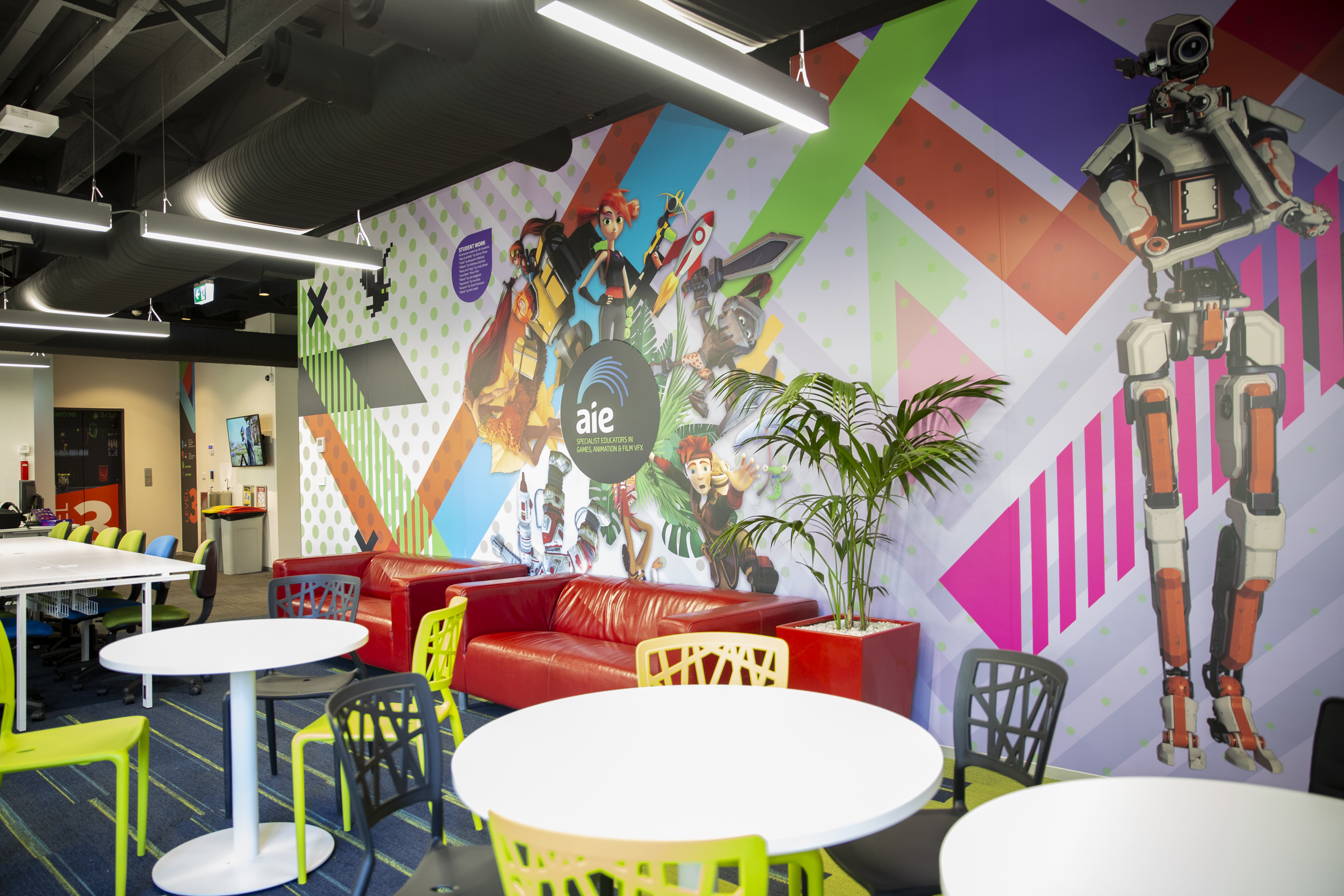
Student life at AIE revolves around its specialized, studio-like environment. The school bills itself as "the world's first non-profit specialist games and visual effects educator," with a mission to "invest in our students, grow the industry and support graduate career" development. The campus setting is urban, located in Lafayette. A unique aspect of the AIE experience is the opportunity for cultural and academic exchange; the school provides students the chance to study abroad at its three campuses in Australia. The institution uses social media platforms like Instagram and YouTube to showcase student experiences, asking them "what their favourite part of studying here is." However, the student experience is not without criticism. A stark counter-narrative exists online, with one Reddit post vehemently advising prospective game developers in the US: "DO NOT pick The Academy of Interactive Entertainment (AIE)... you will NEVER learn any material that is in line with the..." This suggests significant dissatisfaction among some alumni or students, pointing to potential disparities between marketing and the on-the-ground educational reality for some.
Outcomes data for AIE graduates presents a mixed picture, with notable variances in reported figures. A key positive metric comes from College Factual, which reports an on-time (four-year) graduation rate of 100% for first-time, full-time students pursuing bachelor's degrees. Another source lists an overall graduation rate of 84% and a first-year retention rate of 62%. Post-graduation earnings are a critical measure for a career-focused school. The U.S. Department of Education's College Scorecard provides data on the institution, though specific figures from that source are not detailed in the provided snippets. Other sources report median earnings for alumni: $36,662 five years after graduation and $39,209 ten years after graduation. For context, one comparison notes that the average median earnings five years after graduation across institutions is $45,519, suggesting AIE graduates may earn below this benchmark. The school's core promise is that its hands-on approach enables graduates to "show employers they have amazing hands-on skills," ostensibly leading to industry employment, but the earnings data implies starting salaries in the field may be modest.
The at AIE is substantial, and the after aid remains high. The canonical average net price after aid is $32,888. Other sources report similar figures, with an average net price calculated "based on various factors per year after grants and scholarships are applied" and a post-aid cost of $37,331 cited by the College Board. Financial aid is available, with AIE offering "scholarship opportunities for students on the basis of academic merit and financial need." The average financial aid package (grants and scholarships) is reported to be $4,500 by one source and $5,739 per year by another. There is no information in the provided sources to suggest AIE has a "no-loan" financial aid policy, where loans are eliminated from aid packages for qualifying students, or that it meets 100% of demonstrated financial need for all admitted students. A general article notes that only "roughly two dozen schools" have such no-loan policies. The significant gap between the total cost and the average aid award indicates most students and families must cover a large portion of expenses through other means, such as loans, savings, or income.
AIE stands out for its uncompromising, single-minded focus on the trades of game development and digital visual effects. It is not a college in the traditional sense—it's a specialist training ground. Its identity is built on being the "world's first non-profit specialist games and visual effects educator," a claim that underscores its pioneer status and mission-driven approach. The school distinguishes itself by prioritizing industry connections and practical, portfolio-ready skills over theoretical academia, a philosophy that resonates with students seeking a direct path into a competitive creative field. The opportunity for international study at its Australian campuses adds a unique global dimension to its programs. However, its standout nature is a double-edged sword. The polarized student feedback—from those who value the industry links to those who deliver scathing critiques of the education quality—highlights a risk inherent in such a specialized model. It stands out as a potential fast-track for the right student, but also as a potentially expensive misstep for those whose expectations don't align with the studio-centric, technically-driven reality. In a landscape of broad liberal arts colleges, AIE is a narrow, deep dive into a specific digital craft.
Academy of Interactive Entertainment seal · sourceCampuses | Academy of Interactive Entertainment (AIE) · sourceHousing Resources | Academy of Interactive Entertainment (AIE) · sourceAcademy of Interactive Entertainment - Wikipedia · source