Admit rate has ranged 64%–83% over the last 5 years — notably volatile, though the latest figure above (59%) falls outside that window. Source: IPEDS via Urban Institute.
Acceptance & SAT from Common Data Set / IPEDS; net price, earnings & graduation from the U.S. Dept. of Education College Scorecard. Figures lag ~1–2 years — verify with the school.
Albertus Magnus College is a small, Dominican Catholic liberal arts college in the heart of New Haven, Connecticut, offering a pragmatic, career-focused education within a tight-knit community. Its identity is shaped by the Dominican pillars of prayer, study, community, and service, and it leverages its urban setting as a 'cosmopolitan cultural center' for experiential learning. The college is recognized for its workforce readiness, with recent graduating classes achieving near-perfect placement rates, and operates with a moderately selective admissions process that is test-blind.
Admission requirements
Test-blind — scores not considered
Required
High school transcript
Grade point average
TOEFL (non-native English)
Considered (not required)
Class rank
Letters of recommendation
College-prep program
Demonstrated competencies
Source: IPEDS Admissions survey (2022) via Urban Institute. Covers formal factors only — it does not reflect essays, extracurriculars, or other holistic criteria.
More details
Undergrad enrollment
991
In-state tuition
$41,908
Out-of-state tuition
$41,908
Location
New Haven, CT (urban)
Graduation Rate
51%
Meets Full Need
No
On-Campus Housing
39% of students
Demonstrated Interest
Considered
Median Earnings (10yr)
$60,144
Outcomes & value
Outcomes & value
Median earnings (10 yr)
$60,144
Value (earnings ÷ net price)
1.8×
Median debt at graduation
$30,964
Graduation rate
51%
First-year retention
67%
Reducing loan balance (3 yr)
46%
Pell (lower-income) share
51%
First-gen share (among federal-aid recipients)
53%
Financial health
3.0 / 3.0Meets the federal financial-responsibility standard
U.S. Dept. of Education Financial Responsibility Composite Score (FY2022-23). Scale −1.0 to 3.0; ≥1.5 meets the standard. Reported for private nonprofit & for-profit institutions only — public universities are state-backed and not scored, so this is a stability signal, not a ranking.
Top-earning majors
Median earnings by field of study (highest credential), ~2 years after completion.
Management Information Systems and Services$61,516
Business Administration, Management and Operations$52,107
Business/Managerial Economics$52,107
Sociology$37,856
Communication and Media Studies$37,208
Criminal Justice and Corrections$31,848
Campus & location
Campus safety
On-campus violent crimes (2024)
0
Per 1,000 students
0.00
On-campus criminal offenses classed as violent (murder/non-negligent manslaughter, rape, robbery, aggravated assault) for the most recent reported year. Source: U.S. Dept. of Education Campus Safety and Security (Clery Act). Counts reflect what’s reported to the school, and urban campuses often report more partly due to non-student incidents nearby — read alongside campus size and setting, not as a standalone safety verdict.
Climate
Pleasant days / yr
93
Summer high
81°F
Winter low
26°F
Annual rain
57.6"
Annual snow
24.6"
Pleasant days counts days per year with a mean temperature of 55–75°F, a high at or below 90°F, a low at or above 45°F, and little precipitation — a transparent comfort measure, not a weighting we invented. Computed from Open-Meteo ERA5 daily history (2019–2023).
Deep dive — research, future-scholar output & economic mobility▾
Research output
Institutional h-index
30
Scholarly works
160
Institutional research volume and impact from OpenAlex. The h-index reflects large research universities and will be low for teaching-focused liberal-arts colleges — not a measure of undergraduate quality.
Economic mobility
Mobility rate
5.5%
Bottom → top quintile
43%
From bottom quintile
13%
Mobility rate = the share of students who both start in the bottom household-income quintile and reach the top quintile; bottom → top is that chance conditional on starting at the bottom. Source: Opportunity Insights Mobility Report Cards (Chetty, Friedman, Saez, Turner & Yagan). Reflects 1980–82 birth cohorts, so it’s directional, not current.
Quick answers
What is the acceptance rate at Albertus Magnus College?
Albertus Magnus College's acceptance rate is approximately 59% (New Haven, CT), based on the most recent figures we compiled from public and primary sources.
How much does Albertus Magnus College cost?
At Albertus Magnus College, the average net price (after aid) is about $34,028 per year. Actual cost varies with financial aid and residency.
How many undergraduates attend Albertus Magnus College?
Albertus Magnus College enrolls approximately 991 undergraduate students.
Where is Albertus Magnus College located?
Albertus Magnus College is located in New Haven, CT.
Admissions
Albertus Magnus College operates a moderately selective, test-blind admissions process that accepts the Common Application. The college received 3,485 applications for a recent cycle, admitting 2,067 for an of 59%. Of those admitted, 1,006 enrolled, indicating a rate just under 49%. The admissions process does not require SAT or ACT scores, and while specific GPA ranges for admitted students are not detailed in the provided sources, the college emphasizes a . Demonstrated interest is a factor considered in admissions decisions, as indicated by its reporting. The college also offers an Early Decision option, though the specific acceptance rate for that pathway is not detailed in the provided sources.
Earnings = median of students working ~10 years after entry; debt = median of graduates. Value divides 10-yr earnings by one year’s net price — read it as earnings per dollar of annual cost, not a full lifetime ROI; it favors lower-cost schools. Source: U.S. Dept. of Education College Scorecard. Figures lag ~2 years and reflect all students, not your intended major.
Psychology, General$24,421
Source: U.S. Dept. of Education College Scorecard (field-of-study earnings). Figures cover graduates who received federal aid and lag ~2 years; not all programs report data.
The academic experience at Albertus Magnus is built on a liberal arts core with a strong emphasis on translating classroom learning into real-world, career-ready skills. The college offers a wide range of undergraduate degree programs, concentrations, sequences, and minors. The most popular majors cluster in practical, high-demand fields: Business, Management, Marketing, and Related Support Services; and Homeland Security, Law Enforcement, Firefighting, and Related Protective Services. The curriculum is designed to be experiential, a point of institutional pride that is frequently highlighted. The college also provides accelerated graduate programs in areas like art therapy, liberal studies, education, leadership, and business administration, facilitating a direct path to advanced degrees.
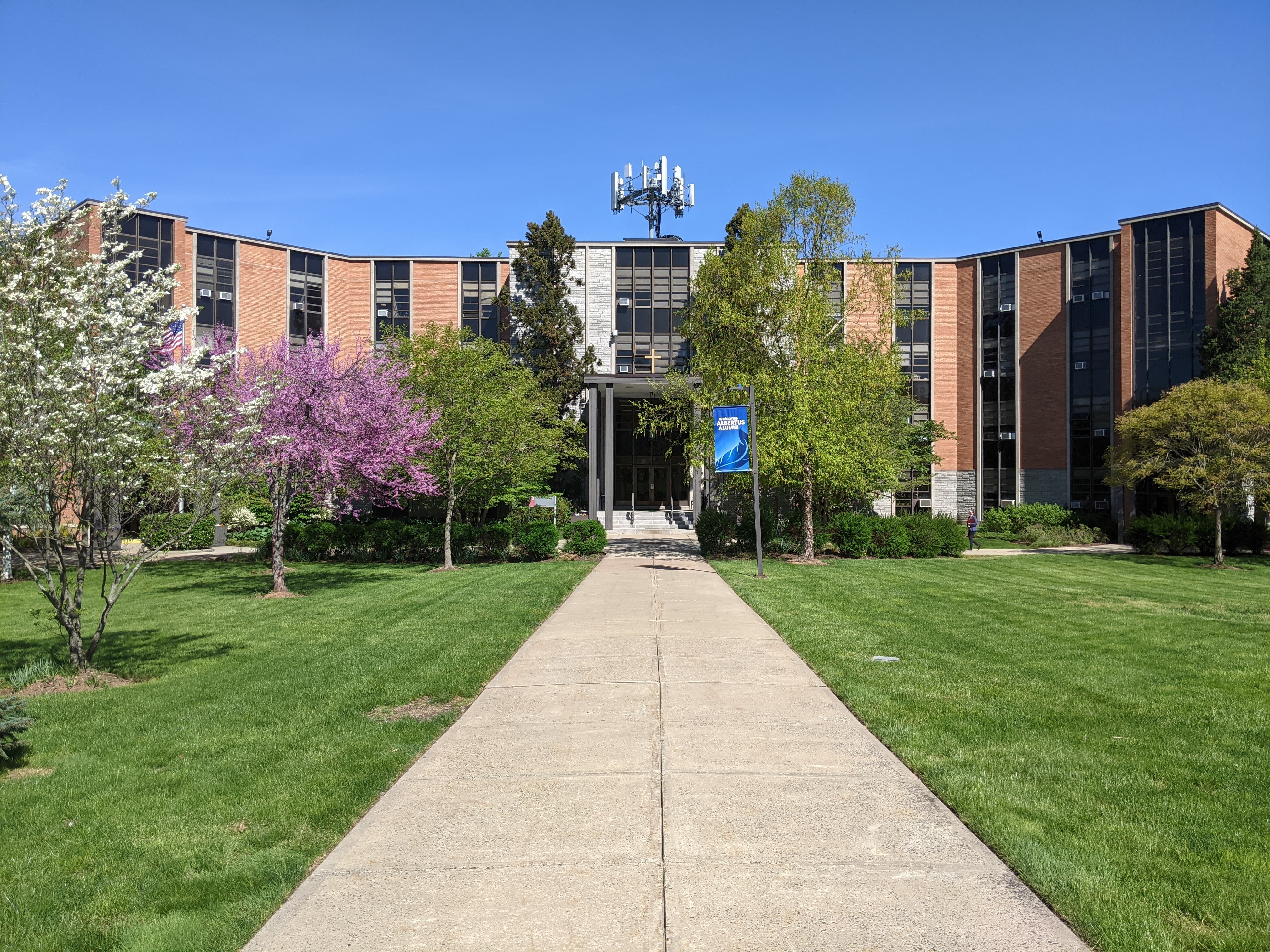
Life at Albertus Magnus unfolds on a residential campus described as a 'safe environment to enjoy independence' within an educational and social community. The student body is split between on-campus and off-campus living, with 39% of students residing in college-owned, -operated, or -affiliated housing and 61% living off campus. The campus atmosphere is reported to be 'busy and involved,' supported by a variety of student activities and clubs. The college's identity is deeply rooted in its Dominican Catholic heritage, organized around the four pillars of Prayer, Study, Community, and Service. This values-based community exists within the vibrant context of New Haven, Connecticut, a city of over 130,000 that the college touts as a 'cosmopolitan cultural center' with award-winning professional theaters, renowned art museums, and a rich urban landscape that serves as an extension of the campus.
Albertus Magnus College prides itself on producing 'workforce ready' graduates, a claim strongly supported by its placement data. The Class of 2022 achieved a 98% success rate (defined as employment or graduate school enrollment) within six months of graduation, which the college notes is an all-time high and surpasses a recent national comparison rate of 84%. Earlier data for the Class of 2017 showed a 96% placement rate. The six-year graduation rate is 51%. In terms of earnings, data indicates that graduates one year out earn an average of $45,812 annually, which rises to an average of $60,642 per year five years after graduation.
Albertus Magnus College is transparent about costs, providing a Calculator for prospective students and adhering to Connecticut state law by sending a Federal College Financing Plan to all awarded students. The college states that 100% of its full-time, first-year undergraduates receive grant or scholarship aid. However, the institution is explicit that it 'is not able to meet 100% of every student's demonstrated financial need.' The average aid package awarded is $34,194, with an average need-based scholarship or grant award of $7,910. The college participates in all federal and state financial aid programs and offers its own institutional scholarships and grants to help eligible students manage expenses.
Albertus Magnus College carves out a distinctive niche by merging a values-based, Dominican Catholic liberal arts education with an unapologetically pragmatic, career-oriented mission. It’s not a college that lives in the theoretical; its celebrated 'experiential learning curriculum' is designed explicitly to polish classroom knowledge into 'real-world skills that employers value.' This focus on tangible outcomes is validated by exceptional postgraduate success rates, recently hitting 98%. The community is intimate and guided by the pillars of Prayer, Study, Community, and Service, offering a structured, supportive environment. Yet, it’s planted in the middle of a lively, culturally rich New Haven, giving students the best of both worlds: a close-knit campus and an urban playground. It’s a college for the student who wants a personal education with a clear line of sight to a job, all within a framework of purpose and service.
Albertus Magnus College seal · sourceVirtual Video Driving Tour · sourceCampus Video Tour | Albertus Magnus College · sourceALBERTUS MAGNUS COLLEGE · source