Loading…
← All schools
Alexandria Technical & Community College
Alexandria, MNpublicwww.alextech.edu/
Avg net price
$13,691
Earnings (10 yr)
$49,393
Acceptance & SAT from Common Data Set / IPEDS; net price, earnings & graduation from the U.S. Dept. of Education College Scorecard. Figures lag ~1–2 years — verify with the school.
Alexandria Technical & Community College is a Minnesota powerhouse that operates on a refreshingly simple premise: get students in, trained, and out into high-wage careers with remarkable efficiency. It’s an open-door institution with a laser focus on practical skills, from diesel mechanics to law enforcement, boasting some of the highest completion and job placement rates in the state's two-year college system. This isn't a place for abstract theory; it's a direct pipeline to the regional workforce, wrapped in a no-frills, community-focused campus life.
More details
- Undergrad enrollment
- 1,533
- In-state tuition
- $6,236
- Out-of-state tuition
- $6,236
- Specialized Majors
- Transportation, Protective Services, Precision Production
- Median Earnings (10yr)
- $49,393
- On-Time Graduation Rate
- 60%
- Overall Graduation Rate
- 65%
- Earnings 1 Year After Graduation
- $46,721
Outcomes & value
Outcomes & value
- Median earnings (10 yr)
- $49,393
- Value (earnings ÷ net price)
- 3.6×
- Median debt at graduation
- $12,000
- Reducing loan balance (3 yr)
- 69%
- Pell (lower-income) share
- 16%
- First-gen share (among federal-aid recipients)
- 26%
Earnings = median of students working ~10 years after entry; debt = median of graduates. Value divides 10-yr earnings by one year’s net price — read it as earnings per dollar of annual cost, not a full lifetime ROI; it favors lower-cost schools. Source: U.S. Dept. of Education College Scorecard. Figures lag ~2 years and reflect all students, not your intended major.
Campus & location
Campus safety
- On-campus violent crimes (2024)
- 2
On-campus criminal offenses classed as violent (murder/non-negligent manslaughter, rape, robbery, aggravated assault) for the most recent reported year. Source: U.S. Dept. of Education Campus Safety and Security (Clery Act). Counts reflect what’s reported to the school, and urban campuses often report more partly due to non-student incidents nearby — read alongside campus size and setting, not as a standalone safety verdict.
Climate
- Pleasant days / yr
- 97
- Summer high
- 79°F
- Winter low
- 7°F
- Annual rain
- 26"
- Annual snow
- 43.1"
- Natural-hazard risk
- Relatively Low
Pleasant days counts days per year with a mean temperature of 55–75°F, a high at or below 90°F, a low at or above 45°F, and little precipitation — a transparent comfort measure, not a weighting we invented. Computed from Open-Meteo ERA5 daily history (2019–2023). Natural-hazard risk is the county’s composite rating from the FEMA National Risk Index.
Deep dive — research, future-scholar output & economic mobility
Research output
- Institutional h-index
- 21
- Scholarly works
- 62
Institutional research volume and impact from OpenAlex. The h-index reflects large research universities and will be low for teaching-focused liberal-arts colleges — not a measure of undergraduate quality.
Quick answers
- How much does Alexandria Technical & Community College cost?
- At Alexandria Technical & Community College, the average net price (after aid) is about $13,691 per year. Actual cost varies with financial aid and residency.
- How many undergraduates attend Alexandria Technical & Community College?
- Alexandria Technical & Community College enrolls approximately 1,533 undergraduate students.
- Where is Alexandria Technical & Community College located?
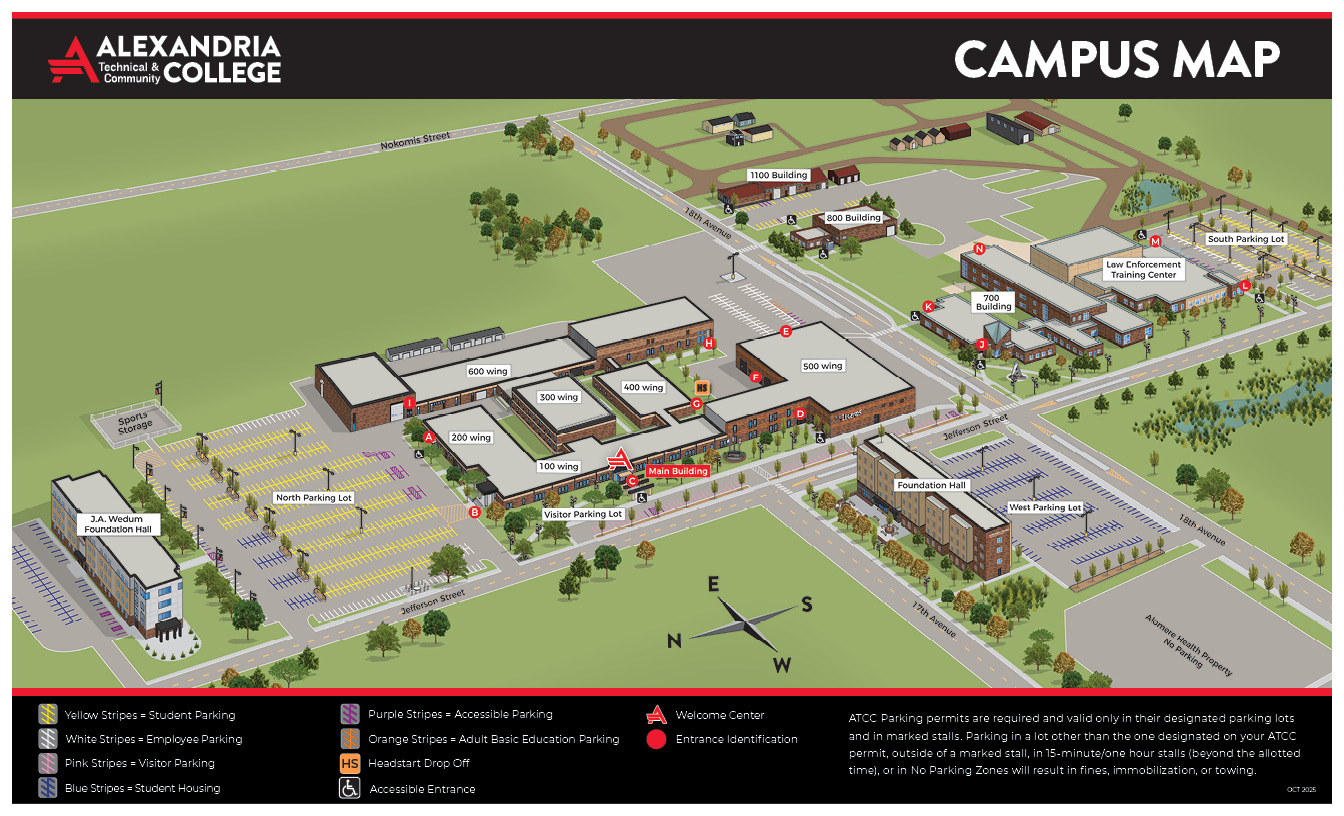
- Alexandria Technical & Community College is located in Alexandria, MN.
Admissions
Alexandria College operates on an open admissions policy, meaning any student with a high school diploma or GED is eligible to apply. The process is deliberately straightforward: the online application takes about 15 minutes to complete, with a $20 application fee. This accessible approach has contributed to significant growth, with the college experiencing a 27.6% enrollment increase from fall 2020 to fall 2024—the highest growth rate among Minnesota community and technical colleges during that period. Total enrollment sits around 2,549 students. The admissions office encourages prospective students to simply begin the process and reach out directly for guidance, emphasizing a supportive, non-selective entry point into higher education.
Academics
The academic identity here is unapologetically vocational and transfer-oriented, built on programs designed to lead directly to employment or seamless continuation to a four-year degree. The college's own data states its retention, graduation, and career placement rates are among the highest of all Minnesota public two-year colleges. Programs are heavily specialized in high-demand technical fields. According to an analysis of awarded degrees, the . The curriculum is hands-on: the Exercise Science program, for example, focuses on the principles of human performance, nutrition, and lifestyle coaching. For students aiming for a bachelor's degree, ATCC provides strong transfer options, particularly noted in accounting, which offers many elective choices. The engineering curriculum ensures students build a fundamental knowledge of physics, chemistry, and mathematics to meet lower-division requirements for transfer.
Compare Alexandria Technical & Community College
vs Dickinson State Universityvs Minot State Universityvs Southwest Minnesota State Universityvs Indiana University-East
See colleges similar to Alexandria Technical & Community College →Sources
- ATCC Student Achievement Data
- Admissions
- Alexandria College Sees 27.6% Enrollment Growth 2020- ...
- Alexandria Technical & Community College Overview
- Student Right to Know
- Apply to Alexandria College
- Alexandria
- Welcome to the City of Alexandria Homepage! | City of Alexandria, VA
- THE 15 BEST Things to Do in Alexandria (2026)
- Visit Alexandria | Washington DC
- Alexandria, Virginia