Admit rate has ranged 32%–65% over the last 5 years — notably volatile, though the latest figure above (73%) falls outside that window. Source: IPEDS via Urban Institute.
Acceptance & SAT from Common Data Set / IPEDS; net price, earnings & graduation from the U.S. Dept. of Education College Scorecard. Figures lag ~1–2 years — verify with the school.
Allen University is a small, historically Black institution in Columbia, South Carolina, with a mission-driven focus on providing access and opportunity. Its academic landscape is defined by a handful of practical, career-oriented majors, most notably Social Sciences, and a campus life that revolves around a tight-knit community and a significant roster of student clubs. The university's profile is marked by high accessibility—reflected in its open admissions—alongside significant challenges in student retention and post-graduate earnings, positioning it as a critical, if under-resourced, gateway for many students.
Admission requirements
Test-blind — scores not considered
Required
High school transcript
Grade point average
Considered (not required)
Letters of recommendation
College-prep program
Demonstrated competencies
TOEFL (non-native English)
Source: IPEDS Admissions survey (2022) via Urban Institute. Covers formal factors only — it does not reflect essays, extracurriculars, or other holistic criteria.
More details
Undergrad enrollment
576
In-state tuition
$14,304
Out-of-state tuition
$14,304
Graduation Rate
13%
Most Popular Major
Social Sciences, General
Average Aid Package
$12,133
Campus Housing Cost
$8,584/year
Demonstrated Interest
Not considered
Student-Faculty Ratio
16:1
Median Earnings (10yr)
$30,497
First-Year Retention Rate
70%
Outcomes & value
Outcomes & value
Median earnings (10 yr)
$30,497
Value (earnings ÷ net price)
2.8×
Median debt at graduation
$34,290
Graduation rate
13%
First-year retention
45%
Reducing loan balance (3 yr)
14%
Pell (lower-income) share
77%
First-gen share (among federal-aid recipients)
51%
Financial health
3.0 / 3.0Meets the federal financial-responsibility standard
U.S. Dept. of Education Financial Responsibility Composite Score (FY2022-23). Scale −1.0 to 3.0; ≥1.5 meets the standard. Reported for private nonprofit & for-profit institutions only — public universities are state-backed and not scored, so this is a stability signal, not a ranking.
Top-earning majors
Median earnings by field of study (highest credential), ~2 years after completion.
Social Sciences, General$23,340
Biology, General$18,315
Source: U.S. Dept. of Education College Scorecard (field-of-study earnings). Figures cover graduates who received federal aid and lag ~2 years; not all programs report data.
On-campus criminal offenses classed as violent (murder/non-negligent manslaughter, rape, robbery, aggravated assault) for the most recent reported year. Source: U.S. Dept. of Education Campus Safety and Security (Clery Act). Counts reflect what’s reported to the school, and urban campuses often report more partly due to non-student incidents nearby — read alongside campus size and setting, not as a standalone safety verdict.
Climate
Pleasant days / yr
108
Summer high
89°F
Winter low
41°F
Annual rain
48"
Natural-hazard risk
Relatively Moderate
Pleasant days counts days per year with a mean temperature of 55–75°F, a high at or below 90°F, a low at or above 45°F, and little precipitation — a transparent comfort measure, not a weighting we invented. Computed from Open-Meteo ERA5 daily history (2019–2023). Natural-hazard risk is the county’s composite rating from the FEMA National Risk Index.
Deep dive — research, future-scholar output & economic mobility▾
Research output
Institutional h-index
34
Scholarly works
231
Institutional research volume and impact from OpenAlex. The h-index reflects large research universities and will be low for teaching-focused liberal-arts colleges — not a measure of undergraduate quality.
Quick answers
What is the acceptance rate at Allen University?
Allen University's acceptance rate is approximately 73% (Columbia, SC), based on the most recent figures we compiled from public and primary sources.
How much does Allen University cost?
At Allen University, the average net price (after aid) is about $10,972 per year. Actual cost varies with financial aid and residency.
How many undergraduates attend Allen University?
Allen University enrolls approximately 576 undergraduate students.
Where is Allen University located?
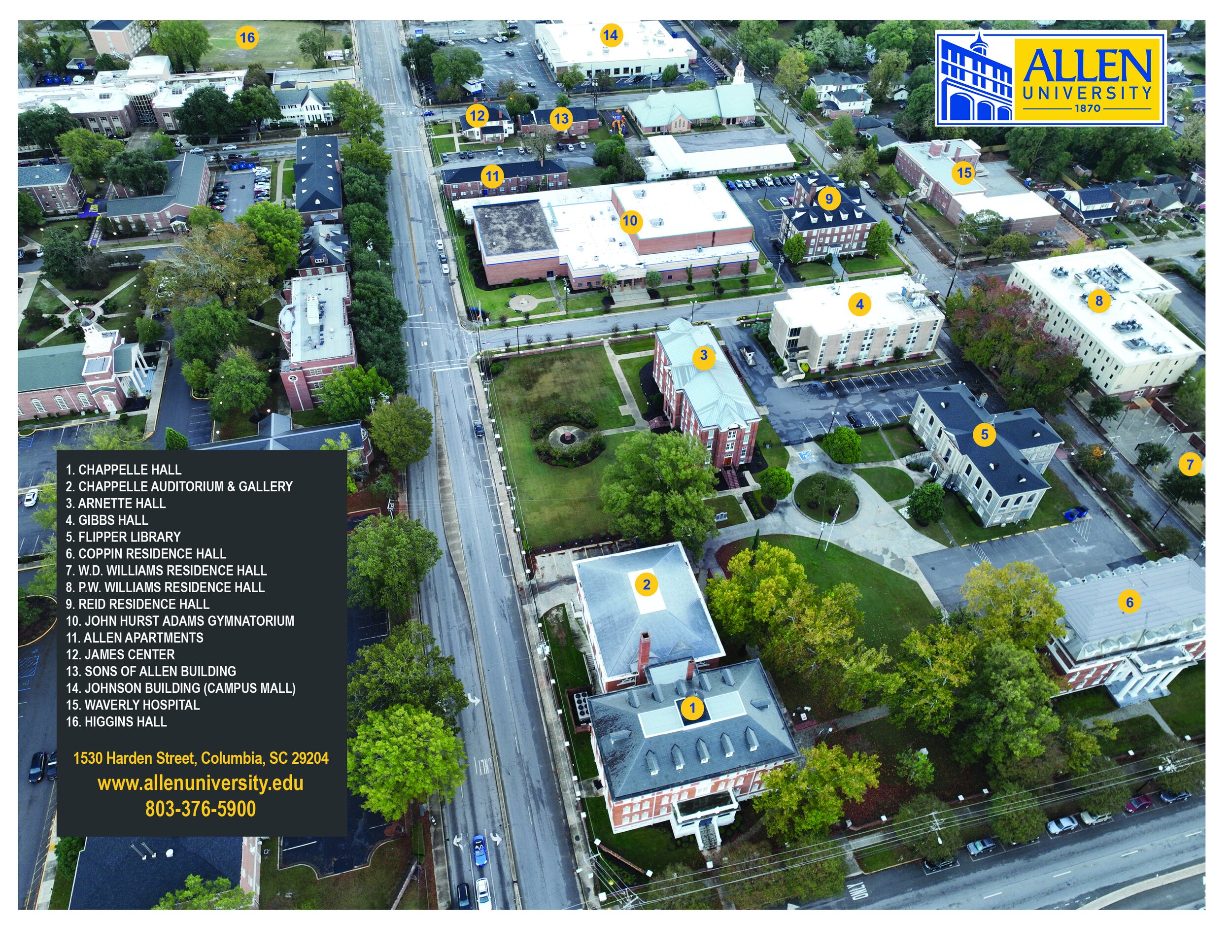
Allen University is located in Columbia, SC.
Admissions
Allen University operates with an open-access admissions philosophy, prioritizing accessibility over selectivity. The university's published is 73%, a figure that aligns with its mission to serve a broad student population. Applicants must have a minimum 2.0 GPA on a 4.0 scale. While standardized test scores (SAT or ACT) are not universally required for admission, they are mandatory for students applying for scholarships. The admissions process does not consider demonstrated interest as a factor. The university's rate—the percentage of admitted students who enroll—is notably low, reported at 6.1%, indicating that many admitted students choose other options.
Academic life at Allen is intimate and focused, with a student-faculty ratio of 16:1. The curriculum centers on a compact set of undergraduate majors designed for direct career pathways. The most popular major by far is Social Sciences, General, which accounts for a significant portion of the approximately 19 degrees conferred annually. Other offerings include Business Administration (with concentrations in Accounting, Banking & Finance, and Management), Sports Management, Criminal Justice, and Elementary Education. The university describes itself as a "pillar of educational excellence" and a "platform for transformative change," with programs aimed at providing "competence in a major discipline" alongside a "broad core" of general education. The average freshman retention rate, a key indicator of student satisfaction and academic fit, is 70%.
Earnings = median of students working ~10 years after entry; debt = median of graduates. Value divides 10-yr earnings by one year’s net price — read it as earnings per dollar of annual cost, not a full lifetime ROI; it favors lower-cost schools. Source: U.S. Dept. of Education College Scorecard. Figures lag ~2 years and reflect all students, not your intended major.
With a total undergraduate enrollment of 635 students, Allen fosters a small, urban-campus community in Columbia, South Carolina. Student life is anchored by a surprisingly active roster of more than 35 clubs and organizations, spanning professional, cultural, spiritual, recreational, and sports interests. The campus atmosphere is often described as "friendly but low-key," with social life primarily revolving around Greek life and occasional on-campus events. University communications celebrate the "enduring spirit of the campus," visible in "students studying late into the night" and a focus on meeting the "diverse needs of students." Campus housing costs an average of $8,584 per year.
Student outcomes at Allen University present a stark picture of the challenges facing its graduates. The six-year graduation rate is 13%. Post-graduation, median earnings ten years after entry are $30,497. Some sources report that graduates of the most popular Social Sciences major can expect median earnings around $17,432, while other institutional data suggests graduates earn a median of $22,477. A separate report indicates median earnings four years after graduation are $36,436. The first-year retention rate is 70%, but other sources cite a retention rate as low as 45%, highlighting significant attrition after the first year.
Allen University positions itself as an affordable option, with an average of $10,972 after grants and scholarships are applied. The university offers a Net Price Calculator to help families estimate their actual cost. Financial aid is awarded "primarily based on financial need," determined by completing the FAFSA. The average financial aid package is reported to be $12,133. The university's aid offerings include federal loans, and it also notes that private loans "may be available to students who do not qualify for federal student loans." There is no indication in the provided sources that Allen University has a "no-loan" policy or that it meets 100% of demonstrated financial need without loans.
Allen University stands out not for prestige or selectivity, but for its unwavering commitment to access and its role as a critical HBCU in South Carolina. It is an institution defined by its contradictions: it boasts a vibrant ecosystem of over 35 student organizations within a small, low-key campus, yet struggles profoundly with student retention and graduation. Its academic focus is narrow and pragmatic, heavily centered on Social Sciences, Business, and Education, designed to provide direct workforce entry. The university's defining characteristic is its open door—a 73% and a under $11,000 make it a viable option for many students who might otherwise be shut out of higher education. Its story is one of providing opportunity amidst significant structural challenges, serving as a testament to the ongoing mission of historically Black colleges to educate and uplift.
.jpg?width=1600)