Admit rate has ranged 62%–69% over the last 5 years, though the latest figure above (57%) falls outside that window. Source: IPEDS via Urban Institute.
Acceptance & SAT from Common Data Set / IPEDS; net price, earnings & graduation from the U.S. Dept. of Education College Scorecard. Figures lag ~1–2 years — verify with the school.
Alma College is a small, residential liberal arts school in central Michigan where the academic calendar is as distinctive as the campus culture. Operating on an intensive 4-4-1 schedule—two four-month terms followed by a one-month immersive 'Spring Term'—Alma demands focus and rewards it with highly accessible professors and a tight-knit community. This is a place for students who want their professors to know their name, who don't mind that the surrounding town is small and quiet, and who are drawn to practical, hands-on programs in health sciences, business, and psychology.
Admission requirements
Test-blind — scores not considered
Required
High school transcript
Grade point average
TOEFL (non-native English)
Considered (not required)
Letters of recommendation
Source: IPEDS Admissions survey (2022) via Urban Institute. Covers formal factors only — it does not reflect essays, extracurriculars, or other holistic criteria.
More details
Undergrad enrollment
1,148
In-state tuition
$49,552
Out-of-state tuition
$49,552
Graduation Rate
63%
Academic Calendar
4-4-1
Average Aid Package
$44,012
Student-Faculty Ratio
14:1
Median Earnings (10yr)
$54,742
First-Year Retention Rate
79.22%
Automatic Merit Scholarships
$28,000-$36,000/year
Students Receiving Financial Aid
92-100%
Outcomes & value
Outcomes & value
Median earnings (10 yr)
$54,742
Value (earnings ÷ net price)
2.6×
Median debt at graduation
$27,000
Graduation rate
63%
First-year retention
85%
Reducing loan balance (3 yr)
74%
Pell (lower-income) share
27%
First-gen share (among federal-aid recipients)
24%
Financial health
3.0 / 3.0Meets the federal financial-responsibility standard
U.S. Dept. of Education Financial Responsibility Composite Score (FY2022-23). Scale −1.0 to 3.0; ≥1.5 meets the standard. Reported for private nonprofit & for-profit institutions only — public universities are state-backed and not scored, so this is a stability signal, not a ranking.
Top-earning majors
Median earnings by field of study (highest credential), ~2 years after completion.
Business Administration, Management and Operations$38,289
Teacher Education and Professional Development, Specific Levels and Methods$37,748
English Language and Literature, General$29,685
Psychology, General$28,236
Biology, General$25,596
Source: U.S. Dept. of Education College Scorecard (field-of-study earnings). Figures cover graduates who received federal aid and lag ~2 years; not all programs report data.
Compare on earnings:
Campus & location
Campus safety
On-campus violent crimes (2024)
9
Per 1,000 students
7.59
On-campus criminal offenses classed as violent (murder/non-negligent manslaughter, rape, robbery, aggravated assault) for the most recent reported year. Source: U.S. Dept. of Education Campus Safety and Security (Clery Act). Counts reflect what’s reported to the school, and urban campuses often report more partly due to non-student incidents nearby — read alongside campus size and setting, not as a standalone safety verdict.
Climate
Pleasant days / yr
91
Summer high
82°F
Winter low
20°F
Annual rain
34"
Annual snow
33.9"
Natural-hazard risk
Relatively Low
Pleasant days counts days per year with a mean temperature of 55–75°F, a high at or below 90°F, a low at or above 45°F, and little precipitation — a transparent comfort measure, not a weighting we invented. Computed from Open-Meteo ERA5 daily history (2019–2023). Natural-hazard risk is the county’s composite rating from the FEMA National Risk Index.
Deep dive — research, future-scholar output & economic mobility▾
Research output
Institutional h-index
55
Scholarly works
1,496
Institutional research volume and impact from OpenAlex. The h-index reflects large research universities and will be low for teaching-focused liberal-arts colleges — not a measure of undergraduate quality.
Economic mobility
Mobility rate
1.2%
Bottom → top quintile
23%
From bottom quintile
5%
Mobility rate = the share of students who both start in the bottom household-income quintile and reach the top quintile; bottom → top is that chance conditional on starting at the bottom. Source: Opportunity Insights Mobility Report Cards (Chetty, Friedman, Saez, Turner & Yagan). Reflects 1980–82 birth cohorts, so it’s directional, not current.
Quick answers
What is the acceptance rate at Alma College?
Alma College's acceptance rate is approximately 57% (Alma, MI), based on the most recent figures we compiled from public and primary sources.
How much does Alma College cost?
At Alma College, the average net price (after aid) is about $20,694 per year. Actual cost varies with financial aid and residency.
How many undergraduates attend Alma College?
Alma College enrolls approximately 1,148 undergraduate students.
Where is Alma College located?
Alma College is located in Alma, MI.
Admissions
Alma College operates with a selective but accessible admissions process, where the majority of applicants are admitted. The is typically reported between 57% and 66%, placing it in the "less selective" category. Admitted students generally present solid academic credentials, with the middle 50% of SAT scores ranging from 978 to 1173 and ACT scores from 21 to 27. The average high school GPA for incoming students is around 3.5. Notably, the college's rate—the percentage of accepted students who enroll—is reported to be low, at around 10%. While the provided sources discuss the importance of the for understanding factors like demonstrated interest, Alma's specific stance on this factor is not detailed in the available snippets. The admissions office emphasizes that all accepted students are automatically considered for merit scholarships.
Earnings = median of students working ~10 years after entry; debt = median of graduates. Value divides 10-yr earnings by one year’s net price — read it as earnings per dollar of annual cost, not a full lifetime ROI; it favors lower-cost schools. Source: U.S. Dept. of Education College Scorecard. Figures lag ~2 years and reflect all students, not your intended major.
The academic heartbeat of Alma College is its unique 4-4-1 calendar. Students take a standard course load during two four-month terms in the fall and winter, followed by a concentrated, often experiential, one-month Spring Term in May. This structure allows for deep dives into single subjects, research, internships, or study abroad. The student-faculty ratio is 14:1, and students describe their professors as "extremely helpful" and as educators who "expect a lot of work out of their students." The curriculum is firmly rooted in the liberal arts but leans heavily toward pre-professional and health-oriented fields. The most popular majors reflect this blend:
Psychology
Health and Wellness / Exercise Physiology
Biology/Biological Sciences
Business Administration and Management
Chemistry
Business Administration is the single most conferred degree, with around 38 granted annually. The college encourages students to layer their interests through majors, minors, and specialized tracks.
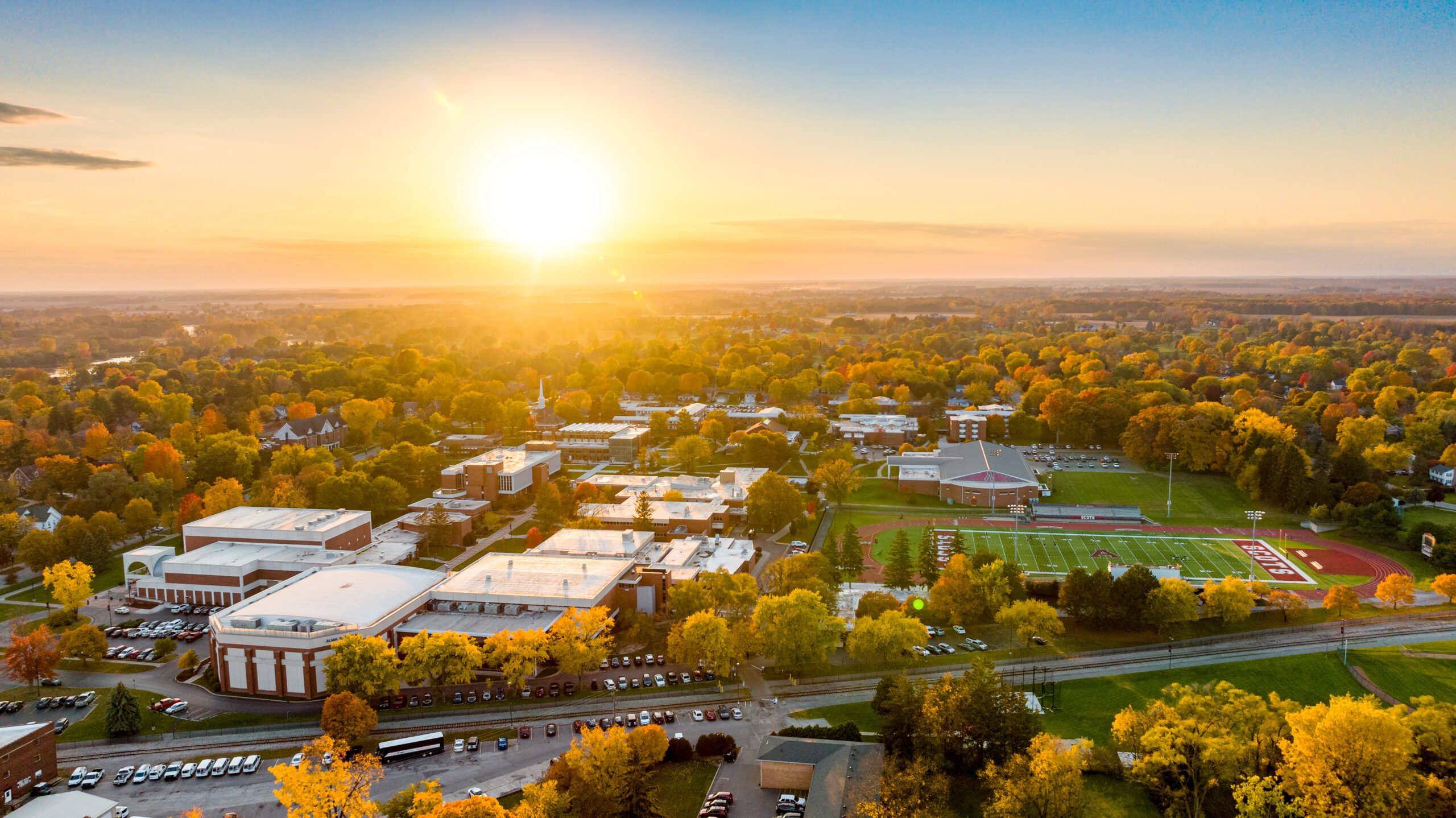
Life at Alma is defined by its scale and sense of community. With only about 1,200 students, the campus has the intimate feel of a large high school, set in the small, rural town of Alma, Michigan, which is described as being "surrounded by farms." This creates a highly residential, all-in environment where campus activities are central. Students can engage with a range of cultural and identity-based organizations like the Asian Student Union, French Club, and Multicultural Student Union. A typical student's day involves moving between classes, meals in campus dining halls, studying, and participating in clubs or recreational activities. The college offers virtual tours to showcase residence halls, academic buildings, and gathering spaces. Reviews of campus life highlight aspects of housing, food, athletics, and Greek life, though specific details on the Greek system are not provided in the sources.
Alma College measures its success through student persistence and postgraduate earnings. The first-year retention rate for the Fall 2024 cohort was 79.22%, indicating that most students who start choose to return. The four-year graduation rate is 63%. In terms of financial payoff, an analysis by the Wall Street Journal found that an Alma education added nearly $29,000 in value to its graduates' salaries when compared to the median wage of high school graduates in Michigan. Specific earnings data shows median salaries of $37,011 one year after graduation, rising to $52,066 five years out. The six-year post-entry median salary is reported as $45,720. These outcomes contributed to the college's recognition on the Wall Street Journal's Best Colleges list, where student outcomes account for 70% of the ranking methodology.
Alma College is a high-tuition institution that mitigates cost through substantial institutional aid. The sticker price for tuition and required fees is significant, but the average after aid and scholarships is $20,694. A remarkable 92% to 100% of full-time beginning undergraduates receive financial aid, with the average aid package totaling $44,012. A cornerstone of the college's aid strategy is automatic merit scholarship consideration for all admitted students, with awards ranging from $28,000 to $36,000 per year. Families are directed to complete the FAFSA to unlock federal, state, and institutional , and the college provides a Net Price Calculator for personalized estimates. The provided sources do not indicate that Alma College has a "no-loan" policy or that it meets 100% of demonstrated financial need for all admitted students without loans.
Alma College stands out for its deliberate and distinctive academic rhythm. The 4-4-1 calendar isn't a gimmick; it's an institutional philosophy that carves out dedicated time for intensive, often hands-on learning that doesn't fit neatly into a standard semester. This creates a culture where the immersive Spring Term project or off-campus study is a universal expectation, not a rare privilege. It couples this with the classic small liberal arts college promise: professors who know you and expect your best work, all within a community so small that it's impossible to be anonymous. The trade-off is location—this is a secluded, self-contained campus in a rural setting, ideal for students who want to focus deeply on their studies and campus life without the distractions of a city. It’s a college that bets big on the value of concentrated attention, both from its faculty toward its students and from its students toward their education.
Alma College seal · sourceFacilities and Service Management | Alma College · sourceAbout Alma College · sourceAlma College | College of Distinction · source