Admit rate has ranged 62%–96% over the last 5 years — notably volatile, though the latest figure above (44%) falls outside that window. Source: IPEDS via Urban Institute.
Acceptance & SAT from Common Data Set / IPEDS; net price, earnings & graduation from the U.S. Dept. of Education College Scorecard. Figures lag ~1–2 years — verify with the school.
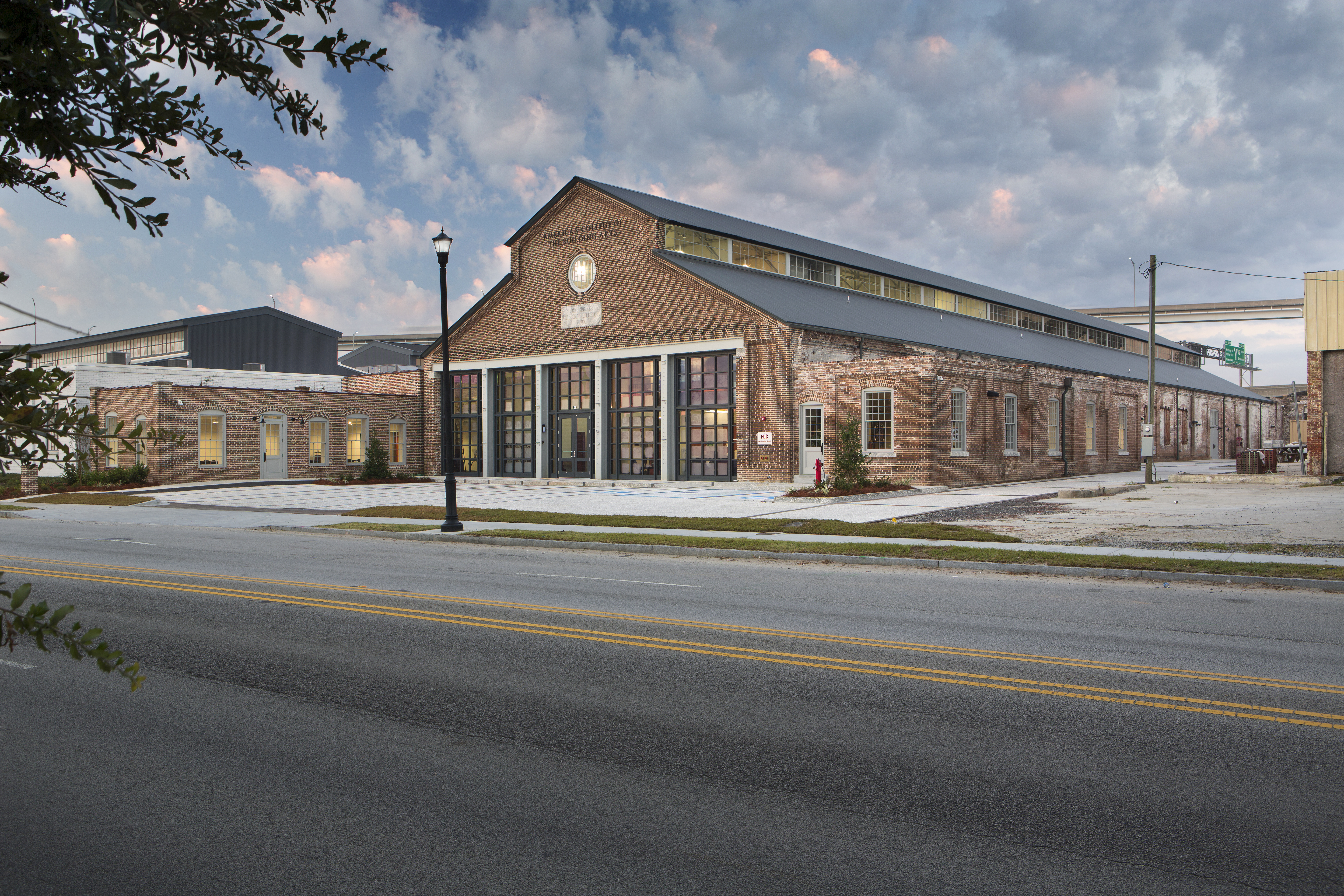
The American College of the Building Arts is the nation's singular accredited college where a liberal arts core meets rigorous, hands-on training in traditional trades like stonemasonry and timber framing. Here, a dedicated cohort of future artisans—just 93 undergraduates strong—learns to wield chisels and drafting pencils with equal fluency, supported by a 62% graduation rate and an average net price of $30,403. It’s a fiercely unique path for students (middle 50% SAT: 1130–1290) drawn to historic preservation and tangible craft.
Admission requirements
Test-optional — scores considered if submitted
Required
High school transcript
Letters of recommendation
Considered (not required)
Grade point average
Class rank
Test scores (SAT/ACT)
Demonstrated competencies
Source: IPEDS Admissions survey (2022) via Urban Institute. Covers formal factors only — it does not reflect essays, extracurriculars, or other holistic criteria.
More details
Undergrad enrollment
155
In-state tuition
$21,500
Out-of-state tuition
$21,500
Founded
2004
Location
Charleston, SC
Degrees Offered
BAS, AAS in Building Arts
4-Year Grad Rate
50-64%
Annual Scholarships
$250,000+
Employment Rate (BAS)
83%
Outcomes & value
Outcomes & value
Median debt at graduation
$12,500
Graduation rate
62%
First-year retention
75%
Pell (lower-income) share
18%
Earnings = median of students working ~10 years after entry; debt = median of graduates. Value divides 10-yr earnings by one year’s net price — read it as earnings per dollar of annual cost, not a full lifetime ROI; it favors lower-cost schools. Source: U.S. Dept. of Education College Scorecard. Figures lag ~2 years and reflect all students, not your intended major.
Financial health
1.4 / 3.0Passing, but in the added-oversight zone
U.S. Dept. of Education Financial Responsibility Composite Score (FY2022-23). Scale −1.0 to 3.0; ≥1.5 meets the standard. Reported for private nonprofit & for-profit institutions only — public universities are state-backed and not scored, so this is a stability signal, not a ranking.
Campus & location
Campus safety
On-campus violent crimes (2024)
0
On-campus criminal offenses classed as violent (murder/non-negligent manslaughter, rape, robbery, aggravated assault) for the most recent reported year. Source: U.S. Dept. of Education Campus Safety and Security (Clery Act). Counts reflect what’s reported to the school, and urban campuses often report more partly due to non-student incidents nearby — read alongside campus size and setting, not as a standalone safety verdict.
Climate
Pleasant days / yr
130
Summer high
86°F
Winter low
46°F
Annual rain
58.4"
Natural-hazard risk
Relatively High
Pleasant days counts days per year with a mean temperature of 55–75°F, a high at or below 90°F, a low at or above 45°F, and little precipitation — a transparent comfort measure, not a weighting we invented. Computed from Open-Meteo ERA5 daily history (2019–2023). Natural-hazard risk is the county’s composite rating from the FEMA National Risk Index.
Quick answers
What is the acceptance rate at American College of the Building Arts?
American College of the Building Arts's acceptance rate is approximately 44% (Charleston, SC), based on the most recent figures we compiled from public and primary sources.
What SAT score do you need for American College of the Building Arts?
Admitted students at American College of the Building Arts typically score 1130–1290 on the SAT (the middle-50% range). Scores outside this band are still admitted, especially with strong applications.
How much does American College of the Building Arts cost?
At American College of the Building Arts, the average net price (after aid) is about $30,403 per year. Actual cost varies with financial aid and residency.
How many undergraduates attend American College of the Building Arts?
American College of the Building Arts enrolls approximately 155 undergraduate students.
Where is American College of the Building Arts located?
American College of the Building Arts is located in Charleston, SC.
Admissions
ACBA’s admissions process is selective but not cutthroat, with a 44.4% (56 admits from 126 applications in 2024). The college takes a holistic approach, considering ACT/SAT/CLT scores (submitted by 22-43% of applicants) alongside other factors. Notably, the average admitted student boasts a 3.7 GPA. With no early decision program, all applicants compete in a single pool. The $50 application fee is modest compared to many private colleges.
ACBA’s curriculum is a unicorn in higher education: a fusion of liberal arts and intensive training in traditional building crafts. Students choose between a or degree, with coursework spanning:
Preservation theory (materials science, conservation ethics)
The program’s rigor is legendary—students might analyze Vitruvius in the morning and carve limestone in the afternoon. Small cohorts (just 38 BAS students in a recent graduating class) ensure close mentorship from master artisans.
Life at ACBA is immersive and tactile. With only 93 undergraduates (98% full-time), the campus feels like a tight-knit guild. Students spend as much time in workshops as in classrooms, restoring Charleston’s historic buildings or crafting original pieces. The Instagram feed (@acba_charleston) showcases their work: hand-turned balusters, wrought-iron gates, and lime-mortar repairs. Beyond the studio, the college leverages its Charleston location for field studies in urban design and preservation. There’s no Greek life or D1 sports—just a shared obsession with craft and a 75% freshman retention rate.
ACBA graduates defy the ‘starving artist’ stereotype. The BAS program reports an 83% employment rate (15 of 18 grads working in-field), with many landing jobs at elite preservation firms or launching their own studios. The 2-year AAS program sees a 67% employment rate. While the 4-year graduation rate is modest (50-64%), those who persist enter a niche market hungry for their skills. Earnings data isn’t publicly benchmarked, but alumni often secure apprenticeships with master craftsmen—a career path less about starting salaries and more about long-term mastery.
ACBA offers $250,000+ in annual scholarships, a critical draw for students facing tuition costs typical of private colleges. The calculator helps estimate aid packages, which can include federal loans, state grants, and institutional awards. Outside scholarships (especially those supporting trades) are actively encouraged. While the college doesn’t publish average debt figures, its small size allows for personalized financial aid counseling—key for students balancing the costs of tools, materials, and tuition.
ACBA is the only U.S. college offering a 4-year degree in traditional building arts, making it a mecca for students who geek out over dovetail joints and Corinthian capitals. Its hybrid model—equal parts Socratic seminar and artisan apprenticeship—prepares graduates to think like historians and work like medieval guildsmen. In an era of disposable architecture, ACBA’s mission feels radical: to train stewards who’ll maintain cathedrals, capitol buildings, and Main Streets for centuries to come. If you’ve ever stared at a 19th-century cornice and thought, ‘I could carve that,’ this is your school.
American College of the Building Arts logo · sourceAmerican College of the Building Arts - Wikipedia · sourceAmerican College of the Building Arts | Only Building Arts Degree in the USA · sourceAmerican College of the Building Arts - OCMP · source