Loading…
← All schools
Antioch University
Yellow Springs, OHprivate nonprofitwww.antioch.edu/
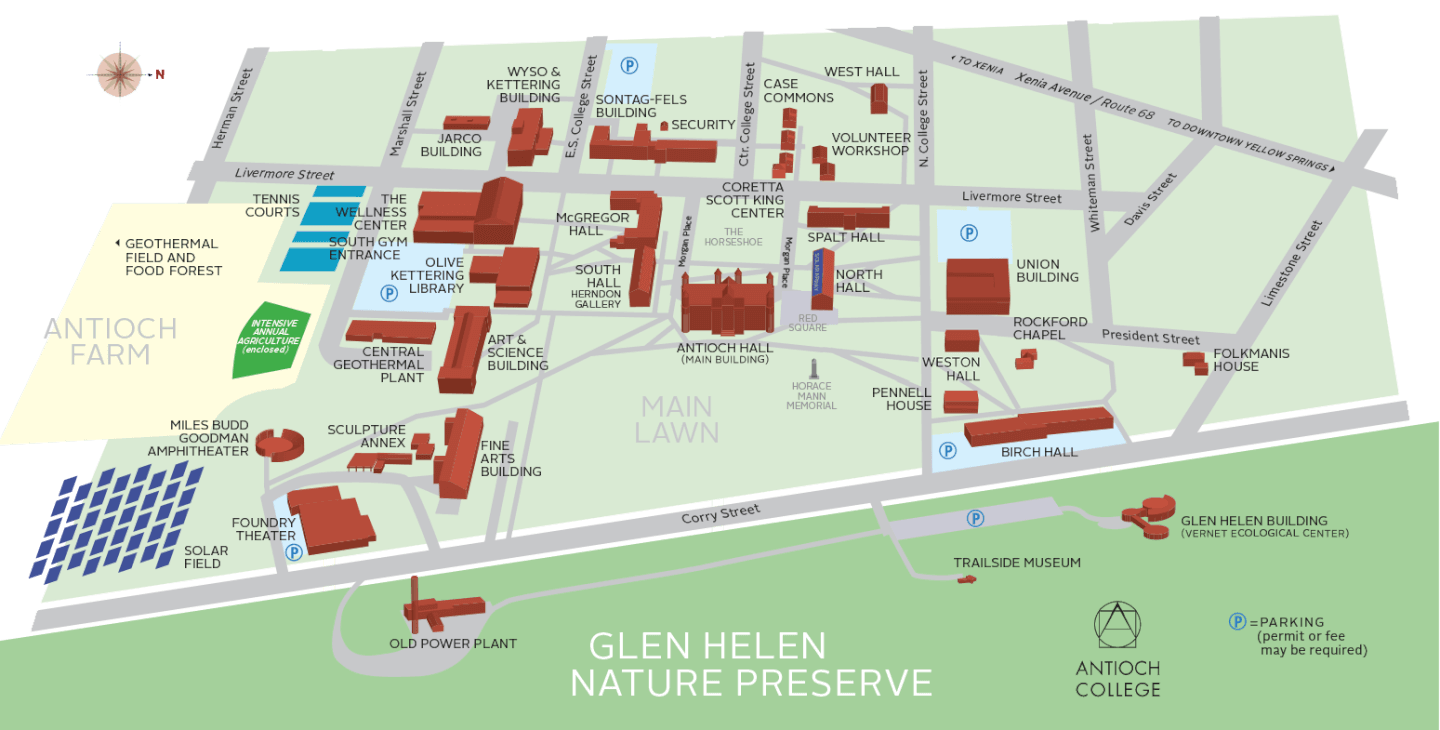
Antioch College is not a typical liberal arts school; it's a fiercely independent, student-driven experiment in Yellow Springs, Ohio, where co-op work terms are woven into the curriculum and activism is part of the campus DNA. With an admissions process that explicitly rejects minimum GPA and test score requirements, it attracts self-directed learners who want to build their own education as much as receive one. The result is a small, intense community where graduation rates are low but post-graduate placement is high, appealing to those who value hands-on, socially engaged learning over traditional academic prestige.
More details
- Undergrad enrollment
- 77
- Housing
- 74% on-campus
- Popular Majors
- Liberal Arts, Anthropology, Environmental Studies
- Graduation Rate
- ~30%
- Signature Program
- Co-operative Education
- Median Earnings (10yr)
- $51,541
- Regular Application Deadline
- August 1
- 6-Month Placement Rate (Recent Classes)
- 87-93%
Outcomes & value
Outcomes & value
- Median earnings (10 yr)
- $51,541
- Median debt at graduation
- $23,501
- Reducing loan balance (3 yr)
- 46%
- Pell (lower-income) share
- 44%
- First-gen share (among federal-aid recipients)
- 37%
- Endowment / student
- $1,905
Earnings = median of students working ~10 years after entry; debt = median of graduates. Value divides 10-yr earnings by one year’s net price — read it as earnings per dollar of annual cost, not a full lifetime ROI; it favors lower-cost schools. Source: U.S. Dept. of Education College Scorecard. Figures lag ~2 years and reflect all students, not your intended major.
Financial health
2.3 / 3.0Meets the federal financial-responsibility standard
U.S. Dept. of Education Financial Responsibility Composite Score (FY2022-23). Scale −1.0 to 3.0; ≥1.5 meets the standard. Reported for private nonprofit & for-profit institutions only — public universities are state-backed and not scored, so this is a stability signal, not a ranking.
Top-earning majors
Median earnings by field of study (highest credential), ~2 years after completion.
- Liberal Arts and Sciences, General Studies and Humanities$35,060
Source: U.S. Dept. of Education College Scorecard (field-of-study earnings). Figures cover graduates who received federal aid and lag ~2 years; not all programs report data.
Campus & location
Campus safety
- On-campus violent crimes (2024)
- 0
- Per 1,000 students
- 0.00
On-campus criminal offenses classed as violent (murder/non-negligent manslaughter, rape, robbery, aggravated assault) for the most recent reported year. Source: U.S. Dept. of Education Campus Safety and Security (Clery Act). Counts reflect what’s reported to the school, and urban campuses often report more partly due to non-student incidents nearby — read alongside campus size and setting, not as a standalone safety verdict.
Climate
- Pleasant days / yr
- 89
- Summer high
- 82°F
- Winter low
- 27°F
- Annual rain
- 43.4"
- Annual snow
- 20.3"
- Natural-hazard risk
- Relatively Low
Pleasant days counts days per year with a mean temperature of 55–75°F, a high at or below 90°F, a low at or above 45°F, and little precipitation — a transparent comfort measure, not a weighting we invented. Computed from Open-Meteo ERA5 daily history (2019–2023). Natural-hazard risk is the county’s composite rating from the FEMA National Risk Index.
Deep dive — research, future-scholar output & economic mobility
Research output
- Institutional h-index
- 56
- Scholarly works
- 1,458
Institutional research volume and impact from OpenAlex. The h-index reflects large research universities and will be low for teaching-focused liberal-arts colleges — not a measure of undergraduate quality.
Quick answers
- How many undergraduates attend Antioch University?
- Antioch University enrolls approximately 77 undergraduate students.
- Where is Antioch University located?
- Antioch University is located in Yellow Springs, OH.
Admissions
Antioch's admissions process is a direct reflection of its philosophy: it's open, holistic, and designed to find students who will thrive in its self-directed environment. The college is notably accessible, with an of 89% and no minimum GPA or standardized test requirements—SAT and ACT scores are considered but not required. The Common Application is accepted, with a regular decision deadline of August 1. The admitted student profile shows a range of academic preparation; among those who submit them, 23% of admitted students have a GPA of 3.75 or higher. The process appears to prioritize fit over scores, seeking applicants aligned with Antioch's unique co-op and community engagement model.
Academics
The academic program at Antioch College is built around its signature co-operative education model, where classroom learning alternates with full-time work terms. Every student graduates with practiced skills in writing and quantitative reasoning, and many pursue language and cultural immersion through their co-ops. The curriculum is highly interdisciplinary and student-driven. Popular majors reflect this ethos, centering on broad liberal arts and sciences, anthropology, and environmental studies. The university system also offers specialized graduate and adult completion programs in areas like counseling psychology, education, environmental studies, and creative writing, with a noted focus on social justice, mindfulness, and trauma-informed practices. The overall academic identity is one of applied, experiential learning geared toward empowerment and social change.
Compare Antioch University
See colleges similar to Antioch University →Sources
- CDS_2021-2022-Antioch College.xlsx
- Data Requests
- Institutional Effectiveness and Research
- Antioch College Admissions
- Antioch University Fact Book
- Apply to Antioch College
- Antioch College Admissions - BigFuture College Search
- Antioch University Seattle Requirements for Admission
- Antioch College Admissions & Acceptance
- Antioch University Acceptance Rate
- Antioch College Tuition, Acceptance Rate, & Academics - Sallie