Loading…
← All schools
Appalachian Beauty School
Belfry, KYprivate forprofitappalachianbeautyschool.com/
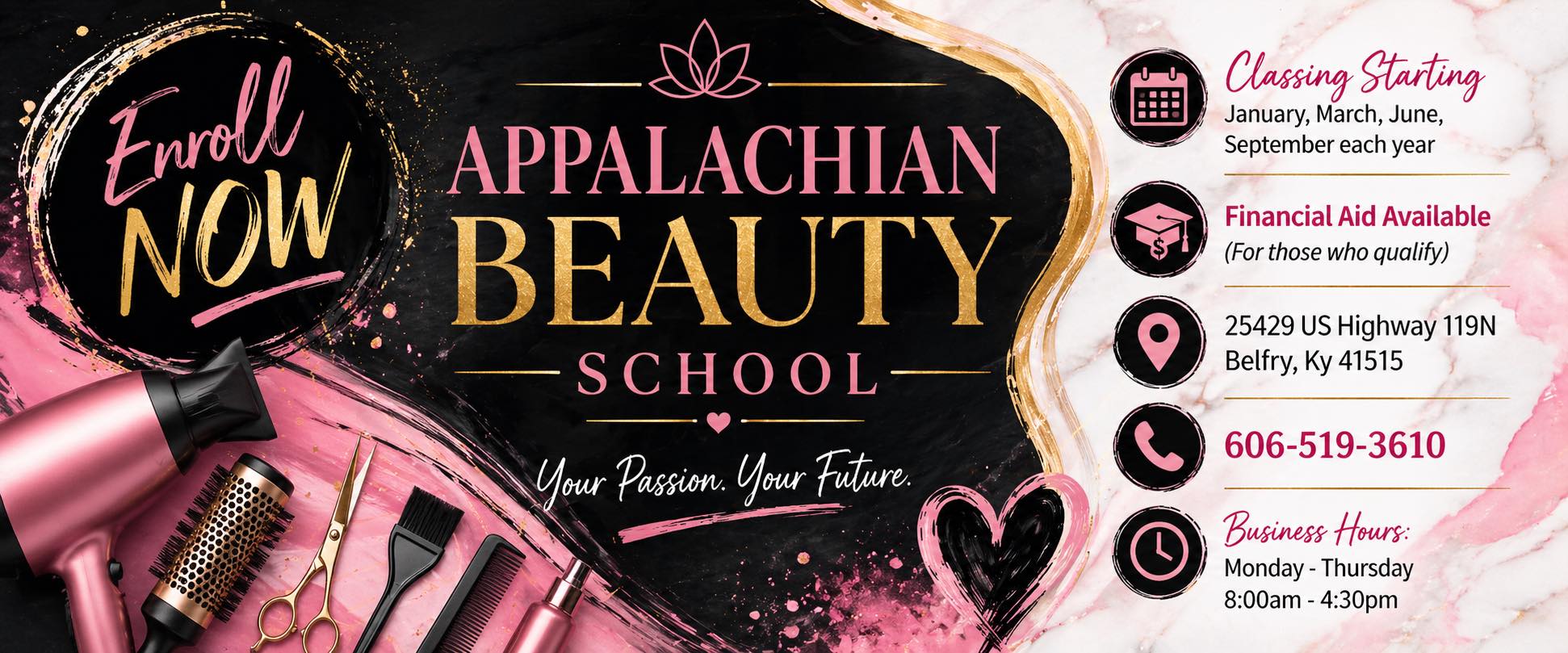
Appalachian Beauty School operates on a fundamentally different wavelength than a traditional university. This is a trade school with a single-minded focus: transforming students into salon-ready cosmetologists through a 1,500-hour, 15-month program in the heart of Belfry, Kentucky. With an open admissions policy and a curriculum built around hands-on mastery of color, cutting, and extensions, it’s a direct pipeline into a skilled trade, not a four-year liberal arts exploration.
More details
- Undergrad enrollment
- 49
- Location
- Belfry, KY
- Program Focus
- Cosmetology
- Program Length
- 15 months / 1,500 hours
- Institution Type
- Private, for-profit trade school
- Average Grant Award
- $4,713
- Student:Faculty Ratio
- 20:1
- % Students Receiving Grant Aid
- 60%
Outcomes & value
Outcomes & value
- Pell (lower-income) share
- 63%
Earnings = median of students working ~10 years after entry; debt = median of graduates. Value divides 10-yr earnings by one year’s net price — read it as earnings per dollar of annual cost, not a full lifetime ROI; it favors lower-cost schools. Source: U.S. Dept. of Education College Scorecard. Figures lag ~2 years and reflect all students, not your intended major.
Financial health
2.3 / 3.0Meets the federal financial-responsibility standard
U.S. Dept. of Education Financial Responsibility Composite Score (FY2022-23). Scale −1.0 to 3.0; ≥1.5 meets the standard. Reported for private nonprofit & for-profit institutions only — public universities are state-backed and not scored, so this is a stability signal, not a ranking.
Campus & location
Campus safety
- On-campus violent crimes (2024)
- 0
On-campus criminal offenses classed as violent (murder/non-negligent manslaughter, rape, robbery, aggravated assault) for the most recent reported year. Source: U.S. Dept. of Education Campus Safety and Security (Clery Act). Counts reflect what’s reported to the school, and urban campuses often report more partly due to non-student incidents nearby — read alongside campus size and setting, not as a standalone safety verdict.
Climate
- Pleasant days / yr
- 101
- Summer high
- 86°F
- Winter low
- 34°F
- Annual rain
- 36.5"
- Annual snow
- 11.3"
- Natural-hazard risk
- Relatively Moderate
Pleasant days counts days per year with a mean temperature of 55–75°F, a high at or below 90°F, a low at or above 45°F, and little precipitation — a transparent comfort measure, not a weighting we invented. Computed from Open-Meteo ERA5 daily history (2019–2023). Natural-hazard risk is the county’s composite rating from the FEMA National Risk Index.
Quick answers
- How much does Appalachian Beauty School cost?
- At Appalachian Beauty School, the average net price (after aid) is about $12,742 per year. Actual cost varies with financial aid and residency.
- How many undergraduates attend Appalachian Beauty School?
- Appalachian Beauty School enrolls approximately 49 undergraduate students.
- Where is Appalachian Beauty School located?
- Appalachian Beauty School is located in Belfry, KY.
Admissions
Appalachian Beauty School has an open admissions policy, meaning the is effectively 100%. The school does not require standardized test scores like the SAT or ACT for admission, focusing instead on fulfilling program-specific requirements. Admissions data and test scores are only presented for institutions without an open admission policy, which this school is not. The practice of deferred admission—allowing admitted students to postpone enrollment—is a defined concept in higher education, but its specific application at this institution is not detailed in the provided sources. The student body is small, with detailed enrollment numbers, demographics, and attendance patterns available for review.
Academics
The academic model is singular and practical: a cosmetology program designed to be completed in 15 months, requiring 1,500 hours of instruction. The curriculum emphasizes hands-on, salon-ready skills, with master classes in color, cutting, and extensions noted. The school also aims to train students in business techniques to prepare them for the industry beyond technical skill. The student-to-faculty ratio is reported as 20:1, which is described as reasonably decent. Graduation rates, however, are a point of significant discrepancy across sources. One review claims an "outstanding" 100% rate, while official data from the College Scorecard reports 62%, and other analyses cite a 150%-time completion rate of 56.25% and a first-year retention rate of 57%. This lower retention may reflect challenges students face in persisting through the program.
Compare Appalachian Beauty School
vs Livingstone Collegevs West Virginia University Institute of Technologyvs Huston-Tillotson Universityvs University of Science and Arts of Oklahoma
See colleges similar to Appalachian Beauty School →Sources
- Appalachian Beauty School
- Common Data Set 2022-2023
- Appalachian Beauty School - DFR Report HTML
- Student Enrollment - Appalachian Beauty School - Trade Colleges
- Common Data Set Explorer 2026: Compare 100 Colleges
- Common Data Set CDS Dashboard | analytics.appstate.edu
- Appalachian Beauty School
- Appalachian State University SAT Scores and GPA
- First Class Cosmetology School Admissions: SAT, ACT & GPA ...
- College Degrees Data for Appalachian Beauty School
- Appalachian State: Acceptance Rate, SAT/ACT Scores, GPA