Admit rate has ranged 70%–81% over the last 5 years — notably volatile. Source: IPEDS via Urban Institute.
Acceptance & SAT from Common Data Set / IPEDS; net price, earnings & graduation from the U.S. Dept. of Education College Scorecard. Figures lag ~1–2 years — verify with the school.
Ashland University is a private, Christian-affiliated liberal arts institution in Ohio that operates with a distinctly pragmatic, accessible ethos. It's a place where a 14:1 student-faculty ratio and over 60 undergraduate programs foster a close-knit, supportive environment, but where the campus culture is also candidly described by students as sheltered and lacking in diversity. The school's identity is built on a balance of faith, community, and career preparation, with outcomes that reliably lift graduates into the middle class.
Admission requirements
Test-optional — scores considered if submitted
Required
Grade point average
Considered (not required)
High school transcript
Class rank
Test scores (SAT/ACT)
Source: IPEDS Admissions survey (2022) via Urban Institute. Covers formal factors only — it does not reflect essays, extracurriculars, or other holistic criteria.
More details
Undergrad enrollment
2,199
In-state tuition
$31,210
Out-of-state tuition
$31,210
Graduation Rate
61%
On-Campus Students
59%
Median Earnings (10yr)
$52,928
Student-to-Faculty Ratio
14:1
Academic Scholarship Range
$2,000 to $11,000
First-Year Students Receiving Aid
98%
Outcomes & value
Outcomes & value
Median earnings (10 yr)
$52,928
Value (earnings ÷ net price)
2.4×
Median debt at graduation
$25,000
Graduation rate
61%
First-year retention
77%
Reducing loan balance (3 yr)
68%
Pell (lower-income) share
29%
First-gen share (among federal-aid recipients)
41%
Financial health
3.0 / 3.0Meets the federal financial-responsibility standard
U.S. Dept. of Education Financial Responsibility Composite Score (FY2022-23). Scale −1.0 to 3.0; ≥1.5 meets the standard. Reported for private nonprofit & for-profit institutions only — public universities are state-backed and not scored, so this is a stability signal, not a ranking.
Top-earning majors
Median earnings by field of study (highest credential), ~2 years after completion.
Registered Nursing, Nursing Administration, Nursing Research and Clinical Nursing$56,513
Finance and Financial Management Services$51,607
Business Administration, Management and Operations$51,482
Marketing$40,281
Sports, Kinesiology, and Physical Education/Fitness$38,289
Criminal Justice and Corrections
Campus & location
Campus safety
On-campus violent crimes (2024)
2
Per 1,000 students
0.60
On-campus criminal offenses classed as violent (murder/non-negligent manslaughter, rape, robbery, aggravated assault) for the most recent reported year. Source: U.S. Dept. of Education Campus Safety and Security (Clery Act). Counts reflect what’s reported to the school, and urban campuses often report more partly due to non-student incidents nearby — read alongside campus size and setting, not as a standalone safety verdict.
Climate
Pleasant days / yr
97
Summer high
80°F
Winter low
25°F
Annual rain
41"
Annual snow
28.1"
Natural-hazard risk
Relatively Low
Pleasant days counts days per year with a mean temperature of 55–75°F, a high at or below 90°F, a low at or above 45°F, and little precipitation — a transparent comfort measure, not a weighting we invented. Computed from Open-Meteo ERA5 daily history (2019–2023). Natural-hazard risk is the county’s composite rating from the FEMA National Risk Index.
Deep dive — research, future-scholar output & economic mobility▾
Research output
Institutional h-index
86
Scholarly works
1,608
Institutional research volume and impact from OpenAlex. The h-index reflects large research universities and will be low for teaching-focused liberal-arts colleges — not a measure of undergraduate quality.
Economic mobility
Mobility rate
0.6%
Bottom → top quintile
12%
From bottom quintile
5%
Mobility rate = the share of students who both start in the bottom household-income quintile and reach the top quintile; bottom → top is that chance conditional on starting at the bottom. Source: Opportunity Insights Mobility Report Cards (Chetty, Friedman, Saez, Turner & Yagan). Reflects 1980–82 birth cohorts, so it’s directional, not current.
Quick answers
What is the acceptance rate at Ashland University?
Ashland University's acceptance rate is approximately 76% (Ashland, OH), based on the most recent figures we compiled from public and primary sources.
What SAT score do you need for Ashland University?
Admitted students at Ashland University typically score 1035–1208 on the SAT (the middle-50% range). Scores outside this band are still admitted, especially with strong applications.
How much does Ashland University cost?
At Ashland University, the average net price (after aid) is about $21,988 per year. Actual cost varies with financial aid and residency.
How many undergraduates attend Ashland University?
Ashland University enrolls approximately 2,199 undergraduate students.
Where is Ashland University located?
Ashland University is located in Ashland, OH.
Admissions
Ashland's admissions process is designed to be accessible, with a clear academic floor. The university requires a high school diploma (or GED) and a minimum high school GPA of 2.50 on a 4.0 scale. For test-takers, minimum composite scores are set at an ACT of 18, an SAT of 970, or a CLT of 62. The process is lightly selective, with the vast majority of applicants receiving an offer. The university offers an Early Decision option, which it describes as a nonbinding pathway for students to receive a decision early. Demonstrated interest is a factor that admissions offices can track and consider, as outlined in discussions, though Ashland's specific policy on it is not detailed in the provided sources. The admitted student profile shows a middle 50% SAT range of 1035–1208, indicating a cohort with generally solid academic preparation but not the ultra-competitive scores of elite liberal arts colleges.
The academic experience at Ashland is framed by its mission to help each student 'discover their talents and calling' and prepare for their 'unique place in society.' With more than 60 undergraduate majors and programs at the associate and bachelor's levels, the curriculum offers breadth. The 14:1 student-to-faculty ratio suggests the potential for accessible instruction. The most popular majors reveal a practical, career-oriented focus among the student body: for the 2024 graduating class, Communication, Journalism, and Related Programs accounted for 35% of degrees, followed by Health Professions and Related Programs (15%) and Business, Management, Marketing, and Related Support Services. Other sources list Nursing Science, Education, and Practice; Special Education and Teaching; and Liberal Arts and Humanities as high-volume majors. The university has earned recognition from U.S. News & World Report, including a No. 50 ranking in 'Best Value Schools' and No. 61 in 'Top Performers on Social Mobility,' metrics that weigh academic quality against net cost and success for Pell Grant recipients.
Earnings = median of students working ~10 years after entry; debt = median of graduates. Value divides 10-yr earnings by one year’s net price — read it as earnings per dollar of annual cost, not a full lifetime ROI; it favors lower-cost schools. Source: U.S. Dept. of Education College Scorecard. Figures lag ~2 years and reflect all students, not your intended major.
$37,568
Political Science and Government$35,518
History$35,274
Source: U.S. Dept. of Education College Scorecard (field-of-study earnings). Figures cover graduates who received federal aid and lag ~2 years; not all programs report data.
Life at Ashland centers on a residential, involved campus community, though student reviews point to notable social limitations. A majority of students (59%) live in college-owned, -operated, or -affiliated housing, with the university promoting on-campus living as a way to be 'in the midst of all the action.' The university encourages involvement through 'over 100 clubs,' Greek life, and a calendar of campus events. However, external assessments of campus life are mixed. While the official line promotes an 'enhanced' campus life, independent reviews describe the environment more candidly: the campus is noted for 'lacking in racial and cultural diversity,' and some students report 'feeling isolated' or that the environment is 'sheltered.' This creates a distinct vibe—a close-knit, perhaps insular, community where getting involved in organized activities is the primary social conduit.
Ashland positions its degree as a reliable investment with a positive return. The university cites a 2021 J.P. Morgan study highlighting the earnings premium of a bachelor's degree ($73,163) over a high school diploma ($39,371). For Ashland graduates specifically, reported earnings vary by source but cluster in the $50,000-$60,000 range early in their careers. One source reports average annual earnings of $56,942, while another notes earnings of $53,021 one year after graduation and $56,218 five years after. The federal College Scorecard reports earnings of $59,855. The university also touts recognition from Money magazine as one of the 'Best Colleges for 2025,' based on an analysis that includes graduation rate, peer quality, instructor access, and Pell Grant recipient outcomes. This focus on social mobility is consistent with its U.S. News ranking as a 'Top Performer' in that category.
Ashland employs a high-tuition, high-aid model, with a published sticker price of $36,760 per year for a full-time, on-campus student before any scholarships or financial aid. The university emphasizes that 98% of full-time, first-year undergraduates receive grant or scholarship aid. Merit-based academic scholarships range from $2,000 to $11,000 and require a minimum 2.5 high school GPA. The —the average cost after grants and scholarships—is a critical figure for families. Sources report this figure variably: the College Scorecard lists it as $21,988, while BigFuture reports $21,971, and U.S. News reports a higher net price of $32,717. The university provides a Net Price Calculator for personalized estimates. The provided sources do not indicate that Ashland University has a 'no-loan' policy or a commitment to meet 100% of demonstrated financial need without loans; its financial aid terms include provisions for private educational alternative loans.
Ashland University stands out not for prestige or selectivity, but for its deliberate, pragmatic approach to regional, faith-based education. It is a university with a clear self-conception: a supportive community that takes students with a 2.5 GPA and a 970 SAT and diligently prepares them for stable, professional careers in fields like communications, healthcare, and business. Its 14:1 ratio and over 60 programs offer a personalized path within a structured environment. This practical mission is validated by its strong showing in 'Best Value' and 'Social Mobility' rankings, which measure real-world outcomes against cost. However, its distinct character is double-edged. The very 'close-knit' community the university cultivates is also, by student accounts, culturally homogeneous and can feel isolating to some. For a certain student—one seeking a supportive, Christian-oriented environment with a direct line to a solid first job in the Midwest—Ashland represents a clear and sensible choice. For others, its insularity may be a significant drawback. It is a university defined by its functional outcomes and its specific, somewhat sheltered, community vibe.
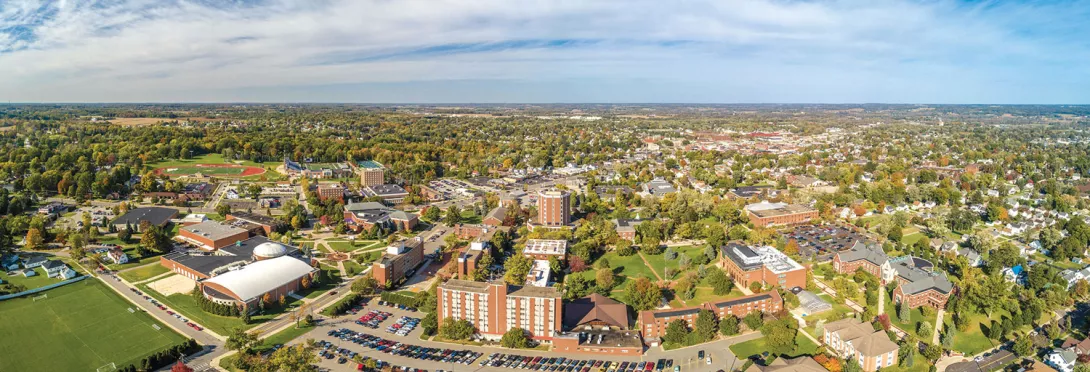
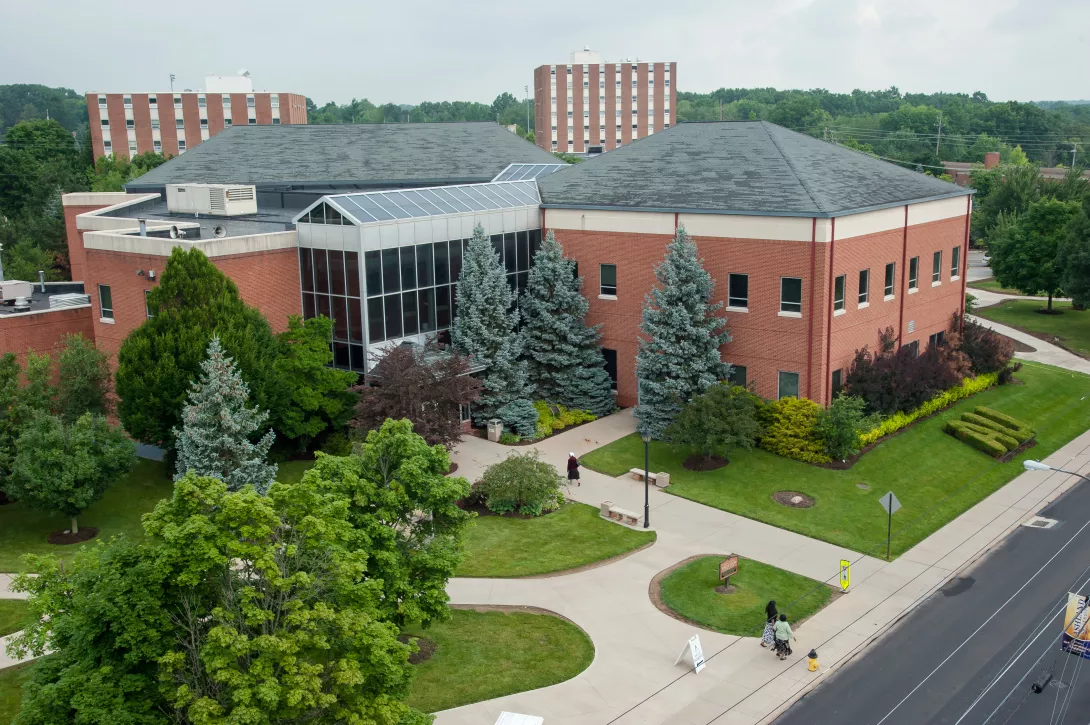
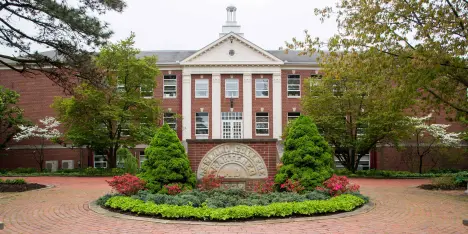
Ashland University seal · sourceAshland University Campus Map and Directions | Ashland · sourceAshland University Campus Map and Directions | Ashland · sourceAbout Ashland University | Ashland · source