Admit rate has ranged 82%–87% over the last 5 years, though the latest figure above (81%) falls outside that window. Source: IPEDS via Urban Institute.
Acceptance & SAT from Common Data Set / IPEDS; net price, earnings & graduation from the U.S. Dept. of Education College Scorecard. Figures lag ~1–2 years — verify with the school.
Aurora University is a small, suburban Illinois campus that operates with the practical, student-centered ethos of a regional teaching institution. It's a place where an 81% acceptance rate opens the door to a hands-on, career-focused education, particularly strong in nursing, education, and social work, delivered on a peaceful, green campus where student life revolves around low-key, community-oriented events. The outcomes tell a story of solid, middle-class returns: a 60% graduation rate and median earnings a decade out that reliably exceed the national average for high school graduates.
Admission requirements
Test-optional — scores considered if submitted
Required
Grade point average
College-prep program
TOEFL (non-native English)
Considered (not required)
High school transcript
Letters of recommendation
Test scores (SAT/ACT)
Source: IPEDS Admissions survey (2022) via Urban Institute. Covers formal factors only — it does not reflect essays, extracurriculars, or other holistic criteria.
More details
Undergrad enrollment
3,974
In-state tuition
$29,170
Out-of-state tuition
$29,170
Graduation Rate
60%
In-State Students
91%
Average Aid Package
$31,013
Demonstrated Interest
Not Considered
Median Earnings (10yr)
$58,709
Post-Grad Next Steps Rate
87%
Students Receiving Financial Aid
76.97%
Outcomes & value
Outcomes & value
Median earnings (10 yr)
$58,709
Value (earnings ÷ net price)
3.1×
Median debt at graduation
$20,318
Graduation rate
60%
First-year retention
77%
Reducing loan balance (3 yr)
62%
Pell (lower-income) share
45%
First-gen share (among federal-aid recipients)
46%
Financial health
2.8 / 3.0Meets the federal financial-responsibility standard
U.S. Dept. of Education Financial Responsibility Composite Score (FY2022-23). Scale −1.0 to 3.0; ≥1.5 meets the standard. Reported for private nonprofit & for-profit institutions only — public universities are state-backed and not scored, so this is a stability signal, not a ranking.
Top-earning majors
Median earnings by field of study (highest credential), ~2 years after completion.
Registered Nursing, Nursing Administration, Nursing Research and Clinical Nursing$62,661
Business/Commerce, General$50,105
Finance and Financial Management Services$48,682
Accounting and Related Services$47,200
Marketing$46,087
Business Administration, Management and Operations
Campus & location
Campus safety
On-campus violent crimes (2024)
2
Per 1,000 students
0.35
On-campus criminal offenses classed as violent (murder/non-negligent manslaughter, rape, robbery, aggravated assault) for the most recent reported year. Source: U.S. Dept. of Education Campus Safety and Security (Clery Act). Counts reflect what’s reported to the school, and urban campuses often report more partly due to non-student incidents nearby — read alongside campus size and setting, not as a standalone safety verdict.
Climate
Pleasant days / yr
84
Summer high
82°F
Winter low
21°F
Annual rain
46.7"
Annual snow
28.9"
Natural-hazard risk
Relatively High
Pleasant days counts days per year with a mean temperature of 55–75°F, a high at or below 90°F, a low at or above 45°F, and little precipitation — a transparent comfort measure, not a weighting we invented. Computed from Open-Meteo ERA5 daily history (2019–2023). Natural-hazard risk is the county’s composite rating from the FEMA National Risk Index.
Deep dive — research, future-scholar output & economic mobility▾
Research output
Institutional h-index
70
Scholarly works
1,311
Institutional research volume and impact from OpenAlex. The h-index reflects large research universities and will be low for teaching-focused liberal-arts colleges — not a measure of undergraduate quality.
Economic mobility
Mobility rate
1.1%
Bottom → top quintile
15%
From bottom quintile
7%
Mobility rate = the share of students who both start in the bottom household-income quintile and reach the top quintile; bottom → top is that chance conditional on starting at the bottom. Source: Opportunity Insights Mobility Report Cards (Chetty, Friedman, Saez, Turner & Yagan). Reflects 1980–82 birth cohorts, so it’s directional, not current.
Quick answers
What is the acceptance rate at Aurora University?
Aurora University's acceptance rate is approximately 81% (Aurora, IL), based on the most recent figures we compiled from public and primary sources.
What SAT score do you need for Aurora University?
Admitted students at Aurora University typically score 900–1150 on the SAT (the middle-50% range). Scores outside this band are still admitted, especially with strong applications.
How much does Aurora University cost?
At Aurora University, the average net price (after aid) is about $18,838 per year. Actual cost varies with financial aid and residency.
How many undergraduates attend Aurora University?
Aurora University enrolls approximately 3,974 undergraduate students.
Where is Aurora University located?
Aurora University is located in Aurora, IL.
Admissions
Aurora University's admissions process is best described as moderately selective and broadly accessible, designed to admit students who show they are prepared for college-level work. The university does not have an open admission policy, but with an of 81%, it is significantly more accessible than many private institutions. The middle 50% SAT range for admitted students is 900–1150, and the university states a minimum ACT composite score of 19 for admission consideration. The average high school GPA for incoming freshmen is reported as 3.51. Aurora accepts the Common Application, streamlining the process for students applying to multiple schools. Notably, the university's indicates that 'level of applicant's interest' is 'Not Considered' in admissions decisions, meaning visiting campus or contacting the admissions office does not formally boost an applicant's chances—decisions are based on the academic record. The student body is overwhelmingly in-state, with 91% of undergraduates hailing from Illinois and only 9% from out of state.
Earnings = median of students working ~10 years after entry; debt = median of graduates. Value divides 10-yr earnings by one year’s net price — read it as earnings per dollar of annual cost, not a full lifetime ROI; it favors lower-cost schools. Source: U.S. Dept. of Education College Scorecard. Figures lag ~2 years and reflect all students, not your intended major.
$42,185
Communication and Media Studies$36,049
Teacher Education and Professional Development, Specific Levels and Methods$34,793
Source: U.S. Dept. of Education College Scorecard (field-of-study earnings). Figures cover graduates who received federal aid and lag ~2 years; not all programs report data.
Academics at Aurora are defined by a practical, career-oriented focus and a notably intimate scale. The university offers a range of undergraduate majors and minors, with particular strength in fields that lead directly to in-demand professions. Its interactive program finder allows students to explore offerings filtered by undergraduate, graduate, online, and areas of interest. Popular and signature programs include Nursing and Elementary Education, reflecting the school's role as a feeder into local healthcare and school systems. The academic catalog provides detailed descriptions of all courses, majors, and minors, as well as university policies. The student-to-faculty ratio is not explicitly stated in the provided sources, but the emphasis on a 'small and peaceful' campus suggests a personalized educational environment. Beyond the traditional Aurora campus, the university also extends its reach through a University Center at McHenry County College.
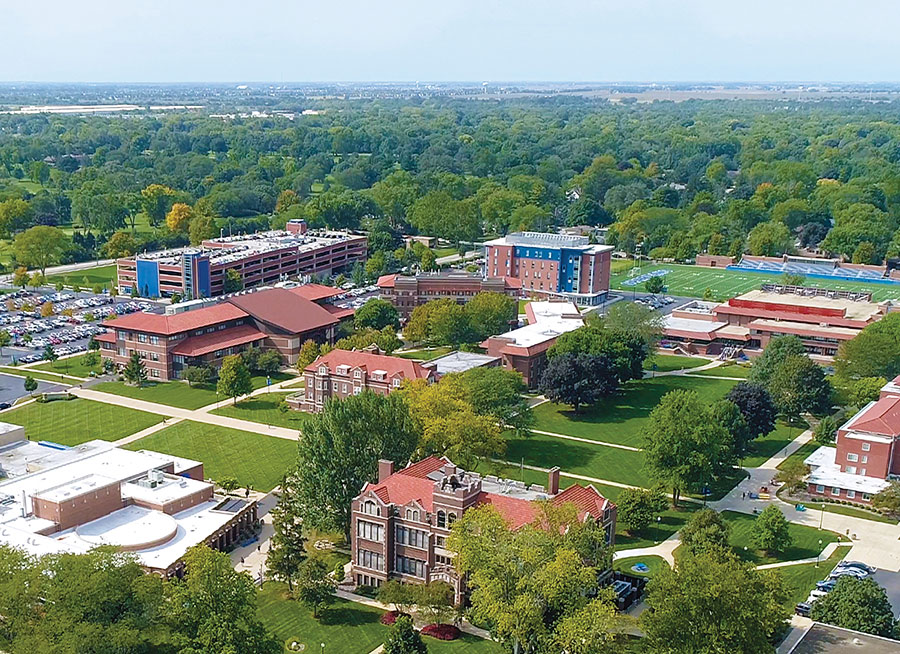
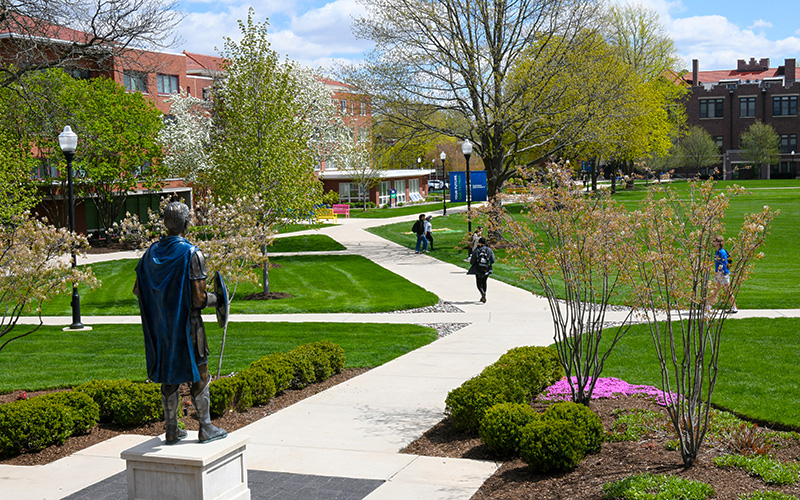
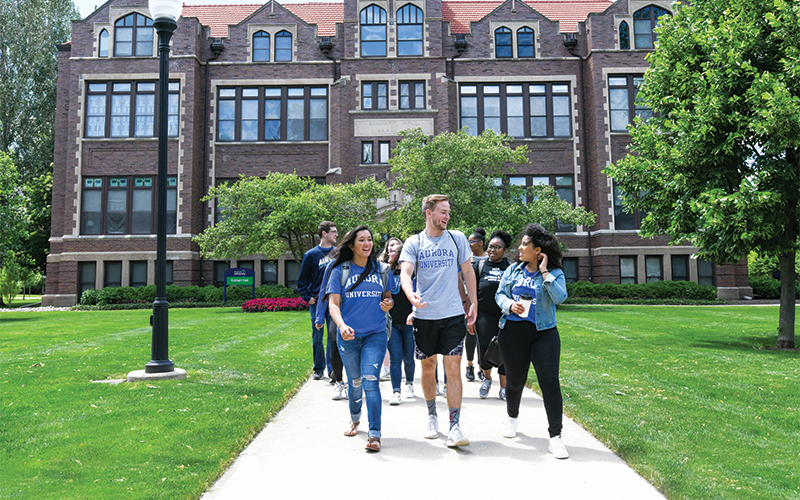
Life on Aurora's campus is described as quiet, close-knit, and heavily focused on community engagement. The campus itself is noted for being 'beautiful and peaceful' with ample green spaces where students relax between classes. Student life is actively programmed by the university, with a calendar of events that leans into wholesome, inclusive activities rather than raucous party scenes. Popular on-campus events include large-scale comedy, hypnosis, or magic shows, outdoor movies, and 'create-your-own stuffed animal' events. Student organizations play a central role, providing opportunities for leadership development and rewarding learning experiences outside the classroom. The university encourages students to 'give back to the nearby community' through service, embedding a sense of local responsibility into the campus culture. Instances of unique programming, like Spanish language students traveling to Cuba for immersion, highlight the university's commitment to creating distinctive experiential learning opportunities. The campus life social media presence actively promotes these events and opportunities for Spartans.
Aurora University graduates typically secure solid, middle-class career footing, with outcomes that underscore the value of its professional-degree focus. The university reports that 87% of students with known outcomes have secured 'next steps' following graduation, based on a high knowledge rate of 97%. The six-year graduation rate stands at 60%, with a notable gender gap: female students graduate at a 65% rate, while male students graduate at 53%. Ten years after enrollment, graduates report a median salary of $58,709. Other sources cite median earnings for recent graduates at $48,840, with 81% of graduates earning more than a high school graduate. These figures paint a picture of a institution whose graduates reliably achieve economic mobility, particularly those who complete degrees in its flagship professional programs.
Aurora University is a private institution with a sticker price that is offset for most students by substantial financial aid. The average after aid—what families actually pay—is $18,838. A significant majority of students (76.97%) receive financial aid, with the average aid package totaling $31,013. The university offers both and several academic scholarships for freshman and transfer undergraduates. Need-based grants from federal, state, and university sources require the submission of the Free Application for Federal Student Aid (FAFSA), which the university 'highly recommends' completing. Students must apply for financial aid every year. The university provides a Net Price Calculator for prospective undergraduate students at its Aurora campus to estimate their individual cost. There is no indication in the provided sources that Aurora University meets 100% of demonstrated financial need or has a 'no-loan' policy that replaces loans with grants; aid packages are likely to include a mix of grants, scholarships, and federal loans.
Aurora University carves out its niche not by chasing prestige, but by perfecting a specific, valuable model: it is a hyper-accessible, teaching-focused institution that serves as a reliable engine of socioeconomic mobility for the region around it. Its identity is rooted in practicality. The curriculum is laser-focused on fields with clear career pathways—nursing, education, social work—ensuring graduates are job-ready. The campus culture mirrors this no-nonsense approach; it's a serene, commuter-heavy environment where student life is orchestrated around community-building events rather than Greek life or big-time sports. This creates a supportive atmosphere for the many and Pell Grant recipients it enrolls. The data tells the story of its effectiveness: a 60% graduation rate that, while not elite, represents a significant achievement for its student demographic, translating into median earnings a decade later that solidly outpace what a high school diploma alone would provide. In an era of soaring college costs and uncertain returns, Aurora represents a straightforward proposition: a low-stress admissions process, a focused education, and a dependable return on investment for students seeking a direct route into the professional middle class.