Loading…
← All schools
Aviation Institute of Maintenance-Kansas City
Kansas City, MOprivate forprofitaviationmaintenance.edu
Avg net price
$26,815
Earnings (10 yr)
$40,743
Acceptance & SAT from Common Data Set / IPEDS; net price, earnings & graduation from the U.S. Dept. of Education College Scorecard. Figures lag ~1–2 years — verify with the school.
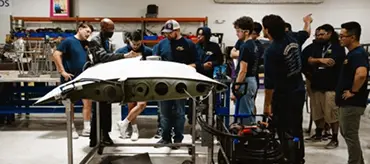
The Aviation Institute of Maintenance-Kansas City is a single-purpose trade school that operates with the directness of a technical bootcamp. It exists to funnel students into one career path: becoming an FAA-certified Airframe and Powerplant (A&P) mechanic. With an open admissions policy and a curriculum built entirely around hands-on hangar work, it's a no-frills, high-intensity environment for those who want to fix planes, not ponder liberal arts. Its identity is defined by its singular focus, its industry connections, and the tangible, greasy reality of its training.
More details
- Undergrad enrollment
- 253
- In-state tuition
- $16,757
- Out-of-state tuition
- $16,757
- Single Major Offered
- Airframe & Aircraft Maintenance Tech
- Median Earnings (10yr)
- $40,743
- Graduation Rate (varies by source)
- 53-71%
Outcomes & value
Outcomes & value
- Median earnings (10 yr)
- $40,743
- Value (earnings ÷ net price)
- 1.5×
- Median debt at graduation
- $30,416
- Reducing loan balance (3 yr)
- 24%
- Pell (lower-income) share
- 31%
- First-gen share (among federal-aid recipients)
- 54%
Earnings = median of students working ~10 years after entry; debt = median of graduates. Value divides 10-yr earnings by one year’s net price — read it as earnings per dollar of annual cost, not a full lifetime ROI; it favors lower-cost schools. Source: U.S. Dept. of Education College Scorecard. Figures lag ~2 years and reflect all students, not your intended major.
Campus & location
Campus safety
- On-campus violent crimes (2024)
- 0
On-campus criminal offenses classed as violent (murder/non-negligent manslaughter, rape, robbery, aggravated assault) for the most recent reported year. Source: U.S. Dept. of Education Campus Safety and Security (Clery Act). Counts reflect what’s reported to the school, and urban campuses often report more partly due to non-student incidents nearby — read alongside campus size and setting, not as a standalone safety verdict.
Climate
- Pleasant days / yr
- 75
- Summer high
- 87°F
- Winter low
- 26°F
- Annual rain
- 47.3"
- Annual snow
- 19.6"
- Natural-hazard risk
- Relatively High
Pleasant days counts days per year with a mean temperature of 55–75°F, a high at or below 90°F, a low at or above 45°F, and little precipitation — a transparent comfort measure, not a weighting we invented. Computed from Open-Meteo ERA5 daily history (2019–2023). Natural-hazard risk is the county’s composite rating from the FEMA National Risk Index.
Quick answers
- How much does Aviation Institute of Maintenance-Kansas City cost?
- At Aviation Institute of Maintenance-Kansas City, the average net price (after aid) is about $26,815 per year. Actual cost varies with financial aid and residency.
- How many undergraduates attend Aviation Institute of Maintenance-Kansas City?
- Aviation Institute of Maintenance-Kansas City enrolls approximately 253 undergraduate students.
- Where is Aviation Institute of Maintenance-Kansas City located?
- Aviation Institute of Maintenance-Kansas City is located in Kansas City, MO.
Admissions
Admissions at AIM-Kansas City is defined by accessibility, not selectivity. Multiple sources report an of 100%, indicating an open-door policy for applicants who meet the basic requirements. The process is streamlined and pragmatic, focused on readiness for a technical program rather than competitive academic metrics. Prospective students can apply online. The institution's small scale is reflected in its enrollment figures, with a total full-time enrollment of 176 students and a part-time enrollment of 77, meaning nearly 70% of the student body is enrolled full-time. There is no indication of an Early Decision process or that demonstrated interest is a considered factor in admissions; this is a career-training institution where the primary gatekeeper is a student's commitment to the rigorous, hands-on program, not a selective admissions committee.
Academics
Academic life here has one track: aviation maintenance. The school offers a single major: . This isn't a college with departments; it's a technical training center built around a federally mandated Part 147 curriculum designed to prepare students for Federal Aviation Administration (FAA) certification. The pedagogy is explicitly hands-on, blending practical learning with industry-driven trends to ensure graduates possess the immediate skills needed in the hangar. The program is designed to help students complete FAA General Aviation courses and gain the skills and attitudes necessary for a meaningful career. This singular focus means every classroom discussion, textbook, and lab session is directly tied to the reality of maintaining and repairing aircraft. It's a vocational education in its purest form, where success is measured by mastery of technical manuals and torque wrenches, not grade-point averages in a broad curriculum.
Compare Aviation Institute of Maintenance-Kansas City
See colleges similar to Aviation Institute of Maintenance-Kansas City →Sources
- Common Data Set - Office of Planning, Analysis and Decision Support
- Common Data Set: Home
- Aviation Institute of Maintenance-Kansas City - College Scorecard
- Aviation Institute of Maintenance - Kansas City - Niche
- Aviation Institute of Maintenance-Kansas City - Data USA
- Aviation Institute of Maintenance-Kansas City - Unigo.com
- Aviation Institute of Maintenance-Kansas City Student Distribution ...
- Admissions - Aviation Institute of Maintenance
- Aviation Institute of Maintenance-Kansas City
- Aviation Institute of Maintenance-Kansas City - Qoollege