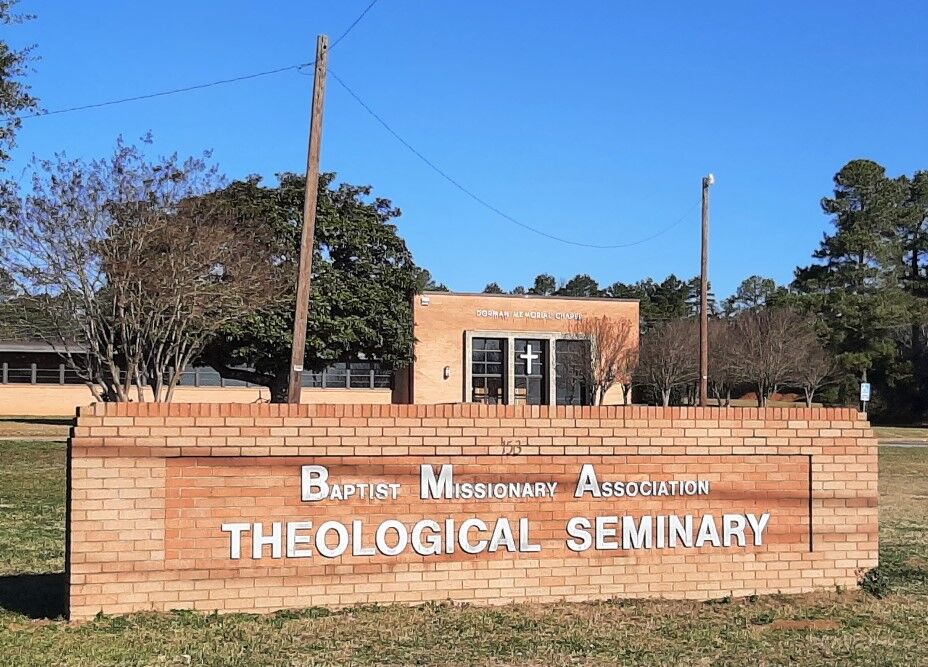
Baptist Missionary Association Theological Seminary is a tiny, fiercely focused graduate school in Jacksonville, Texas, where the mission is to produce ministers, missionaries, and biblical scholars for a specific conservative Baptist tradition. With a microscopic student body and a 3:1 student-faculty ratio, it offers an intensely personal, theologically conservative education entirely centered on religious vocations. This is not a place for academic exploration; it's a vocational forge where nearly every graduate is trained for placement in ministry.
Admission requirements
Test-blind — scores not considered
Required
Letters of recommendation
TOEFL (non-native English)
Considered (not required)
Demonstrated competencies
Source: IPEDS Admissions survey (2022) via Urban Institute. Covers formal factors only — it does not reflect essays, extracurriculars, or other holistic criteria.
More details
Undergrad enrollment
39
In-state tuition
$10,050
Out-of-state tuition
$10,050
Location
Jacksonville, TX
Institution Type
Private Graduate Theological Seminary
Campus Housing Cost
$9,000/year
Median Earnings (4yr)
$46,562
Single Academic Focus
Theology & Religious Vocations
Student-Faculty Ratio
3:1
Graduate Placement Rate
82%
Outcomes & value
Outcomes & value
Pell (lower-income) share
35%
Endowment / student
$28,936
Earnings = median of students working ~10 years after entry; debt = median of graduates. Value divides 10-yr earnings by one year’s net price — read it as earnings per dollar of annual cost, not a full lifetime ROI; it favors lower-cost schools. Source: U.S. Dept. of Education College Scorecard. Figures lag ~2 years and reflect all students, not your intended major.
Financial health
3.0 / 3.0Meets the federal financial-responsibility standard
U.S. Dept. of Education Financial Responsibility Composite Score (FY2022-23). Scale −1.0 to 3.0; ≥1.5 meets the standard. Reported for private nonprofit & for-profit institutions only — public universities are state-backed and not scored, so this is a stability signal, not a ranking.
Campus & location
Campus safety
On-campus violent crimes (2024)
1
Per 1,000 students
14.71
On-campus criminal offenses classed as violent (murder/non-negligent manslaughter, rape, robbery, aggravated assault) for the most recent reported year. Source: U.S. Dept. of Education Campus Safety and Security (Clery Act). Counts reflect what’s reported to the school, and urban campuses often report more partly due to non-student incidents nearby — read alongside campus size and setting, not as a standalone safety verdict.
Climate
Pleasant days / yr
95
Summer high
94°F
Winter low
43°F
Annual rain
49.2"
Annual snow
2.1"
Natural-hazard risk
Relatively Low
Pleasant days counts days per year with a mean temperature of 55–75°F, a high at or below 90°F, a low at or above 45°F, and little precipitation — a transparent comfort measure, not a weighting we invented. Computed from Open-Meteo ERA5 daily history (2019–2023). Natural-hazard risk is the county’s composite rating from the FEMA National Risk Index.
Quick answers
What is the acceptance rate at Baptist Missionary Association Theological Seminary?
Baptist Missionary Association Theological Seminary's acceptance rate is approximately 29% (Jacksonville, TX), based on the most recent figures we compiled from public and primary sources.
How many undergraduates attend Baptist Missionary Association Theological Seminary?
Baptist Missionary Association Theological Seminary enrolls approximately 39 undergraduate students.
Where is Baptist Missionary Association Theological Seminary located?
Baptist Missionary Association Theological Seminary is located in Jacksonville, TX.
Admissions
Admissions at BMATS is a deliberate, vocationally-focused process, not a numbers game. The seminary reports a selective , though external sources show some variance. According to the canonical figure, the acceptance rate is 29%, though other sources cite rates of 23.1%, 23.07%, and 28.57%. The process is notably test-blind: SAT and ACT scores are "neither required nor recommended" for admission. Applicants must complete their application at least four weeks prior to registration, with inquiries directed to the recruiting office. The overall enrollment —the percentage of admitted students who choose to enroll—is reported at a high 75%, suggesting those who are admitted are highly committed to the seminary's specific mission. The small applicant pool (one source notes 13 total applicants) means admissions decisions are highly individualized, likely weighing an applicant's call to ministry, denominational alignment, and academic preparedness for graduate theological work far more heavily than any standardized metric.
Acceptance Rate: 29% (Canonical Figure).
Standardized Tests: Not required or recommended.
Application Deadline: At least four weeks prior to registration.
The academic universe at BMATS is singular and deep: every program falls under the umbrella of "Theology and Religious Vocations." This is a graduate theological seminary, offering a variety of graduate theology degree programs both online and on-campus, including a Master of Divinity, Master of Arts, and Master of Church Ministries, as well as a bachelor's degree in Religion. The institution's purpose is explicitly formative, aiming to prepare students to be "Biblical teacher[s], scholar[s], minister[s] and missionary[ies]" with a "strong understanding of Biblical scholarship." The experience is defined by extraordinary intimacy; the student-to-faculty ratio is an astonishing 3:1. Students describe professors as "experts in their fields, patient and gracious, and willing to work with you," and "experienced, full of wisdom." This hyper-focused, conservative theological environment is encapsulated in the seminary's own pride in "providing students with a theologically conservative education where Scripture is regarded as infallible and inerrant." There is no academic diversity here—only depth in one field, delivered through close mentorship.
Life at BMATS revolves around a shared, all-consuming vocational purpose on a small campus at 1530 E Pine St in Jacksonville, Texas. The seminary promises a "truly life changing experience" that blends "fun campus life" with "robust theological training." However, the available data points to a starkly practical and affordable living arrangement rather than a traditional collegiate experience. Campus housing costs an average of $9,000 per year, which presumably covers both room and board. With such a small, graduate-level student body focused intensely on ministry preparation, organized athletics and a wide array of clubs are unlikely. The 'campus life' is the life of the mind and spirit within a close-knit community of aspiring ministers, set in a small East Texas town.
For BMATS graduates, success is measured not in corporate salaries but in placement into ministry. The seminary explicitly tracks this, reporting that overall placement rates for graduates averaged 82% across all degree programs, and it expects 80% of graduates to be placed in ministry. This is the core metric of institutional effectiveness. Financial outcomes are modest, reflecting typical earnings in religious vocations. Median earnings four years after graduation are reported as $46,562, which is also cited as the 10-year median. Federal data shows a typical median earnings figure of $34,809. Graduation rates are low in a traditional sense, with sources reporting 20%, 24%, and 33%—figures that are common for graduate theological schools where students often study part-time while serving in churches. The average time to graduate is 4.0 years. The high placement rate underscores the seminary's effectiveness in its primary mission: moving graduates directly into the pulpits, missions fields, and classrooms of the Baptist Missionary Association.
BMATS keeps costs relatively low for a private graduate institution, with in-state and out-of-state tuition and fees both set at $10,050. The all-in , including room, board, and other expenses, is estimated at $22,250. Financial aid is available with the stated purpose "to assist students to attend school so that they might acquire a theological education." The average total aid awarded is $4,365, though one source notes an average aid package of $1,482. The average reported annual for students receiving grant or scholarship aid was $0 in the 2019/2020 year. The seminary is eligible for federal and international student loans, but there is no indication in the provided sources of a "no-loan" policy or a commitment to meet 100% of demonstrated financial need without loans. The cost structure reflects its mission to be accessible to those called to ministry.
BMATS stands out for its radical focus and doctrinal clarity. It is not a liberal arts college with a theology department; it is a denominational seminary that exists for one purpose: to train pastors, missionaries, and teachers for the Baptist Missionary Association. This mission creates an academic and social environment of remarkable purity. The 3:1 student-faculty ratio is less a luxury and more a necessity for the kind of discipleship and ministerial formation it offers. Its 82% average placement rate is a powerful testament to its effectiveness within its niche. In a higher education landscape obsessed with rankings, prestige, and breadth, BMATS is an unapologetic antithesis: small, specific, conservative, and laser-focused on producing graduates who will serve a particular flock. For a student certain of a calling to ministry within this tradition, it offers a direct, intimate, and purpose-built path that larger, more diversified universities or seminaries simply cannot match.