Loading…
← All schools
Best Care College
East Orange, NJprivate forprofitbestcarecollege.edu/
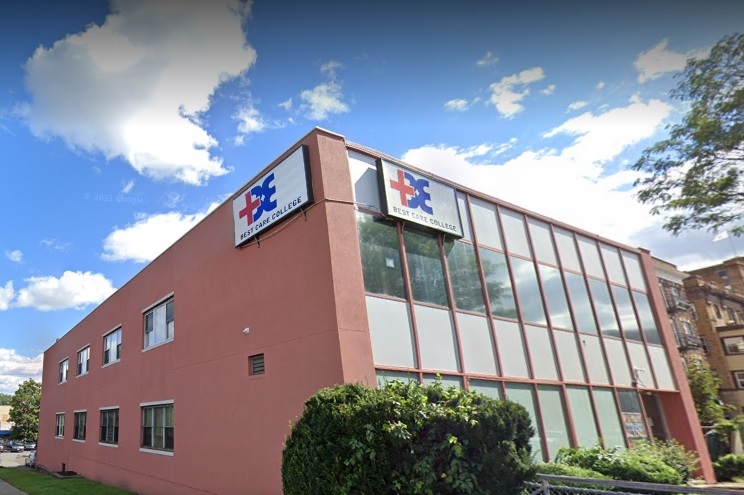
Best Care College is a tightly focused, mission-driven post-secondary institution in East Orange, New Jersey, built entirely around launching careers in practical healthcare. It’s not a traditional liberal arts college; it’s a fast-track, high-intensity training ground where the goal is singular: to turn out job-ready Licensed Practical Nurses and nursing assistants. The student body is overwhelmingly Black or African American, and the culture is one of direct, hands-on preparation for a field defined by compassion and critical skill.
More details
- Undergrad enrollment
- 44
- Founded
- 1997
- Location
- East Orange, NJ
- Flagship Program
- 52-week Licensed Practical Nursing (LPN)
- Student Demographics
- 95.5% Black or African American
- LPN Program Placement Rate
- 93%
- LPN Program NCLEX Pass Rate
- 93%
- Average Aid Award (per Niche)
- $4,415 per year
- Median Earnings After Attending
- $89,155
Outcomes & value
Outcomes & value
- Median earnings (10 yr)
- $64,311
- Pell (lower-income) share
- 54%
- First-gen share (among federal-aid recipients)
- 73%
Earnings = median of students working ~10 years after entry; debt = median of graduates. Value divides 10-yr earnings by one year’s net price — read it as earnings per dollar of annual cost, not a full lifetime ROI; it favors lower-cost schools. Source: U.S. Dept. of Education College Scorecard. Figures lag ~2 years and reflect all students, not your intended major.
Financial health
2.6 / 3.0Meets the federal financial-responsibility standard
U.S. Dept. of Education Financial Responsibility Composite Score (FY2022-23). Scale −1.0 to 3.0; ≥1.5 meets the standard. Reported for private nonprofit & for-profit institutions only — public universities are state-backed and not scored, so this is a stability signal, not a ranking.
Campus & location
Campus safety
- On-campus violent crimes (2024)
- 0
On-campus criminal offenses classed as violent (murder/non-negligent manslaughter, rape, robbery, aggravated assault) for the most recent reported year. Source: U.S. Dept. of Education Campus Safety and Security (Clery Act). Counts reflect what’s reported to the school, and urban campuses often report more partly due to non-student incidents nearby — read alongside campus size and setting, not as a standalone safety verdict.
Climate
- Pleasant days / yr
- 89
- Summer high
- 83°F
- Winter low
- 29°F
- Annual rain
- 54"
- Annual snow
- 19.5"
- Natural-hazard risk
- Relatively High
Pleasant days counts days per year with a mean temperature of 55–75°F, a high at or below 90°F, a low at or above 45°F, and little precipitation — a transparent comfort measure, not a weighting we invented. Computed from Open-Meteo ERA5 daily history (2019–2023). Natural-hazard risk is the county’s composite rating from the FEMA National Risk Index.
Quick answers
- How many undergraduates attend Best Care College?
- Best Care College enrolls approximately 44 undergraduate students.
- Where is Best Care College located?
- Best Care College is located in East Orange, NJ.
Admissions
Admissions at Best Care College are fundamentally different from the holistic, essay-heavy processes of four-year liberal arts institutions. This is a career-training program with clear, practical gates. Applicants to the core Licensed Practical Nursing (LPN) program must be at least 18 years old and submit a completed application. The college does not publish a with detailed breakdowns of GPA percentiles or test scores, which is typical for specialized vocational schools. Its selectivity is framed by its ranking and outcomes rather than by traditional academic metrics; it was ranked #4 among the best LPN programs in New Jersey in 2021. The enrolled student population is notably homogenous, with 95.5% identifying as Black or African American, 2.27% as Asian, and 2.27% as Hispanic or Latino. There is no information provided on Early Decision policies, relative to a national average, or the consideration of demonstrated interest, as these concepts largely pertain to the undergraduate admissions cycles of four-year colleges.
Compare Best Care College
vs United States Coast Guard Academyvs Albertus Magnus Collegevs Hartwick Collegevs Dominican University New York
See colleges similar to Best Care College →Sources
- What is the College Common Data Set and Why Should I Care?
- How To Use a Common Data Set - The College Solution
- Common Data Set Application Priorities for T-25s Visualized - Reddit
- Common Data Set: Home
- [PDF] Common Data Set 2025-2026 - Claremont McKenna College
- Common Data Set - ccmrwithmsthrash
- Best Care College
- Licensed Practical Nursing Program
- First-Year Class Profile
- News Updates
- Best Care College
- Highly regarded colleges for nursing in America