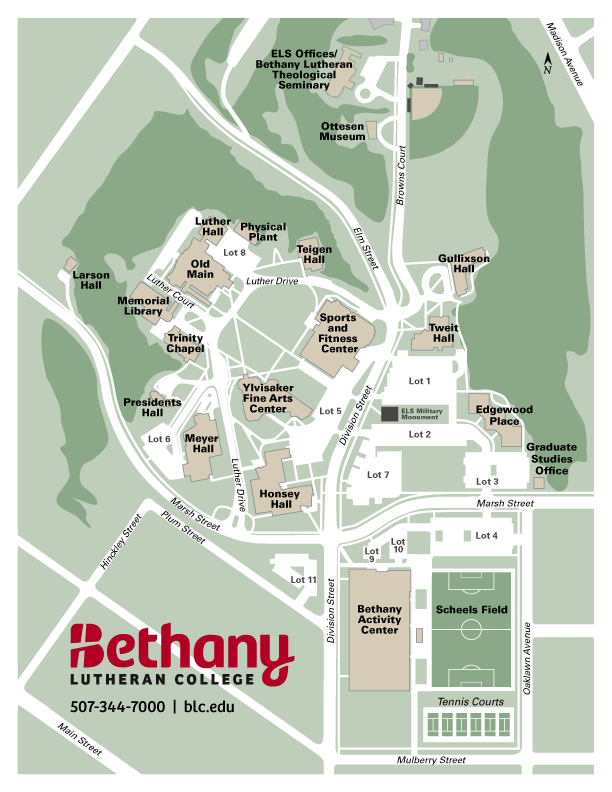
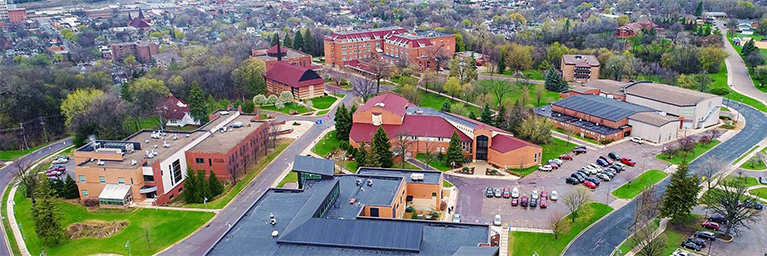
Admit rate has ranged 51%–73% over the last 5 years — notably volatile, though the latest figure above (39%) falls outside that window. Source: IPEDS via Urban Institute.
Acceptance & SAT from Common Data Set / IPEDS; net price, earnings & graduation from the U.S. Dept. of Education College Scorecard. Figures lag ~1–2 years — verify with the school.
Bethany Lutheran College is a small, intensely communal Christian liberal arts school in Mankato, Minnesota, where faith isn't just a footnote—it's the framework for a tight-knit, academically pragmatic education. With a student body under 900, a 12:1 student-faculty ratio, and a campus culture built on 'respect, responsibility, and connection,' it offers a highly personal alternative to sprawling state universities. The college is straightforward in its admissions, rolling and test-flexible, and focuses on turning out graduates in high-demand fields like business, nursing, and education with a solid return on investment.
Admission requirements
Test-optional — scores considered if submitted
Required
High school transcript
Grade point average
TOEFL (non-native English)
Considered (not required)
Letters of recommendation
Test scores (SAT/ACT)
College-prep program
Source: IPEDS Admissions survey (2022) via Urban Institute. Covers formal factors only — it does not reflect essays, extracurriculars, or other holistic criteria.
More details
Undergrad enrollment
669
In-state tuition
$31,360
Out-of-state tuition
$31,360
Graduation Rate
55%
ED Share of Class
Not offered
First-Year Retention
79%
Demonstrated Interest
Not considered
Student-Faculty Ratio
12:1
Median Earnings (10yr)
$46,110
Outcomes & value
Outcomes & value
Median earnings (10 yr)
$46,110
Value (earnings ÷ net price)
2.3×
Median debt at graduation
$23,000
Graduation rate
55%
First-year retention
72%
Reducing loan balance (3 yr)
75%
Pell (lower-income) share
22%
Endowment / student
$67,797
Earnings = median of students working ~10 years after entry; debt = median of graduates. Value divides 10-yr earnings by net price — read it as earnings per dollar of annual cost, not a full lifetime ROI; it favors lower-cost schools. Source: U.S. Dept. of Education College Scorecard. Figures lag ~2 years and reflect all students, not your intended major.
Top-earning majors
Median earnings by field of study (highest credential), ~2 years after completion.
Business Administration, Management and Operations$38,289
Biology, General$29,685
Communication and Media Studies$27,488
Fine and Studio Arts$25,194
Source: U.S. Dept. of Education College Scorecard (field-of-study earnings). Figures cover graduates who received federal aid and lag ~2 years; not all programs report data.
On-campus criminal offenses classed as violent (murder/non-negligent manslaughter, rape, robbery, aggravated assault) for the most recent reported year. Source: U.S. Dept. of Education Campus Safety and Security (Clery Act). Counts reflect what’s reported to the school, and urban campuses often report more partly due to non-student incidents nearby — read alongside campus size and setting, not as a standalone safety verdict.
Climate
Pleasant days / yr
90
Summer high
82°F
Winter low
10°F
Annual rain
36.6"
Annual snow
39"
Natural-hazard risk
Relatively Low
Pleasant days counts days per year with a mean temperature of 55–75°F, a high at or below 90°F, a low at or above 45°F, and little precipitation — a transparent comfort measure, not a weighting we invented. Computed from Open-Meteo ERA5 daily history (2019–2023). Natural-hazard risk is the county’s composite rating from the FEMA National Risk Index.
Deep dive — research, future-scholar output & economic mobility▾
Research output
Institutional h-index
13
Scholarly works
87
Institutional research volume and impact from OpenAlex. The h-index reflects large research universities and will be low for teaching-focused liberal-arts colleges — not a measure of undergraduate quality.
Economic mobility
Mobility rate
0.8%
Bottom → top quintile
12%
From bottom quintile
7%
Mobility rate = the share of students who both start in the bottom household-income quintile and reach the top quintile; bottom → top is that chance conditional on starting at the bottom. Source: Opportunity Insights Mobility Report Cards (Chetty, Friedman, Saez, Turner & Yagan). Reflects 1980–82 birth cohorts, so it’s directional, not current.
Quick answers
What is the acceptance rate at Bethany Lutheran College?
Bethany Lutheran College's acceptance rate is approximately 39% (Mankato, MN), based on the most recent figures we compiled from public and primary sources.
What SAT score do you need for Bethany Lutheran College?
Admitted students at Bethany Lutheran College typically score 1040–1180 on the SAT (the middle-50% range). Scores outside this band are still admitted, especially with strong applications.
How much does Bethany Lutheran College cost?
At Bethany Lutheran College, the average net price (after aid) is about $20,148 per year. Actual cost varies with financial aid and residency.
How many undergraduates attend Bethany Lutheran College?
Bethany Lutheran College enrolls approximately 669 undergraduate students.
Where is Bethany Lutheran College located?
Bethany Lutheran College is located in Mankato, MN.
Admissions
Bethany Lutheran College operates on a rolling admissions basis with no early decision or early action programs, making the process relatively straightforward and continuous. The college admitted 39% of its 1,319 applicants for a recent cycle. For those who submit scores, the middle 50% SAT range for admitted students is 1040–1180, and the ACT range is 21–26; a significant portion of incoming students boast strong high school performance, with 36% reporting a GPA of 3.75 or higher. The admissions office does not employ a formal 'demonstrated interest' metric as a significant factor in its decisions. The rate—the percentage of admitted students who enroll—stands at 34%.
Academics at Bethany are defined by intimate scale and practical focus. The college offers 35 majors leading to a Bachelor of Arts or a Bachelor of Science in Nursing, with a student-to-faculty ratio of 12:1 ensuring close interaction. The most popular majors reflect career-oriented paths: Business Administration and Management (22% of recent graduates), Exercise Physiology and Kinesiology (8%), and Elementary Education and Teaching. The college also maintains a suite of pre-professional tracks to prepare students for graduate study in law, medicine, dentistry, and physical therapy. This is not a place for sprawling graduate research, but for undergraduate teaching where professors are expected to know their students' names and ambitions.
Life on Bethany's Mankato campus is inseparable from its Christ-centered, communal identity. With a total undergraduate enrollment of 856 (54.7% female, 45.3% male), the atmosphere is that of a 'close-knit community' built on explicitly stated values of 'respect, responsibility, and connection.' The college has recently emphasized embracing a 'growing global family,' actively increasing international student enrollment to enrich campus with diverse languages and perspectives. The culture is characterized by a strong sense of shared faith and academic rigor, where campus standards and activities are framed within a Lutheran tradition. This isn't a school with a sprawling Greek life or big-time athletics; the social fabric is woven through shared beliefs, small classes, and residence hall life.
Bethany's outcomes tell a story of steady, middle-class preparation. The college reports a first-year retention rate of 79%, a key indicator that students find their footing. The four-year graduation rate is 43%, while the overall graduation rate is 55%. Post-graduate earnings are a point of emphasis; the college has been ranked among the nation's best for social mobility based on outcomes like graduation rates and post-graduate earnings. The median earnings for graduates ten years after entry are $46,110, with earlier career earnings reported at $37,463 one year out and $45,652 after five years. These figures suggest a reliable trajectory for graduates, many of whom enter fields like business, education, and health sciences directly from their undergraduate studies.
Bethany is transparent about cost, positioning itself as a value-conscious private option. The average annual for first-time freshmen living on campus is $19,400, after scholarships and grants. Financial aid is widespread, with 75% of students receiving grants or scholarships, and the average need-based award for first-year students is $22,150. The college uses the FAFSA and offers academic scholarships automatically upon admission based on GPA and test scores. There is no mention in the provided sources of a 'no-loan' policy or a guarantee to meet 100% of demonstrated financial need for low-income students; the aid approach appears to be a mix of merit and need-based assistance designed to make the sticker price more accessible.
Bethany Lutheran College stands out for its unapologetic fusion of faith, community, and pragmatic career preparation. It doesn't try to be a miniature research university; it excels at being a specific kind of teaching college. The 12:1 student-faculty ratio and sub-900 enrollment create an environment where anonymity is impossible and personal accountability is the norm. Its academic strengths are deliberately channeled into fields with clear career pathways—business, nursing, education, kinesiology—and bolstered by pre-professional advising. This is a school for students who want a small, supportive, values-explicit environment and are focused on a direct return on their educational investment. It's a niche that rejects the generic 'liberal arts college' model in favor of something more focused, communal, and grounded in its Lutheran identity.
Bethany Lutheran College seal · sourceCampus Map, Parking & Directions for Bethany Lutheran College · sourceExplore Campus Facilities at Bethany Lutheran College in Mankato · sourceBethany Lutheran College - Study Minnesota : Study Minnesota · source