Admit rate has ranged 55%–97% over the last 5 years — notably volatile. Source: IPEDS via Urban Institute.
Acceptance & SAT from Common Data Set / IPEDS; net price, earnings & graduation from the U.S. Dept. of Education College Scorecard. Figures lag ~1–2 years — verify with the school.
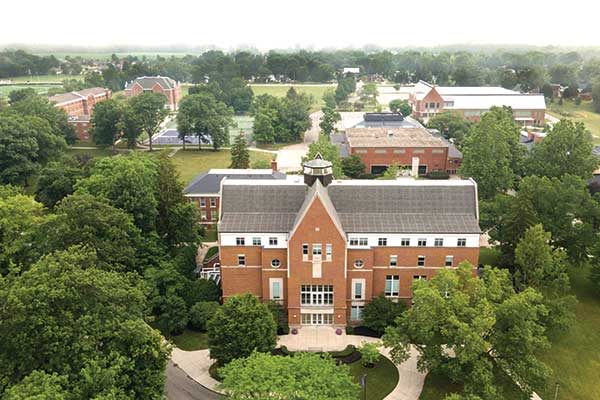
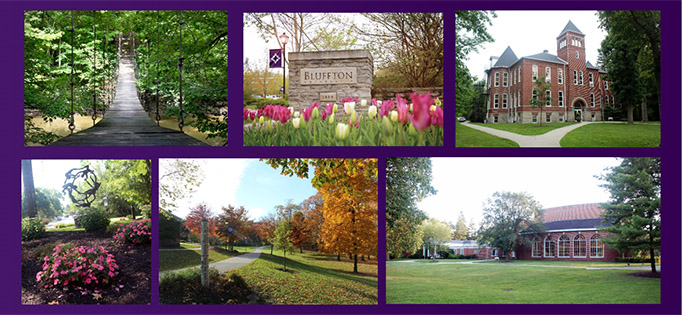
Bluffton University is a small, private Mennonite-affiliated liberal arts college in rural Ohio that operates with a distinctly communal, values-driven ethos. It’s a place where the academic catalog of over 90 programs—including notable strengths in education, business, and social work—is delivered in small classes, and where student life is overwhelmingly residential and centered on campus organizations, spiritual life, and a stated commitment to mutual respect. The profile is one of moderate selectivity, significant financial aid, and a mission focused on preparing students for meaningful work and service, with outcomes that reflect its regional, teaching-oriented character.
Admission requirements
Test-optional — scores considered if submitted
Required
High school transcript
Grade point average
TOEFL (non-native English)
Considered (not required)
Class rank
Letters of recommendation
Test scores (SAT/ACT)
College-prep program
Source: IPEDS Admissions survey (2022) via Urban Institute. Covers formal factors only — it does not reflect essays, extracurriculars, or other holistic criteria.
More details
Undergrad enrollment
582
In-state tuition
$37,362
Out-of-state tuition
$37,362
Campus Housing
94% of students live on campus
Graduation Rate
53%
Frequent Class Size
10-19 students
Application Platform
Accepts Common App
Median Earnings (10yr)
$49,547
Outcomes & value
Outcomes & value
Median earnings (10 yr)
$49,547
Value (earnings ÷ net price)
2.5×
Median debt at graduation
$27,000
Graduation rate
53%
First-year retention
60%
Reducing loan balance (3 yr)
64%
Pell (lower-income) share
45%
First-gen share (among federal-aid recipients)
33%
Financial health
2.3 / 3.0Meets the federal financial-responsibility standard
U.S. Dept. of Education Financial Responsibility Composite Score (FY2022-23). Scale −1.0 to 3.0; ≥1.5 meets the standard. Reported for private nonprofit & for-profit institutions only — public universities are state-backed and not scored, so this is a stability signal, not a ranking.
Top-earning majors
Median earnings by field of study (highest credential), ~2 years after completion.
Business Administration, Management and Operations$39,153
Accounting and Related Services$38,289
Human Resources Management and Services$38,289
Sports, Kinesiology, and Physical Education/Fitness$36,077
Special Education and Teaching$35,060
Social Work
Campus & location
Campus safety
On-campus violent crimes (2024)
1
Per 1,000 students
1.55
On-campus criminal offenses classed as violent (murder/non-negligent manslaughter, rape, robbery, aggravated assault) for the most recent reported year. Source: U.S. Dept. of Education Campus Safety and Security (Clery Act). Counts reflect what’s reported to the school, and urban campuses often report more partly due to non-student incidents nearby — read alongside campus size and setting, not as a standalone safety verdict.
Climate
Pleasant days / yr
90
Summer high
82°F
Winter low
25°F
Annual rain
37.6"
Annual snow
22.1"
Natural-hazard risk
Relatively Low
Pleasant days counts days per year with a mean temperature of 55–75°F, a high at or below 90°F, a low at or above 45°F, and little precipitation — a transparent comfort measure, not a weighting we invented. Computed from Open-Meteo ERA5 daily history (2019–2023). Natural-hazard risk is the county’s composite rating from the FEMA National Risk Index.
Deep dive — research, future-scholar output & economic mobility▾
Research output
Institutional h-index
51
Scholarly works
390
Institutional research volume and impact from OpenAlex. The h-index reflects large research universities and will be low for teaching-focused liberal-arts colleges — not a measure of undergraduate quality.
Economic mobility
Mobility rate
0.2%
Bottom → top quintile
5%
From bottom quintile
3%
Mobility rate = the share of students who both start in the bottom household-income quintile and reach the top quintile; bottom → top is that chance conditional on starting at the bottom. Source: Opportunity Insights Mobility Report Cards (Chetty, Friedman, Saez, Turner & Yagan). Reflects 1980–82 birth cohorts, so it’s directional, not current.
Quick answers
What is the acceptance rate at Bluffton University?
Bluffton University's acceptance rate is approximately 67% (Bluffton, OH), based on the most recent figures we compiled from public and primary sources.
What SAT score do you need for Bluffton University?
Admitted students at Bluffton University typically score 860–1130 on the SAT (the middle-50% range). Scores outside this band are still admitted, especially with strong applications.
How much does Bluffton University cost?
At Bluffton University, the average net price (after aid) is about $19,943 per year. Actual cost varies with financial aid and residency.
How many undergraduates attend Bluffton University?
Bluffton University enrolls approximately 582 undergraduate students.
Where is Bluffton University located?
Bluffton University is located in Bluffton, OH.
Admissions
Bluffton’s admissions process is moderately selective, designed to identify students who are a good fit for its close-knit, community-oriented campus. The university accepts the Common Application and maintains a policy, though it still requires either the ACT or SAT from students who choose to submit scores. The middle 50% SAT range for admitted students who submitted scores is 860–1130. While the is a critical source for understanding admissions factors at any institution, the specific weight Bluffton places on elements like demonstrated interest, as detailed in section C7, is not explicitly stated in the provided sources. The process appears holistic, with no available data on Early Decision or the share of the class filled through early plans, suggesting a focus on the regular decision pool. The rate—the percentage of admitted students who enroll—is a key metric for understanding a school’s desirability, but specific figures for Bluffton are not provided in the sources.
Earnings = median of students working ~10 years after entry; debt = median of graduates. Value divides 10-yr earnings by one year’s net price — read it as earnings per dollar of annual cost, not a full lifetime ROI; it favors lower-cost schools. Source: U.S. Dept. of Education College Scorecard. Figures lag ~2 years and reflect all students, not your intended major.
$33,637
Teacher Education and Professional Development, Specific Levels and Methods$28,598
Source: U.S. Dept. of Education College Scorecard (field-of-study earnings). Figures cover graduates who received federal aid and lag ~2 years; not all programs report data.
Academics at Bluffton are defined by breadth within an intimate setting. The university offers study in more than 90 academic programs, including bachelor’s degrees and master’s programs in business administration (MBA), education (MAEd), and social work. The most frequent undergraduate class size is 10-19 students, ensuring a low student-to-faculty ratio and personalized attention. Popular majors reflect the university’s practical and service-oriented mission: Elementary Education and Teaching and Business Administration and Management are among the top producers of graduates. Psychology, Biological and Biomedical Sciences, and Communication/Journalism are also significant programs. This academic structure supports a learning environment where, as the Princeton Review notes, the most frequent lab or discussion section size is also in the 10-19 range, reinforcing the hands-on, participatory nature of a Bluffton education.
Life at Bluffton is intensely campus-centric and community-driven. A full 94% of students live in college-owned, -operated, or -affiliated housing, creating a residential bubble where friendships, study, group activities, worship, discussion, and service are interwoven. The university explicitly strives to be a "community of respect where everyone is held in mutual high regard." This ethos is activated through a busy calendar of intramural athletics, student organizations, music ensembles, theater productions, and spiritual life activities. Leadership development is encouraged for all, with specific support offered through the Multicultural Student Development Center to help embrace and celebrate the diverse college community. The campus vibe is active and participatory; students don’t just attend Bluffton, they live fully within its ecosystem, from the residence halls to global experiences like the documented student trip to Ecuador.
Bluffton’s outcomes tell the story of a regional university focused on creating pathways to stable, service-oriented careers. The six-year graduation rate is 53%, and the university has been recognized as a Top Performer for Social Mobility among Midwest Regional Colleges, indicating success in graduating students from lower-income backgrounds. For graduates, median earnings ten years after entry are $49,547. Earnings vary by field; for example, Social Work graduates report average earnings of $33,857. The university’s own expenditure data shows a median salary payout of $7.57 million in 2024, representing over a third of its total budget, which underscores its role as a significant employer in the region. These figures collectively paint a picture of a institution whose graduates typically enter fields like education, social work, and business, with earnings commensurate with those professions.
Making a Bluffton education affordable is a stated priority, achieved through a mix of scholarships, grants, and loans. The average after aid is $19,943. The university offers a wide range of merit-based scholarships and need-based financial aid, with the average aid package reported as $28,075. To help families navigate costs, Bluffton provides net price calculators for both first-year and transfer students. Financial aid is awarded based on demonstrated financial need and/or remaining costs after other aid is applied. The provided sources do not indicate that Bluffton has a policy of meeting 100% of demonstrated financial need for all admitted students, nor do they describe a specific "no-loan" policy where loans are eliminated from packages for students below certain income thresholds. The focus is instead on a comprehensive offering of grants and scholarships to reduce the net price.
Bluffton University stands out for its unwavering commitment to a specific, values-saturated form of community—one that is more than a marketing slogan. It’s a place where 94% of students live on campus, where the official campus life catalog speaks of "mutual high regard," and where learning happens in small classes across a surprisingly vast array of 90+ programs. This creates a distinctive environment: a rural Ohio campus that feels both insular and intentionally connected, where preparation for careers in teaching, business, and social work is infused with a Mennonite heritage of service and community. It’s not a university for those seeking anonymity or a sprawling urban experience. It is, decidedly, for students who want to be known, to participate, and to graduate not just with a degree but as part of a defined community, ready for meaningful work that aligns with the institution’s demonstrated focus on social mobility and service.
.jpg?width=1600)