Loading…
← All schools
Cankdeska Cikana Community College
Fort Totten, NDpublicwww.littlehoop.edu/
Avg net price
$6,507
Earnings (10 yr)
$17,008
Acceptance & SAT from Common Data Set / IPEDS; net price, earnings & graduation from the U.S. Dept. of Education College Scorecard. Figures lag ~1–2 years — verify with the school.
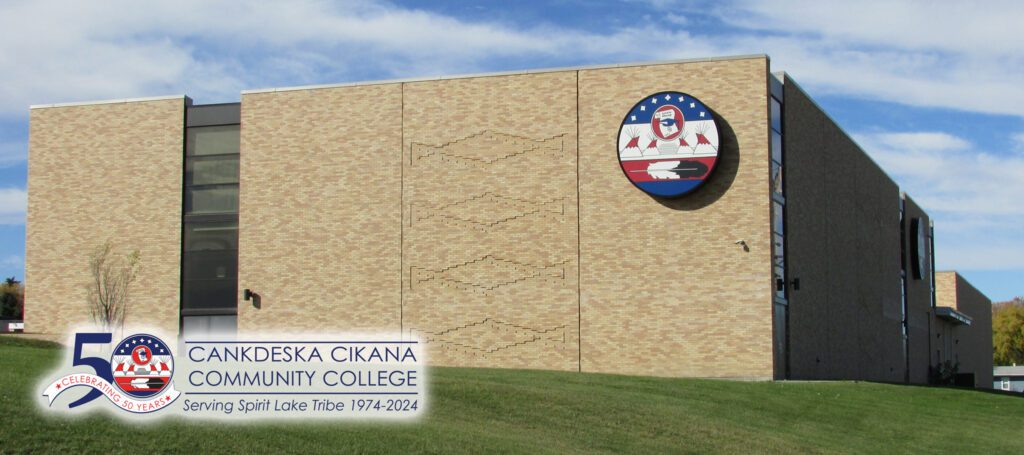
Cankdeska Cikana Community College (CCCC) is an open-door institution on the Spirit Lake Dakota Nation in Fort Totten, North Dakota, where education is an act of cultural reclamation. Its mission is inseparable from its location, integrating Dakota language, history, and values directly into its curriculum and community life. This is a college built for access, offering practical associate degrees and certificates with a uniquely low net price, serving a student body that is overwhelmingly local and Indigenous.
More details
- Undergrad enrollment
- 222
- In-state tuition
- $3,950
- Out-of-state tuition
- $3,950
- Top Majors
- Liberal Arts, Social Work
- Cultural Mission
- Integrates Spirit Lake Dakota culture & language
- In-State Students
- 96%
- Median Earnings (10yr)
- $17,008
Outcomes & value
Outcomes & value
- Median earnings (10 yr)
- $17,008
- Value (earnings ÷ net price)
- 2.6×
- Pell (lower-income) share
- 57%
- First-gen share (among federal-aid recipients)
- 41%
Earnings = median of students working ~10 years after entry; debt = median of graduates. Value divides 10-yr earnings by one year’s net price — read it as earnings per dollar of annual cost, not a full lifetime ROI; it favors lower-cost schools. Source: U.S. Dept. of Education College Scorecard. Figures lag ~2 years and reflect all students, not your intended major.
Campus & location
Campus safety
- On-campus violent crimes (2024)
- 0
On-campus criminal offenses classed as violent (murder/non-negligent manslaughter, rape, robbery, aggravated assault) for the most recent reported year. Source: U.S. Dept. of Education Campus Safety and Security (Clery Act). Counts reflect what’s reported to the school, and urban campuses often report more partly due to non-student incidents nearby — read alongside campus size and setting, not as a standalone safety verdict.
Climate
- Pleasant days / yr
- 100
- Summer high
- 78°F
- Winter low
- 5°F
- Annual rain
- 18.9"
- Annual snow
- 41.4"
- Natural-hazard risk
- Very Low
Pleasant days counts days per year with a mean temperature of 55–75°F, a high at or below 90°F, a low at or above 45°F, and little precipitation — a transparent comfort measure, not a weighting we invented. Computed from Open-Meteo ERA5 daily history (2019–2023). Natural-hazard risk is the county’s composite rating from the FEMA National Risk Index.
Deep dive — research, future-scholar output & economic mobility
Research output
- Institutional h-index
- 9
- Scholarly works
- 36
Institutional research volume and impact from OpenAlex. The h-index reflects large research universities and will be low for teaching-focused liberal-arts colleges — not a measure of undergraduate quality.
Quick answers
- How much does Cankdeska Cikana Community College cost?
- At Cankdeska Cikana Community College, the average net price (after aid) is about $6,507 per year. Actual cost varies with financial aid and residency.
- How many undergraduates attend Cankdeska Cikana Community College?
- Cankdeska Cikana Community College enrolls approximately 222 undergraduate students.
- Where is Cankdeska Cikana Community College located?
- Cankdeska Cikana Community College is located in Fort Totten, ND.
Admissions
CCCC operates on a radically open admissions model, a deliberate policy of accessibility for the community it serves. Multiple external sources confirm a 100% , meaning any applicant who completes the basic requirements is admitted. The process is straightforward: prospective students must submit an Application for Admission form and official high school transcripts (or GED). There is no mention of standardized test scores (SAT/ACT) being required or considered, and no data on high school GPA is reported. The admitted student body is overwhelmingly in-state, with one source indicating 96% of enrolled students are from North Dakota. This is not a selective institution in the traditional sense; its selectivity lies in its commitment to serving the Spirit Lake Dakota community and surrounding region.
Academics
The college offers a focused slate of 12 associate degree and certificate programs designed for immediate career entry or transfer. The academic offerings are pragmatic and community-centered. The most popular majors, based on conferred degrees, are Liberal Arts and Sciences/Liberal Studies and Social Work. Other notable programs include Business Administration, Early Childhood Education, and Indigenous Studies—the latter being a core component of the college's mission. Data also shows a significant specialization in Transportation, reflecting local economic needs. Beyond traditional coursework, the college emphasizes holistic student development, offering career coaching, Gallup Strengths coaching, and life coaching to every student and staff member. The academic experience is intentionally structured to blend practical skill-building with cultural grounding.
Compare Cankdeska Cikana Community College
vs United States Coast Guard Academyvs Florida Polytechnic Universityvs United States Air Force Academyvs Hillsdale College
See colleges similar to Cankdeska Cikana Community College →Sources
- Common Data Set: Home
- Decoding the Common Data Set What You Need to Know for ...
- Common Data Set 2023-2024
- Common Data Set
- Common Data Set
- How to Apply
- Cankdeska Cikana Community College
- Cankdeska Cikana Community College - Fort Totten, ND
- Cankdeska Cikana Community College
- Cankdeska Cikana Community College: Home
- Cankdeska Cikana Community College
- Programs of Study - Cankdeska Cikana Community College