Loading…
← All schools
Cerro Coso Community College
Ridgecrest, CApubliccerrocoso.edu
Avg net price
$18,306
Earnings (10 yr)
$34,963
Acceptance & SAT from Common Data Set / IPEDS; net price, earnings & graduation from the U.S. Dept. of Education College Scorecard. Figures lag ~1–2 years — verify with the school.
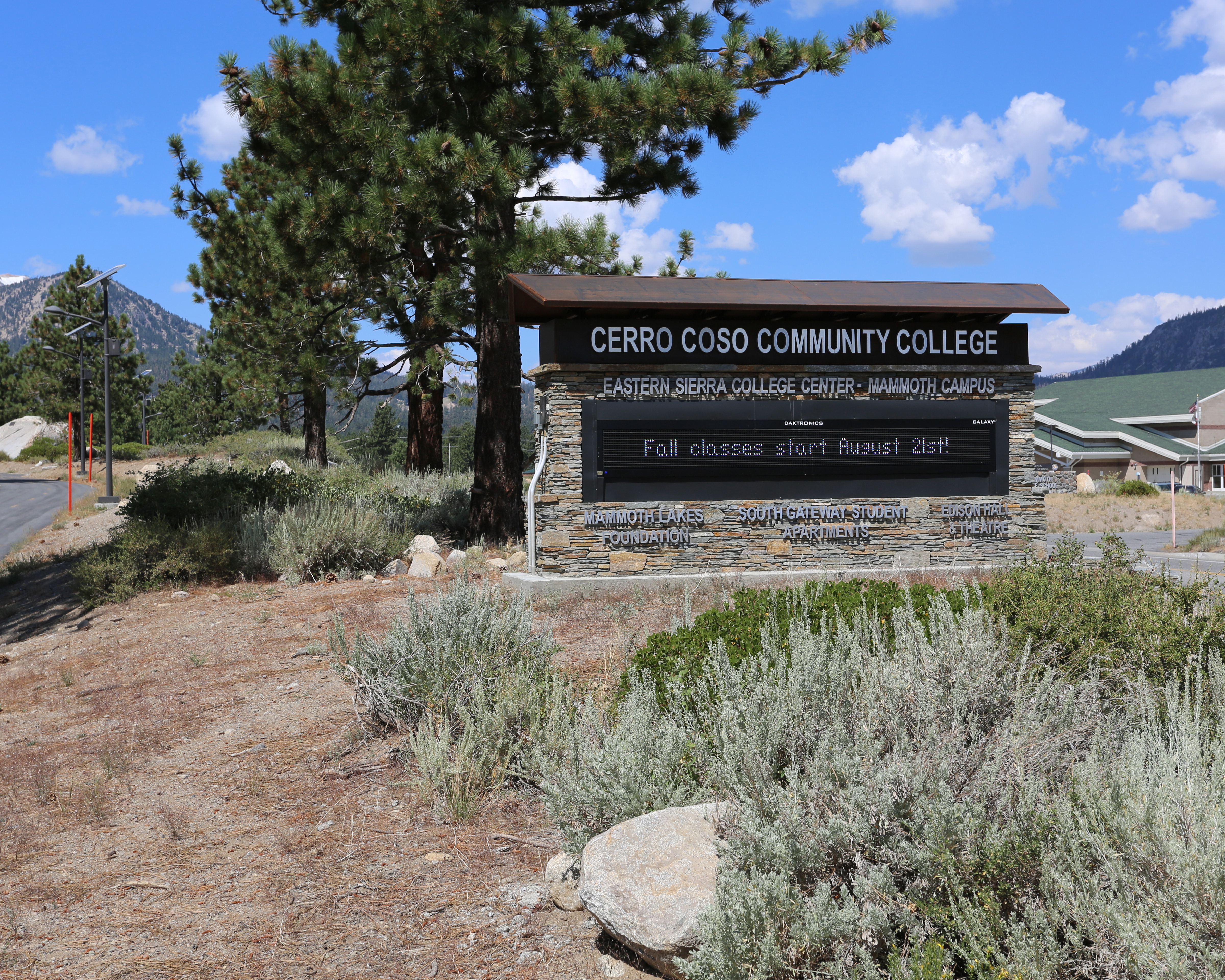
Cerro Coso Community College is a rural, open-access institution in California's high desert that serves a predominantly part-time, local student body with a practical, flexible mission. Its identity is defined by accessibility—admitting anyone with a high school diploma or equivalent—and a focus on foundational transfer degrees, workforce certificates, and online learning tailored to adult learners. The college operates more like a vital public utility than a traditional campus, providing a low-cost academic on-ramp against a starkly beautiful backdrop of desert hills and snow-capped mountains.
More details
- Undergrad enrollment
- 3,171
- In-state tuition
- $1,384
- Out-of-state tuition
- $11,254
- Part-Time Students
- 84.2%
- Demonstrated Interest
- Not considered
- Student-Faculty Ratio
- 24:1
- 6-Year Graduation Rate
- 25%
- Median Earnings (10yr)
- $34,963
- First-Year Retention Rate
- 50%
- Associate Degrees for Transfer
- 13
Outcomes & value
Outcomes & value
- Median earnings (10 yr)
- $34,963
- Value (earnings ÷ net price)
- 1.9×
- Pell (lower-income) share
- 15%
- First-gen share (among federal-aid recipients)
- 51%
Earnings = median of students working ~10 years after entry; debt = median of graduates. Value divides 10-yr earnings by one year’s net price — read it as earnings per dollar of annual cost, not a full lifetime ROI; it favors lower-cost schools. Source: U.S. Dept. of Education College Scorecard. Figures lag ~2 years and reflect all students, not your intended major.
Campus & location
Campus safety
- On-campus violent crimes (2024)
- 0
On-campus criminal offenses classed as violent (murder/non-negligent manslaughter, rape, robbery, aggravated assault) for the most recent reported year. Source: U.S. Dept. of Education Campus Safety and Security (Clery Act). Counts reflect what’s reported to the school, and urban campuses often report more partly due to non-student incidents nearby — read alongside campus size and setting, not as a standalone safety verdict.
Climate
- Pleasant days / yr
- 109
- Summer high
- 98°F
- Winter low
- 40°F
- Annual rain
- 6.4"
- Annual snow
- 2.2"
- Natural-hazard risk
- Relatively High
Pleasant days counts days per year with a mean temperature of 55–75°F, a high at or below 90°F, a low at or above 45°F, and little precipitation — a transparent comfort measure, not a weighting we invented. Computed from Open-Meteo ERA5 daily history (2019–2023). Natural-hazard risk is the county’s composite rating from the FEMA National Risk Index.
Deep dive — research, future-scholar output & economic mobility
Research output
- Institutional h-index
- 8
- Scholarly works
- 23
Institutional research volume and impact from OpenAlex. The h-index reflects large research universities and will be low for teaching-focused liberal-arts colleges — not a measure of undergraduate quality.
Quick answers
- How much does Cerro Coso Community College cost?
- At Cerro Coso Community College, the average net price (after aid) is about $18,306 per year. Actual cost varies with financial aid and residency.
- How many undergraduates attend Cerro Coso Community College?
- Cerro Coso Community College enrolls approximately 3,171 undergraduate students.
- Where is Cerro Coso Community College located?
- Cerro Coso Community College is located in Ridgecrest, CA.
Admissions
Cerro Coso operates on a policy of open admission, making the process one of enrollment rather than selective review. The is effectively 100%, as the college admits any individual who meets basic eligibility criteria, such as being a graduate of an accredited high school [7][8]. There is no indication that standardized test scores (SAT/ACT) are required for admission, aligning with its open-access mission [10][12]. The process is administrative: prospective students create an account on CCCApply, submit an admissions application, and complete an identity verification through ID.me or the California DMV Wallet [1]. The student body is overwhelmingly part-time, with only 15.8% of its 5,559 total students enrolled full-time [2][11]. The demographic profile reflects its service area: 45.16% of students identify as Hispanic/Latino, 35.48% as White, 7.06% as Black or African American, 3.91% as Asian, and 1.73% as American Indian or Alaska Native [9]. Demonstrated interest—such as campus visits or contacting admissions officers—is not a factor in this process, as the college's admissions policy is non-competitive [30][31][32].
Compare Cerro Coso Community College
vs United States Air Force Academyvs Fort Lewis Collegevs Abraham Baldwin Agricultural Collegevs SUNY at Purchase College
See colleges similar to Cerro Coso Community College →Sources
- Steps to Apply & Enroll
- Common Data Set: Home
- Common Data Set 2023-2024
- Cerro Coso Community College
- Cerro Coso Community College
- Common Data Set 2021-2022
- Cerro Coso Community College - Niche
- Admissions & Records - Cerro Coso Community College
- Cerro Coso Community College - Tuition and Acceptance Rate
- Cerro Coso Community College Acceptance Rate, SAT, GPA & ACT ...
- International Students - Cerro Coso Community College