Loading…
← All schools
City Colleges of Chicago-Richard J Daley College
Chicago, ILpublicwww.ccc.edu/colleges/daley/pages/default.aspx
Avg net price
$7,886
Earnings (10 yr)
$37,962
Acceptance & SAT from Common Data Set / IPEDS; net price, earnings & graduation from the U.S. Dept. of Education College Scorecard. Figures lag ~1–2 years — verify with the school.
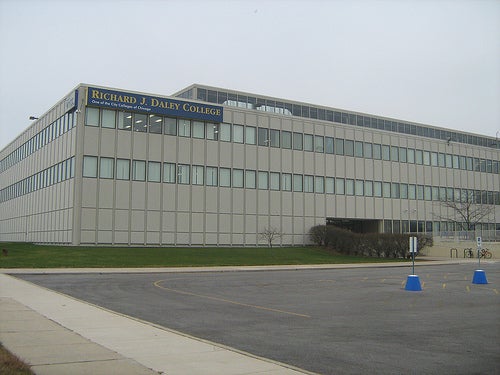
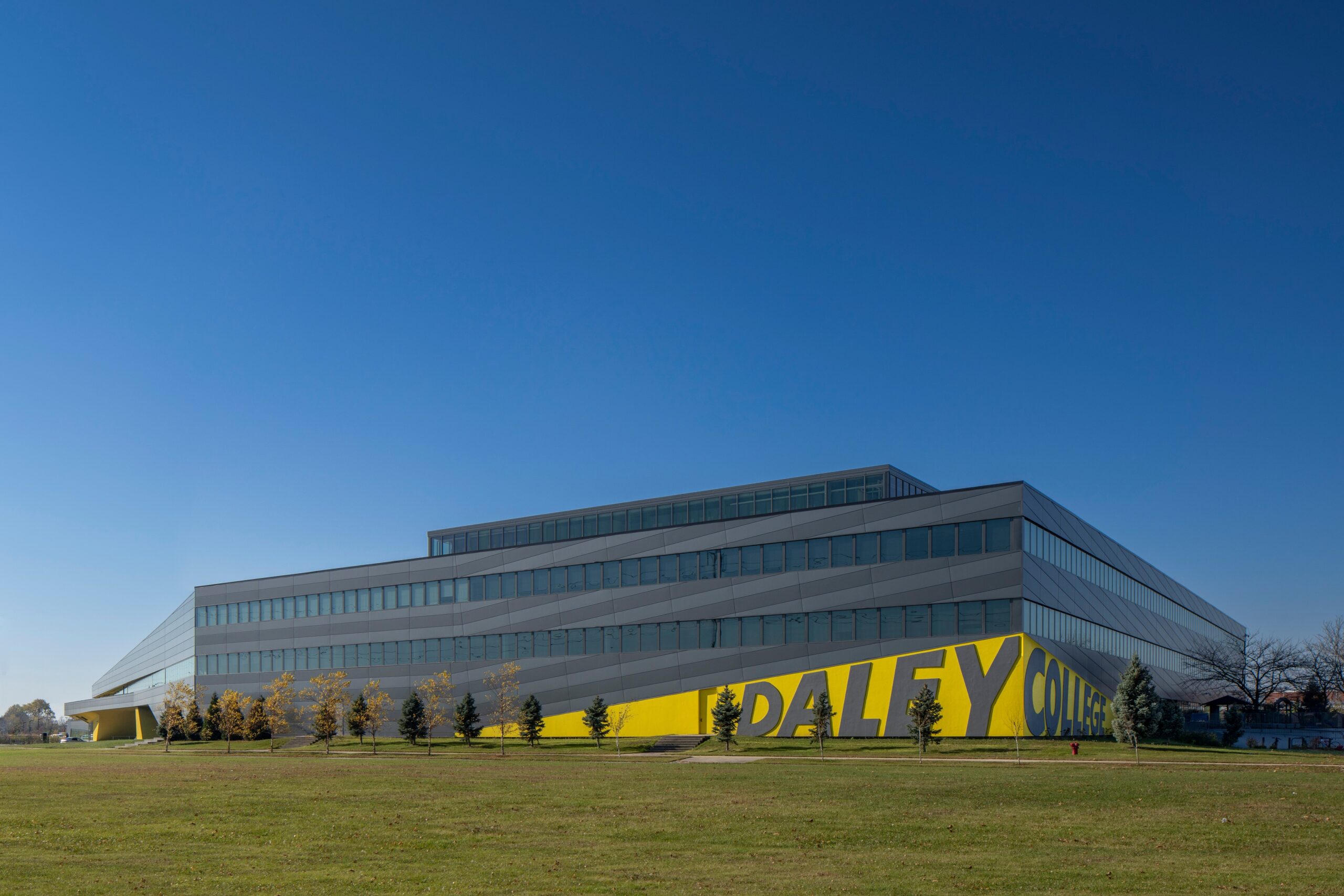
Richard J. Daley College is an unapologetically open-door institution on Chicago's Southwest Side, a community college where the mission of access is not a marketing line but a daily reality. It's a place where the electrician's certificate holds as much weight as the associate's degree, where students gather in the main lobby between shifts and classes, and where the path to a four-year university or a skilled trade begins with a simple assessment test. This is higher education stripped of pretense, focused squarely on practical skills, transfer pathways, and serving the immediate needs of its diverse, working-class community.
More details
- Undergrad enrollment
- 2,789
- In-state tuition
- $4,590
- Out-of-state tuition
- $15,150
- Graduation Rate
- 31-32%
- Transfer-Out Rate
- 10%
- Part-Time Students
- 63% of first-time, degree-seeking undergraduates
- Early College Program
- Free college courses for eligible high school students
- Most Specialized Major
- Construction
- Average Financial Aid Package
- $3,996
Outcomes & value
Outcomes & value
- Median earnings (10 yr)
- $37,962
- Value (earnings ÷ net price)
- 4.8×
- Median debt at graduation
- $4,500
- Reducing loan balance (3 yr)
- 37%
- Pell (lower-income) share
- 19%
- First-gen share (among federal-aid recipients)
- 61%
Earnings = median of students working ~10 years after entry; debt = median of graduates. Value divides 10-yr earnings by one year’s net price — read it as earnings per dollar of annual cost, not a full lifetime ROI; it favors lower-cost schools. Source: U.S. Dept. of Education College Scorecard. Figures lag ~2 years and reflect all students, not your intended major.
Campus & location
Campus safety
- On-campus violent crimes (2024)
- 1
On-campus criminal offenses classed as violent (murder/non-negligent manslaughter, rape, robbery, aggravated assault) for the most recent reported year. Source: U.S. Dept. of Education Campus Safety and Security (Clery Act). Counts reflect what’s reported to the school, and urban campuses often report more partly due to non-student incidents nearby — read alongside campus size and setting, not as a standalone safety verdict.
Climate
- Pleasant days / yr
- 84
- Summer high
- 82°F
- Winter low
- 22°F
- Annual rain
- 49.4"
- Annual snow
- 30.7"
- Natural-hazard risk
- Very High
Pleasant days counts days per year with a mean temperature of 55–75°F, a high at or below 90°F, a low at or above 45°F, and little precipitation — a transparent comfort measure, not a weighting we invented. Computed from Open-Meteo ERA5 daily history (2019–2023). Natural-hazard risk is the county’s composite rating from the FEMA National Risk Index.
Quick answers
- How much does City Colleges of Chicago-Richard J Daley College cost?
- At City Colleges of Chicago-Richard J Daley College, the average net price (after aid) is about $7,886 per year. Actual cost varies with financial aid and residency.
- How many undergraduates attend City Colleges of Chicago-Richard J Daley College?
- City Colleges of Chicago-Richard J Daley College enrolls approximately 2,789 undergraduate students.
- Where is City Colleges of Chicago-Richard J Daley College located?
- City Colleges of Chicago-Richard J Daley College is located in Chicago, IL.
Admissions
Daley College operates on a radically simple principle: if you want to attend, you can. The City Colleges of Chicago are open admission colleges, a policy the district states clearly: "Everyone is welcome." There is no traditional in the selective college sense; sources like Niche report a 100% acceptance rate, while others, like College Board's BigFuture, note that acceptance rate information is not available, precisely because the concept doesn't apply. The barrier to entry is not a GPA or test score, but a commitment to the process. All students are required to take the District assessment and placement tests upon enrollment to determine appropriate course levels. The institution accepts students year-round, and a high school diploma or GED is sufficient for admission to degree programs. This creates a student body where 63% of degree-seeking, first-time undergraduates are part-time, reflecting the lives of students who are often balancing work, family, and education.
There is no Early Decision process in the conventional sense. However, Daley offers an Early College Program for high school students, allowing them to take college-level courses free of charge if they maintain at least a 2.5 GPA. Demonstrated interest, a critical factor at many private colleges, is irrelevant here; the admissions philosophy is purely about removing hurdles, not evaluating appeal.
Compare City Colleges of Chicago-Richard J Daley College
vs Indiana University-Northwestvs Indiana University-Eastvs University of Wisconsin-Parksidevs Chicago State University
See colleges similar to City Colleges of Chicago-Richard J Daley College →Sources
- City Colleges of Chicago-Richard J Daley College - IPEDS
- Facts and Statistics - City Colleges of Chicago
- Common Data Set: Home
- [PDF] Common Data Set 2022-2023
- How To Use a Common Data Set - The College Solution
- Common Data Set | data.uchicago.edu - Institutional Analysis
- City Colleges of Chicago: Richard J. Daley College Admissions
- City Colleges of Chicago - Richard J. Daley College - Niche
- City Colleges of Chicago-Richard J Daley College - Sallie
- Admissions Requirements - City Colleges of Chicago