Admit rate has ranged 58%–72% over the last 5 years — notably volatile. Source: IPEDS via Urban Institute.
Acceptance & SAT from Common Data Set / IPEDS; net price, earnings & graduation from the U.S. Dept. of Education College Scorecard. Figures lag ~1–2 years — verify with the school.
Concordia College at Moorhead is a small, Lutheran-affiliated liberal arts college in the upper Midwest that runs on a distinct rhythm of faith, music, and community. Its identity is defined by a required core curriculum, a powerhouse music program with over 20 ensembles, and a deeply collaborative campus culture where nearly everyone participates in something—from NCAA Division III athletics to one of 90 student clubs. While its most popular majors tilt toward practical fields like business and biology, the education is firmly rooted in the liberal arts, producing graduates who reliably find their footing in the region and beyond.
Admission requirements
Test-optional — scores considered if submitted
Required
High school transcript
Grade point average
TOEFL (non-native English)
Considered (not required)
Class rank
Letters of recommendation
Test scores (SAT/ACT)
College-prep program
Source: IPEDS Admissions survey (2022) via Urban Institute. Covers formal factors only — it does not reflect essays, extracurriculars, or other holistic criteria.
More details
Undergrad enrollment
1,829
In-state tuition
$31,170
Out-of-state tuition
$31,170
Popular Majors
Business, Biology, Education, Psychology, Nursing
Graduation Rate
61%
Median Earnings (10yr)
$59,317
Student-to-Faculty Ratio
12:1
First-Year Retention Rate
84%
Outcomes & value
Outcomes & value
Median earnings (10 yr)
$59,317
Value (earnings ÷ net price)
2.4×
Median debt at graduation
$26,847
Graduation rate
61%
First-year retention
84%
Reducing loan balance (3 yr)
85%
Pell (lower-income) share
19%
First-gen share (among federal-aid recipients)
13%
Top-earning majors
Median earnings by field of study (highest credential), ~2 years after completion.
Registered Nursing, Nursing Administration, Nursing Research and Clinical Nursing$61,941
Accounting and Related Services$56,641
Business Administration, Management and Operations$47,686
Social Work$44,170
Mathematics$43,426
Teacher Education and Professional Development, Specific Subject Areas
Campus & location
Campus safety
On-campus violent crimes (2024)
2
Per 1,000 students
1.05
On-campus criminal offenses classed as violent (murder/non-negligent manslaughter, rape, robbery, aggravated assault) for the most recent reported year. Source: U.S. Dept. of Education Campus Safety and Security (Clery Act). Counts reflect what’s reported to the school, and urban campuses often report more partly due to non-student incidents nearby — read alongside campus size and setting, not as a standalone safety verdict.
Climate
Pleasant days / yr
88
Summer high
82°F
Winter low
6°F
Annual rain
25.3"
Annual snow
41.2"
Natural-hazard risk
Relatively Low
Pleasant days counts days per year with a mean temperature of 55–75°F, a high at or below 90°F, a low at or above 45°F, and little precipitation — a transparent comfort measure, not a weighting we invented. Computed from Open-Meteo ERA5 daily history (2019–2023). Natural-hazard risk is the county’s composite rating from the FEMA National Risk Index.
Quick answers
What is the acceptance rate at Concordia College at Moorhead?
Concordia College at Moorhead's acceptance rate is approximately 63% (Moorhead, MN), based on the most recent figures we compiled from public and primary sources.
How much does Concordia College at Moorhead cost?
At Concordia College at Moorhead, the average net price (after aid) is about $24,902 per year. Actual cost varies with financial aid and residency.
How many undergraduates attend Concordia College at Moorhead?
Concordia College at Moorhead enrolls approximately 1,829 undergraduate students.
Where is Concordia College at Moorhead located?
Concordia College at Moorhead is located in Moorhead, MN.
Admissions
Concordia College's admissions process is characterized as "somewhat selective" or "less selective," with a clear academic profile for admitted students. The is 63%, meaning nearly two-thirds of applicants are offered admission. The middle 50% of admitted students who submit test scores have an ACT range of 21-26 and an SAT range of 1160-1420. The average high school GPA of incoming students is 3.58. The college accepts Advanced Placement (AP) credits. While sources detail the academic benchmarks, specific information on the relative importance of factors like essays, recommendations, or class rank within the framework, as well as definitive policies on Early Decision or demonstrated interest, is not provided in the given snippets.
Earnings = median of students working ~10 years after entry; debt = median of graduates. Value divides 10-yr earnings by one year’s net price — read it as earnings per dollar of annual cost, not a full lifetime ROI; it favors lower-cost schools. Source: U.S. Dept. of Education College Scorecard. Figures lag ~2 years and reflect all students, not your intended major.
$41,317
Teacher Education and Professional Development, Specific Levels and Methods$39,909
Sociology$38,289
Source: U.S. Dept. of Education College Scorecard (field-of-study earnings). Figures cover graduates who received federal aid and lag ~2 years; not all programs report data.
Concordia offers a traditional liberal arts education anchored by a required core curriculum that includes courses in health, communication, religion, and culture. The college provides over 140 undergraduate and graduate programs, with 52 undergraduate majors. The student-to-faculty ratio is a close 12:1. The most popular majors cluster in professional and pre-professional fields: Business, Management, Marketing, and Related Support Services; Education; Biological and Biomedical Sciences; Psychology; and Nursing. Specific outcomes data highlights strength in certain graduate pathways: the college reports a 100% to dental school for its applicants and a five-year average NCLEX pass rate of 81% for Nursing graduates.
Life at Concordia is intensely participatory, built around a tight-knit community where connection among students, faculty, and staff is a noted strength. The campus buzzes with organized activity: there are more than 90 student clubs, 20 major music ensembles (a particular point of pride), and NCAA Division III athletic teams competing in 22 sports. The college actively promotes its multicultural resources and events. This is not a suitcase school; the required curriculum and wealth of activities create a shared, immersive experience where involvement is the norm rather than the exception.
Concordia students show strong persistence, with an 84% first-year retention rate. Graduation outcomes are solid, with one source noting a 72% overall graduation rate placing it in the top 25% nationally. Early-career earnings for graduates are reported to average around $40,000, which is described as expected given the mix of majors. The college highlights exceptional outcomes in specific health professions, including a 100% to dental school and a 100% pass rate for a recent cohort of Nutrition/Dietetics graduates on their registration exam.
The sticker price for tuition, fees, room, and board is substantial, but Concordia uses institutional aid aggressively to lower the for most students. The average net price after grants and scholarships is $24,902. The college states that its merit scholarships range from $13,000 to $19,000 per year. It provides a Net Price Calculator for families to estimate their individual cost. The financial aid office processes federal loans, and its handbook indicates it does not accept requests for the "maximum loan amount" without a calculated figure, suggesting a focus on controlled borrowing. The provided sources do not specify a policy of meeting 100% of demonstrated need or a no-loan guarantee for any income bracket.
Concordia College stands out for its distinctive fusion of Lutheran tradition, musical excellence, and communal intensity. This isn't a generic liberal arts college; its personality is sharpened by a required core that includes religion, a campus life dominated by prolific music-making (20+ ensembles), and a culture of participation that feels both wholesome and all-consuming. It successfully bridges the liberal arts and professional preparation, turning out business and education graduates alongside a notable pipeline to health professions. For students seeking a supportive, activity-rich environment where faith and community are explicit values, Concordia offers a coherent and immersive experience far from the coastal academic hubs.
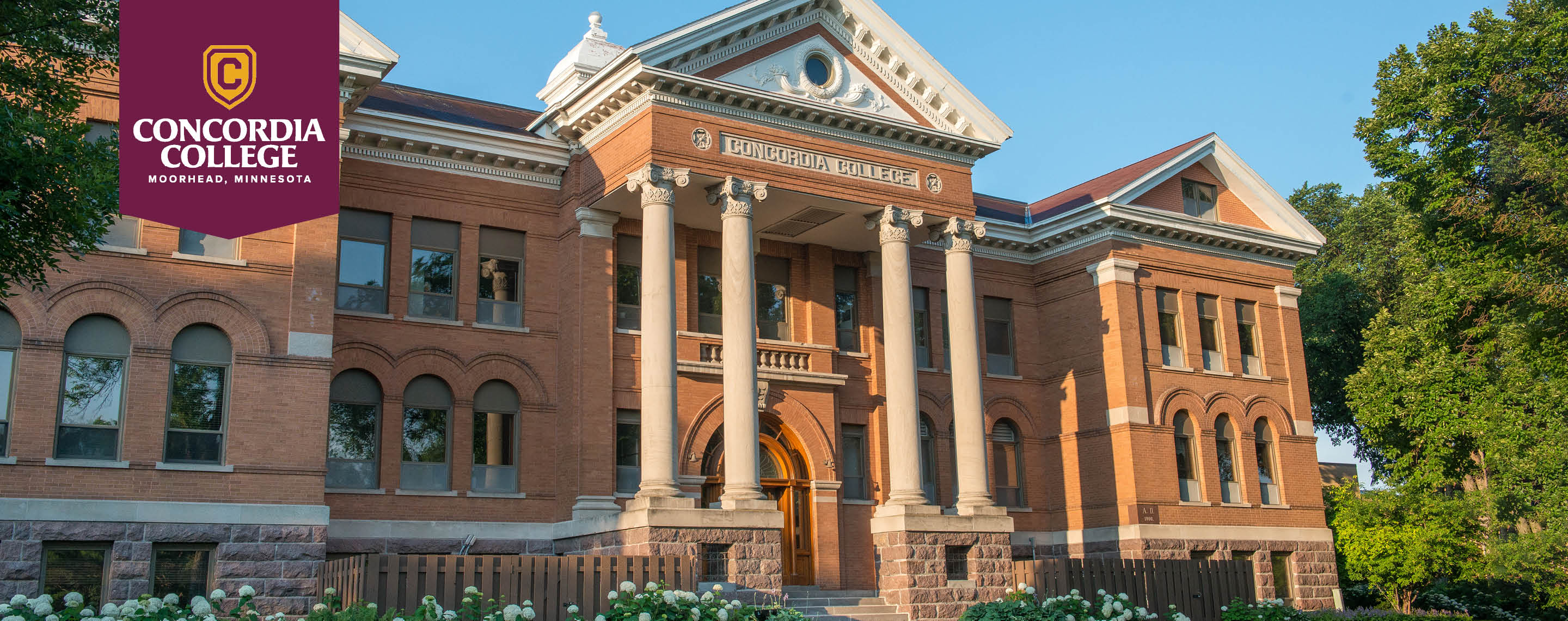
Concordia College at Moorhead seal · sourceCampus Visits and Tours | Concordia College · sourceCampus Visits and Tours | Concordia College · sourceApply to Concordia College at Moorhead · source