Admit rate has ranged 69%–76% over the last 5 years. Source: IPEDS via Urban Institute.
Acceptance & SAT from Common Data Set / IPEDS; net price, earnings & graduation from the U.S. Dept. of Education College Scorecard. Figures lag ~1–2 years — verify with the school.
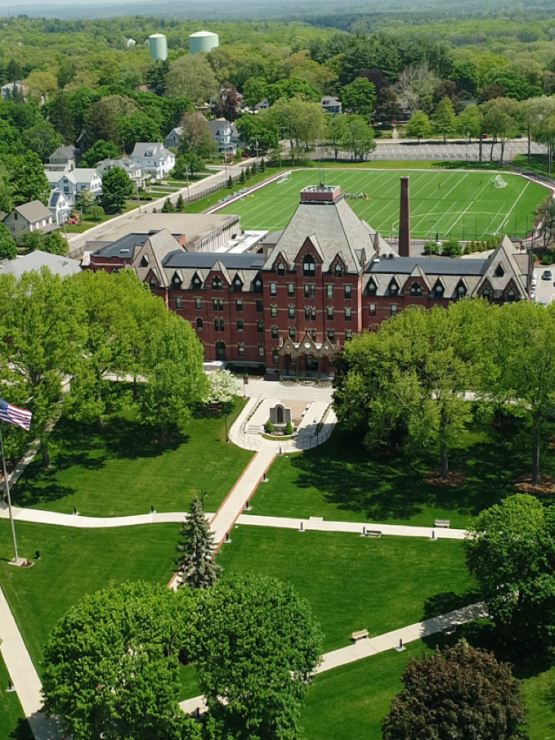
Dean College in Franklin, Massachusetts, is a small, private residential college that operates less as a hyper-selective intellectual pressure cooker and more as a hands-on, supportive launchpad. Its identity is built on a tight-knit, active campus community where nearly every student lives on-site, and a pragmatic academic focus that guarantees an internship and pushes hard for job placement. While its sticker price is high, the college is notably accessible in admissions and leans heavily on scholarships to bring down the net cost for most families.
Admission requirements
Test-blind — scores not considered
Required
High school transcript
Grade point average
College-prep program
TOEFL (non-native English)
Considered (not required)
Letters of recommendation
Source: IPEDS Admissions survey (2022) via Urban Institute. Covers formal factors only — it does not reflect essays, extracurriculars, or other holistic criteria.
More details
Undergrad enrollment
1,089
In-state tuition
$46,526
Out-of-state tuition
$46,526
Graduation Rate
54%
On-Campus Housing
89% of students
Average Class Size
16
Application Deadline
Rolling (Regular deadline Sep 1)
Internship Completion
100% of graduates
Student-Faculty Ratio
17:1
Median Earnings (10yr)
$38,109
Outcomes & value
Outcomes & value
Median earnings (10 yr)
$38,109
Value (earnings ÷ net price)
1.2×
Median debt at graduation
$25,000
Graduation rate
54%
First-year retention
68%
Reducing loan balance (3 yr)
49%
Pell (lower-income) share
34%
First-gen share (among federal-aid recipients)
32%
Financial health
2.4 / 3.0Meets the federal financial-responsibility standard
U.S. Dept. of Education Financial Responsibility Composite Score (FY2022-23). Scale −1.0 to 3.0; ≥1.5 meets the standard. Reported for private nonprofit & for-profit institutions only — public universities are state-backed and not scored, so this is a stability signal, not a ranking.
Top-earning majors
Median earnings by field of study (highest credential), ~2 years after completion.
Business Administration, Management and Operations$41,565
Liberal Arts and Sciences, General Studies and Humanities$26,933
Dance$26,121
Drama/Theatre Arts and Stagecraft$20,140
Source: U.S. Dept. of Education College Scorecard (field-of-study earnings). Figures cover graduates who received federal aid and lag ~2 years; not all programs report data.
On-campus criminal offenses classed as violent (murder/non-negligent manslaughter, rape, robbery, aggravated assault) for the most recent reported year. Source: U.S. Dept. of Education Campus Safety and Security (Clery Act). Counts reflect what’s reported to the school, and urban campuses often report more partly due to non-student incidents nearby — read alongside campus size and setting, not as a standalone safety verdict.
Climate
Pleasant days / yr
91
Summer high
81°F
Winter low
25°F
Annual rain
50.8"
Annual snow
31.6"
Natural-hazard risk
Relatively Moderate
Pleasant days counts days per year with a mean temperature of 55–75°F, a high at or below 90°F, a low at or above 45°F, and little precipitation — a transparent comfort measure, not a weighting we invented. Computed from Open-Meteo ERA5 daily history (2019–2023). Natural-hazard risk is the county’s composite rating from the FEMA National Risk Index.
Deep dive — research, future-scholar output & economic mobility▾
Research output
Institutional h-index
131
Scholarly works
6,114
Institutional research volume and impact from OpenAlex. The h-index reflects large research universities and will be low for teaching-focused liberal-arts colleges — not a measure of undergraduate quality.
Economic mobility
Mobility rate
0.9%
Bottom → top quintile
9%
From bottom quintile
9%
Mobility rate = the share of students who both start in the bottom household-income quintile and reach the top quintile; bottom → top is that chance conditional on starting at the bottom. Source: Opportunity Insights Mobility Report Cards (Chetty, Friedman, Saez, Turner & Yagan). Reflects 1980–82 birth cohorts, so it’s directional, not current.
Quick answers
What is the acceptance rate at Dean College?
Dean College's acceptance rate is approximately 74% (Franklin, MA), based on the most recent figures we compiled from public and primary sources.
How much does Dean College cost?
At Dean College, the average net price (after aid) is about $30,684 per year. Actual cost varies with financial aid and residency.
How many undergraduates attend Dean College?
Dean College enrolls approximately 1,089 undergraduate students.
Where is Dean College located?
Dean College is located in Franklin, MA.
Admissions
Dean College is a notably accessible institution, with an that reflects its mission to provide opportunities for a broad range of students. For the 2024 cycle, the college received 4,617 applications and admitted 3,403, resulting in an acceptance rate of 73.7%. Other sources consistently report a 74% admission rate. The process is rolling, with a regular admission deadline of September 1, and the college offers an Early Action plan. Dean is ; submitted SAT or ACT scores are only considered if they benefit the applicant and are never used negatively in the decision. The middle 50% SAT range for admitted students is between 910 and 1100. The early acceptance rate is significantly higher, reported at 82.8%, indicating a strategic advantage for applicants who apply early.
Earnings = median of students working ~10 years after entry; debt = median of graduates. Value divides 10-yr earnings by one year’s net price — read it as earnings per dollar of annual cost, not a full lifetime ROI; it favors lower-cost schools. Source: U.S. Dept. of Education College Scorecard. Figures lag ~2 years and reflect all students, not your intended major.
Academics at Dean are defined by small classes, direct faculty engagement, and a powerful emphasis on real-world experience. The student-to-faculty ratio is 17:1, with an average class size of 16 students. The college offers bachelor's degree programs across business, communication, the arts, humanities, sciences, and social sciences. Popular majors include Business Administration and Management, General; Dance, General; and Sport and Fitness Administration/Management. Psychology is also a significant program, representing 7% of degrees conferred. A defining feature of the curriculum is the guaranteed internship: 100% of graduates complete one. Programs are organized into tracks within broader disciplines, such as Finance within Business or Global Studies within Liberal Arts and Studies, allowing for focused study within a flexible framework.
Life at Dean is intensely residential and community-oriented, creating a classic, all-in New England college experience on a compact scale. An overwhelming 89% of students live in college-owned, -operated, or -affiliated housing, with only 11% living off campus. The college offers a variety of housing options, including suite-style living, single-sex residence halls, and co-ed halls. This residential density fuels an active, engaging campus culture where involvement is encouraged. Dean has been recognized as a 'College of Distinction' for delivering a transformative undergraduate experience, with a campus culture that empowers students to take ownership of their learning. The college competes in NCAA Division III athletics and is part of the Great Northeast Athletic Conference (GNAC). The overall vibe, as described by the community, is familial, with top-notch facilities and endless opportunities for growth both as a student and an athlete.
Dean College measures its success by the employability and career progression of its graduates, with data pointing to solid returns for many alumni. According to the college, 96% of graduates are employed or pursuing further education. A significant 33% of graduates report earning over $100,000 per year, and 86% felt that their Dean education contributed to their career success. The six-year graduation rate for bachelor's degree seekers is 53%. The median earnings ten years after entry are $38,109. These figures suggest a career-focused education that, for a majority of graduates, leads to stable employment and, for a substantial subset, strong financial outcomes.
Like many private colleges, Dean's stated tuition and costs are high, but the institution uses substantial institutional aid to lower the for most students. The college states its tuition and fees are competitive and that it offers generous scholarships and grants. A typical financial aid offer for a resident student includes $38,707 in scholarships and grants and $5,500 in federal student loans, totaling $44,207 in aid. According to external sources, 73.98% of students receive financial aid, with an average aid package of $38,803. The average net price after aid—the cost a typical student actually pays—is $31,472. Dean's own financial aid policies indicate that private loan funds may be retained to satisfy an outstanding balance owed to the college. The college meets the financial need of some students through a combination of grants, scholarships, and loans, but it is not among the small group of institutions with a universal 'no-loan' policy for all qualifying students.
Dean College carves out a distinct niche by unapologetically focusing on the transitional, hands-on, and communal aspects of the undergraduate experience. It's not trying to be a miniature Ivy; it's a place built for students who thrive with structure, support, and direct pathways to a career. Several elements combine to create this singular profile:
The 100% Internship Guarantee: This isn't an optional perk; it's a graduation requirement woven into the fabric of the education. It signals a profound institutional commitment to applied learning and professional readiness that few colleges match so explicitly.
The Overwhelmingly Residential Model: With nearly 9 out of 10 students living on campus, Dean fosters an immersive, 24/7 community. This creates a tight-knit, almost familial environment where the line between classroom and campus life blurs, fostering strong peer networks and a deep sense of belonging.
Accessible Admissions with an Early Advantage: Its high and policy lower barriers to entry, making a private college education a tangible possibility for many. The dramatically higher early acceptance rate (82.8% vs. 74% overall) provides a clear strategic roadmap for motivated applicants.
Outcomes-Oriented Culture: The college prominently touts its 96% employment/graduate school rate and the fact that a third of its alumni earn over $100,000. This data-driven focus on postgraduate success informs everything from curriculum design to student support, appealing to families with a pragmatic view of the return on a college investment.
In essence, Dean stands out as a college that knows exactly what it is: a supportive, engaging, and career-focused launchpad where the typical student is actively involved, lives on campus, completes an internship, and graduates ready for the job market.
Dean College seal · sourceVisitor Information | Dean College | Franklin Massachusetts | Dean College · sourceVisit Our Franklin Massachusetts Campus | Dean College · sourceDean College | Private College in Franklin Massachusetts · source