Admit rate has ranged 59%–92% over the last 5 years — notably volatile, though the latest figure above (58%) falls outside that window. Source: IPEDS via Urban Institute.
Acceptance & SAT from Common Data Set / IPEDS; net price, earnings & graduation from the U.S. Dept. of Education College Scorecard. Figures lag ~1–2 years — verify with the school.
East Texas Baptist University is a small, private Christian university in Marshall, Texas, where faith and learning are explicitly integrated into a tight-knit, residential campus culture. It operates as a practical, career-focused institution with a strong emphasis on nursing and business, attracting students who seek a supportive, values-based environment. The experience is defined by its 19:1 student-faculty ratio, a campus where 80% of students live on the 'Hill,' and a straightforward admissions process for those who meet its academic benchmarks.
Admission requirements
Test-blind — scores not considered
Required
High school transcript
Grade point average
TOEFL (non-native English)
Source: IPEDS Admissions survey (2022) via Urban Institute. Covers formal factors only — it does not reflect essays, extracurriculars, or other holistic criteria.
More details
Undergrad enrollment
1,352
In-state tuition
$30,680
Out-of-state tuition
$30,680
Graduation Rate
47%
On-Campus Housing
80% of students
Average Class Size
20
Most Popular Major
Registered Nursing
Student-Faculty Ratio
19:1
Median Earnings (10yr)
$52,788
First-Year Retention Rate
71%
Outcomes & value
Outcomes & value
Median earnings (10 yr)
$52,788
Value (earnings ÷ net price)
2.2×
Median debt at graduation
$23,250
Graduation rate
47%
First-year retention
71%
Reducing loan balance (3 yr)
55%
Pell (lower-income) share
32%
First-gen share (among federal-aid recipients)
32%
Financial health
1.7 / 3.0Meets the federal financial-responsibility standard
U.S. Dept. of Education Financial Responsibility Composite Score (FY2022-23). Scale −1.0 to 3.0; ≥1.5 meets the standard. Reported for private nonprofit & for-profit institutions only — public universities are state-backed and not scored, so this is a stability signal, not a ranking.
Top-earning majors
Median earnings by field of study (highest credential), ~2 years after completion.
Registered Nursing, Nursing Administration, Nursing Research and Clinical Nursing$63,005
Teacher Education and Professional Development, Specific Subject Areas$44,356
Teacher Education and Professional Development, Specific Levels and Methods$35,060
Business/Commerce, General$35,060
Multi/Interdisciplinary Studies, Other$30,771
Campus & location
Campus safety
On-campus violent crimes (2024)
0
Per 1,000 students
0.00
On-campus criminal offenses classed as violent (murder/non-negligent manslaughter, rape, robbery, aggravated assault) for the most recent reported year. Source: U.S. Dept. of Education Campus Safety and Security (Clery Act). Counts reflect what’s reported to the school, and urban campuses often report more partly due to non-student incidents nearby — read alongside campus size and setting, not as a standalone safety verdict.
Climate
Pleasant days / yr
93
Summer high
93°F
Winter low
41°F
Annual rain
53.5"
Annual snow
2.7"
Natural-hazard risk
Relatively Low
Pleasant days counts days per year with a mean temperature of 55–75°F, a high at or below 90°F, a low at or above 45°F, and little precipitation — a transparent comfort measure, not a weighting we invented. Computed from Open-Meteo ERA5 daily history (2019–2023). Natural-hazard risk is the county’s composite rating from the FEMA National Risk Index.
Deep dive — research, future-scholar output & economic mobility▾
Research output
Institutional h-index
18
Scholarly works
153
Institutional research volume and impact from OpenAlex. The h-index reflects large research universities and will be low for teaching-focused liberal-arts colleges — not a measure of undergraduate quality.
Economic mobility
Mobility rate
1.5%
Bottom → top quintile
14%
From bottom quintile
11%
Mobility rate = the share of students who both start in the bottom household-income quintile and reach the top quintile; bottom → top is that chance conditional on starting at the bottom. Source: Opportunity Insights Mobility Report Cards (Chetty, Friedman, Saez, Turner & Yagan). Reflects 1980–82 birth cohorts, so it’s directional, not current.
Quick answers
What is the acceptance rate at East Texas Baptist University?
East Texas Baptist University's acceptance rate is approximately 58% (Marshall, TX), based on the most recent figures we compiled from public and primary sources.
How much does East Texas Baptist University cost?
At East Texas Baptist University, the average net price (after aid) is about $23,911 per year. Actual cost varies with financial aid and residency.
How many undergraduates attend East Texas Baptist University?
East Texas Baptist University enrolls approximately 1,352 undergraduate students.
Where is East Texas Baptist University located?
East Texas Baptist University is located in Marshall, TX.
Admissions
ETBU's admissions process is selective but accessible, designed to identify students prepared for its academic and faith-based community. The university admits just over half of its applicants, with an of 58%. For the Spring 2026 semester, total enrollment reached a record 1,709 students, reflecting a 6% increase over the previous year. The middle 50% of admitted students who submit test scores present SAT scores between 930 and 1150, or ACT scores between 18 and 24. The university provides clear minimum thresholds for automatic admission consideration: an ACT score of 18 or above, or an SAT score of 970 or above (excluding the Writing section). While a high school GPA is a factor, with some sources citing an average of 3.53 for admitted students, the published minimum requirement is a 2.75. The process appears to be largely focused on academic preparedness, with no available source snippets indicating the use of Early Decision plans or the consideration of demonstrated interest as a formal factor.
Earnings = median of students working ~10 years after entry; debt = median of graduates. Value divides 10-yr earnings by one year’s net price — read it as earnings per dollar of annual cost, not a full lifetime ROI; it favors lower-cost schools. Source: U.S. Dept. of Education College Scorecard. Figures lag ~2 years and reflect all students, not your intended major.
Criminal Justice and Corrections
$30,409
Source: U.S. Dept. of Education College Scorecard (field-of-study earnings). Figures cover graduates who received federal aid and lag ~2 years; not all programs report data.
Academics at ETBU are delivered through a Christian worldview, emphasizing personalized instruction in a small-class setting. The student-to-faculty ratio is 19:1, with an average class size of 20. The curriculum is career-oriented, with nursing dominating as the most popular major. For the 2024 graduating class, 13% of degrees were in Registered Nursing, followed by Multi-/Interdisciplinary Studies (11%) and General Business/Commerce (9%). The university offers a range of undergraduate programs, including majors in Healthcare Administration, Health Science, History, and Humanities. The institutional focus is squarely on integrating faith with learning to develop 'mind, body, and soul,' positioning the academic experience as one component of holistic, character-focused education.
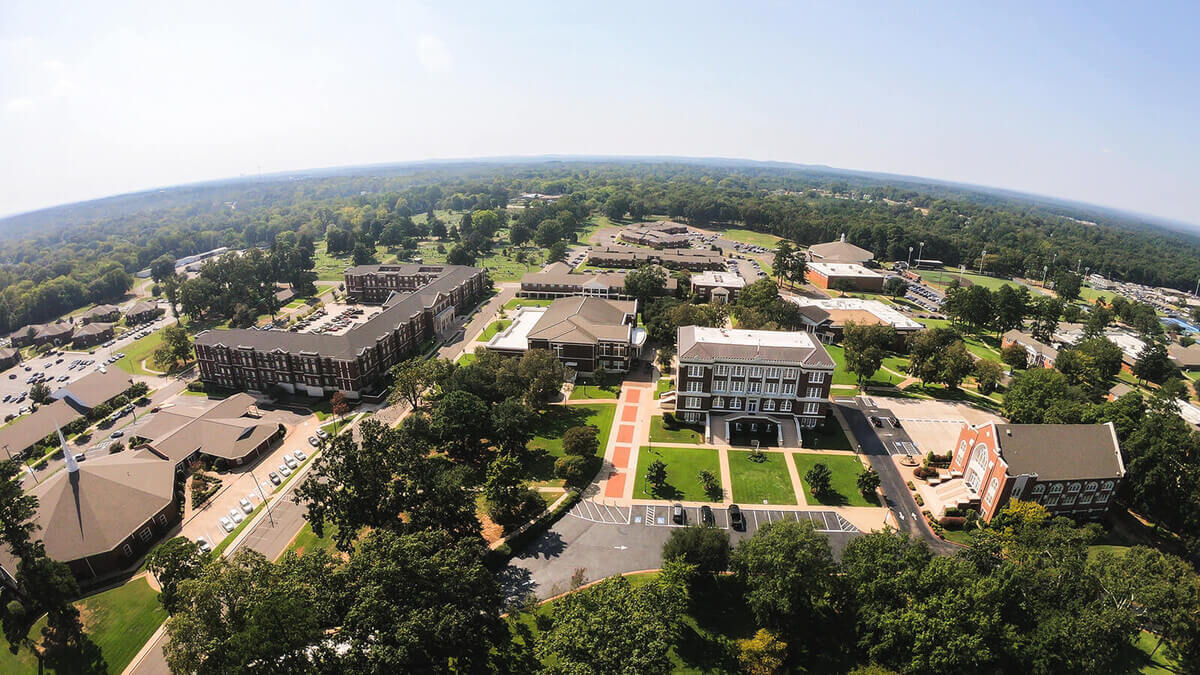
Life at ETBU is intensely communal and residential, creating the self-contained environment often described as 'Life on the Hill.' A full 80% of students live in college-owned, -operated, or -affiliated housing, making campus the central hub for social and spiritual activity. The Student Life Office and Student Foundation sponsor a calendar of events and activities designed to foster engagement. The stated goal of the student experience is the 'integration of faith and learning to develop mind, body, and soul through community engagement.' Students are encouraged to get involved in campus programs to enhance their personal, social, and spiritual lives. This creates a specific vibe: a protected, faith-centered community where students' lives are largely oriented around campus-sponsored activities and peer relationships within the university's residential framework.
Outcomes data paints a picture of a university where persistence and postgraduate earnings are areas of focus. The most recent six-year graduation rate for first-time, full-time freshmen is reported by the university as 45%. Other sources cite a four-year graduation rate of 46% and a six-year rate of 50%. The first-year retention rate is 71%. In terms of earnings, graduates see a notable salary progression. Early career earnings (one year after graduation) average around $37,108, which grows to approximately $51,883 after five years. One critical analysis notes that early career earnings are about $6,000 worse than might be expected compared to national benchmarks, suggesting the value of the degree accrues more steadily over time rather than providing an immediate high-income launch.
ETBU is a private university with a published total of $47,076, which includes tuition and fees of $31,760 and room and board of $11,622. However, the vast majority of students do not pay this sticker price due to widespread financial aid. Notably, 100% of full-time beginning undergraduates receive grant or scholarship aid. The average aid package is substantial, leading to a significantly reduced . One source places the average net price after scholarships and grants at $24,388, with 74.29% of students receiving financial aid. The university offers a variety of aid, including merit scholarships, academic awards, , and departmental scholarships, with early application encouraged for scholarship consideration. Need-based aid includes programs like the Texas Tuition Equalization Grant. The financial aid office emphasizes its commitment to helping students secure assistance, and loans are also available, with students not required to demonstrate financial need for certain types like the CAL (likely referring to federal loans), though cost of attendance is considered in determining limits.
East Texas Baptist University stands out for its uncompromising commitment to being a small, residential, faith-saturated community. It is not a school with sprawling graduate programs or cutthroat academic competition; it is a purposeful environment for students seeking a specific type of formation. Its identity is built on three clear pillars: a Christian worldview integrated into all learning, a highly residential campus culture (80% live on campus), and practical, high-demand majors like nursing and business. The 19:1 student-faculty ratio and average class size of 20 ensure a level of personal attention that is the hallmark of its academic promise. It’s a place for students who want their college experience to be a cohesive whole—where spiritual life, community living, and career preparation are not separate tracks but are intentionally woven together. The record Spring 2026 enrollment suggests this model continues to resonate with a specific segment of students looking for a supportive, values-aligned path to a degree.
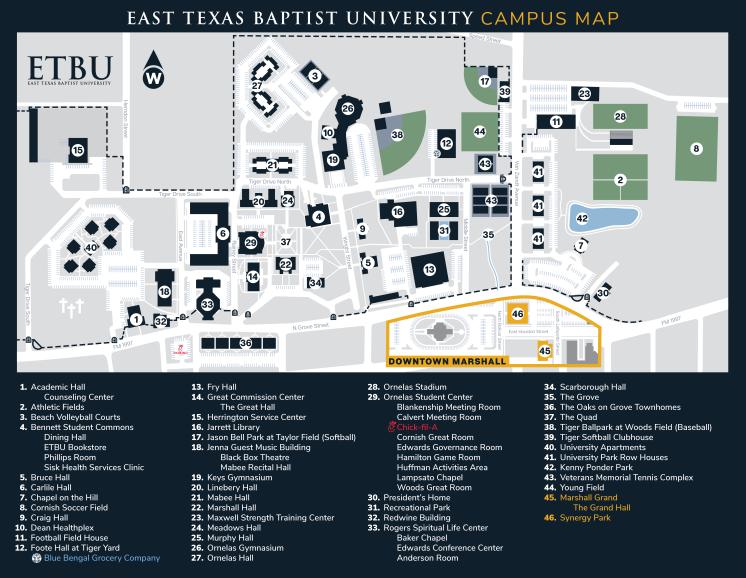
East Texas Baptist University seal · sourceCampus Map | East Texas Baptist University · sourceEast Texas Baptist University — Admissions, Tuition & Acceptance Rate | Appily · sourceUndergraduates | East Texas Baptist University · source