Admit rate has ranged 66%–76% over the last 5 years — notably volatile. Source: IPEDS via Urban Institute.
Acceptance & SAT from Common Data Set / IPEDS; net price, earnings & graduation from the U.S. Dept. of Education College Scorecard. Figures lag ~1–2 years — verify with the school.
Elmhurst University is a small, private liberal arts school in a quiet Chicago suburb that has carved out a distinctive niche by blending a traditional liberal arts core with robust, career-oriented programs in business, nursing, and health professions. It's a place where students can study jazz or criminal justice, join over 100 clubs, and still be a short train ride from the internships and energy of downtown Chicago. With an accessible admissions process and a focus on practical outcomes, Elmhurst offers a grounded, community-focused alternative to both large research universities and more insular liberal arts colleges.
Admission requirements
Test-optional — scores considered if submitted
Required
High school transcript
Grade point average
TOEFL (non-native English)
Considered (not required)
Letters of recommendation
Test scores (SAT/ACT)
Source: IPEDS Admissions survey (2022) via Urban Institute. Covers formal factors only — it does not reflect essays, extracurriculars, or other holistic criteria.
More details
Undergrad enrollment
3,006
In-state tuition
$42,955
Out-of-state tuition
$42,955
Graduation Rate
70%
Number of Majors
70+
On-Campus Housing
28% of students
Most Popular Majors
Business (22%), Health Professions (20%)
Clubs & Organizations
100+
Early Action Deadline
November 15 (Non-binding)
Median Earnings (10yr)
$61,462
Students Receiving Aid
100% of full-time beginners
First-Year Retention Rate
Outcomes & value
Outcomes & value
Median earnings (10 yr)
$61,462
Value (earnings ÷ net price)
2.5×
Median debt at graduation
$20,489
Graduation rate
70%
First-year retention
80%
Reducing loan balance (3 yr)
71%
Pell (lower-income) share
37%
First-gen share (among federal-aid recipients)
35%
Financial health
3.0 / 3.0Meets the federal financial-responsibility standard
U.S. Dept. of Education Financial Responsibility Composite Score (FY2022-23). Scale −1.0 to 3.0; ≥1.5 meets the standard. Reported for private nonprofit & for-profit institutions only — public universities are state-backed and not scored, so this is a stability signal, not a ranking.
Top-earning majors
Median earnings by field of study (highest credential), ~2 years after completion.
Registered Nursing, Nursing Administration, Nursing Research and Clinical Nursing$63,832
Accounting and Related Services$55,964
Finance and Financial Management Services$54,209
Marketing$51,690
Economics$48,823
Business Administration, Management and Operations
Campus & location
Campus safety
On-campus violent crimes (2024)
4
Per 1,000 students
1.06
On-campus criminal offenses classed as violent (murder/non-negligent manslaughter, rape, robbery, aggravated assault) for the most recent reported year. Source: U.S. Dept. of Education Campus Safety and Security (Clery Act). Counts reflect what’s reported to the school, and urban campuses often report more partly due to non-student incidents nearby — read alongside campus size and setting, not as a standalone safety verdict.
Climate
Pleasant days / yr
85
Summer high
81°F
Winter low
21°F
Annual rain
47.7"
Annual snow
31.5"
Natural-hazard risk
Relatively High
Pleasant days counts days per year with a mean temperature of 55–75°F, a high at or below 90°F, a low at or above 45°F, and little precipitation — a transparent comfort measure, not a weighting we invented. Computed from Open-Meteo ERA5 daily history (2019–2023). Natural-hazard risk is the county’s composite rating from the FEMA National Risk Index.
Quick answers
What is the acceptance rate at Elmhurst University?
Elmhurst University's acceptance rate is approximately 74% (Elmhurst, IL), based on the most recent figures we compiled from public and primary sources.
What SAT score do you need for Elmhurst University?
Admitted students at Elmhurst University typically score 990–1260 on the SAT (the middle-50% range). Scores outside this band are still admitted, especially with strong applications.
How much does Elmhurst University cost?
At Elmhurst University, the average net price (after aid) is about $24,185 per year. Actual cost varies with financial aid and residency.
How many undergraduates attend Elmhurst University?
Elmhurst University enrolls approximately 3,006 undergraduate students.
Where is Elmhurst University located?
Elmhurst University is located in Elmhurst, IL.
Admissions
Elmhurst University operates with an accessible, moderately selective admissions process. The university is , meaning applicants are not required to submit ACT or SAT scores to be considered for admission. For those who do submit, the middle 50% SAT range for admitted students is 990–1260, and the ACT range is 23–30. The university offers a non-restrictive, non-binding Early Action deadline of November 15 for first-year students, with decisions released by early December. The admissions landscape is characterized by high , with sources consistently reporting figures around 73-76% for recent cycles. This approach aligns with the university's mission to provide broad access to its programs.
Earnings = median of students working ~10 years after entry; debt = median of graduates. Value divides 10-yr earnings by one year’s net price — read it as earnings per dollar of annual cost, not a full lifetime ROI; it favors lower-cost schools. Source: U.S. Dept. of Education College Scorecard. Figures lag ~2 years and reflect all students, not your intended major.
$45,383
Public Relations, Advertising, and Applied Communication$42,682
Teacher Education and Professional Development, Specific Levels and Methods$42,276
Source: U.S. Dept. of Education College Scorecard (field-of-study earnings). Figures cover graduates who received federal aid and lag ~2 years; not all programs report data.
Elmhurst provides what one guide calls "a robust learning experience" across a curriculum that strategically bridges the liberal arts and professional preparation. Undergraduates choose from more than 70 majors, supported by 15 pre-professional programs and 44 study abroad opportunities. The academic profile is decidedly pragmatic: the most popular majors for recent graduates are heavily concentrated in business, management, and marketing (22%) and health professions and related programs (20%). This creates a campus culture where discussions in philosophy seminars might be followed by clinical rotations or business simulations. The university also offers 17 graduate degree programs, indicating a commitment to serving students beyond the traditional undergraduate experience. The breadth of options—from accounting and criminal justice to theatre and jazz studies—allows students to craft an education that is both personally meaningful and professionally relevant.
Life at Elmhurst is defined by its tight-knit, suburban campus community and its proximity to Chicago. With about 2,600 undergraduates, the scale is intimate. Students describe a campus that is "always lively," offering both social spots to hang out with friends and quiet nooks for studying. Getting involved is a central theme, with more than 100 student clubs and organizations available. The residential experience is mixed; only 28% of students live in college-owned, -operated, or -affiliated housing, while the majority (72%) live off campus. This likely contributes to a more commuter-influenced vibe, though the university promotes a "welcoming, inclusive community" with endless ways to engage. The location in Elmhurst, Illinois, provides the safety and familiarity of a small town while placing students just a quick train ride from the internships, culture, and vast career networks of downtown Chicago—a significant perk that shapes the student experience.
Elmhurst University focuses on delivering strong, tangible returns on a student's investment. The graduation rate is a solid 70%, notably above the national midpoint for four-year colleges (59%). This suggests the university effectively supports students through to completion. Post-graduate earnings data shows promising growth: while earnings one year after graduation are reported around $46,060, that figure jumps significantly to approximately $64,263 five years out. The median salary six years after graduation is reported as $52,803. These figures indicate that Elmhurst graduates gain a foothold in the workforce quickly and experience substantial salary progression as they advance in their careers, particularly in its strong sectors like business and health care. The average debt at graduation is reported as $31,590, which, when considered alongside the earnings trajectory, points to a manageable financial outcome for most graduates.
Elmhurst University is a private institution with a corresponding tuition, but it actively uses financial aid to improve accessibility. The university states it offers aid based on demonstrated financial need, utilizing federal, state, and institutional resources. A key statistic is that 100% of full-time beginning undergraduates receive grant or scholarship aid. The average aid package is reported to be $41,166. After accounting for this aid, the average —the actual cost students pay—is $24,185. The university provides a Net Price Calculator to help families estimate their individual costs. While the university offers aid based on need, the available sources do not indicate the presence of a "no-loan" policy, where loans are replaced entirely by grants for qualifying students. Financial aid packages are likely to be a mix of grants, scholarships, loans, and work-study opportunities.
Elmhurst University stands out for its purposeful hybrid identity. It refuses to be pigeonholed as either a purely liberal arts college or a vocational school, instead successfully merging the two. Students get the close-knit community, faculty attention, and intellectual exploration of a small liberal arts college, paired with the direct career pathways and professional focus more common at larger universities. Its location is another masterstroke: it offers the safe, manageable environment of a suburban campus while being seamlessly connected to the immense professional and cultural opportunities of Chicago. This combination is particularly powerful for students in fields like business, nursing, and the arts, where classroom theory can be immediately tested and enriched through city-based internships and networking. Ultimately, Elmhurst represents a pragmatic and effective model for higher education—one that is deeply connected to the world its graduates will enter, without sacrificing the formative value of a broad-based education.
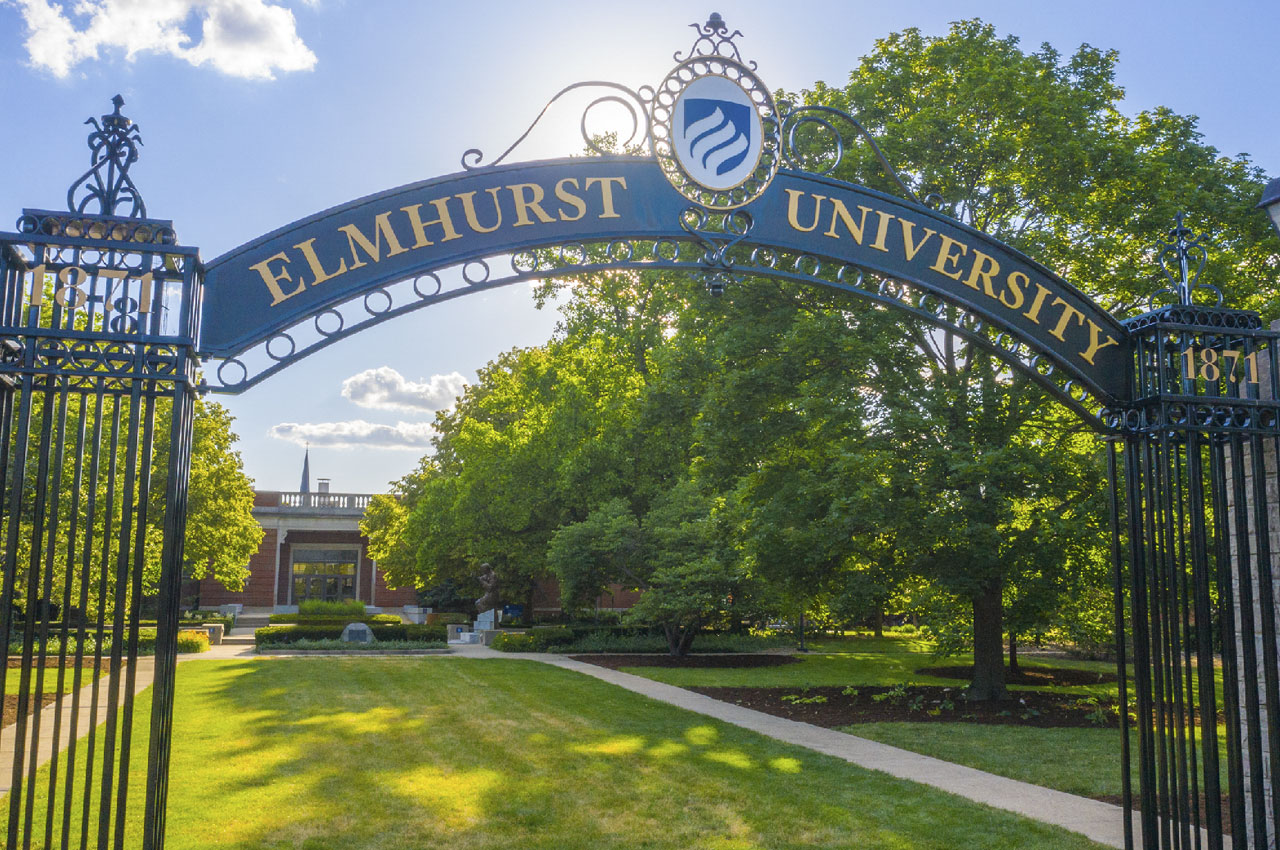
Elmhurst University seal · sourceElmhurst University - Top Liberal Arts University Near Chicago · sourceElmhurst College Wins Tree Campus USA® Recognition | Elmhurst University · sourceAbout Elmhurst University | Elmhurst University · source