Admit rate has ranged 64%–97% over the last 5 years — notably volatile. Source: IPEDS via Urban Institute.
Acceptance & SAT from Common Data Set / IPEDS; net price, earnings & graduation from the U.S. Dept. of Education College Scorecard. Figures lag ~1–2 years — verify with the school.
Evangel University is a private Christian liberal arts university in Springfield, Missouri, where faith isn't just a footnote—it's the framework. With a campus culture described as 'wholesome' and centered on spiritual growth, it offers over 70 degree programs and a residential experience for the majority of its students. The school is riding a wave of momentum, having set an all-time enrollment record for the fifth consecutive year, and is recognized for its role in social mobility, helping a significant portion of its student body climb the economic ladder.
Admission requirements
Test-blind — scores not considered
Required
High school transcript
Grade point average
TOEFL (non-native English)
Considered (not required)
Class rank
Source: IPEDS Admissions survey (2022) via Urban Institute. Covers formal factors only — it does not reflect essays, extracurriculars, or other holistic criteria.
More details
Undergrad enrollment
1,229
In-state tuition
$28,548
Out-of-state tuition
$28,548
Graduation Rate
65%
On-Campus Housing
77%
First-Year Retention
76%
Early Decision Offered
No
Median Earnings (10yr)
$46,573
Outcomes & value
Outcomes & value
Median earnings (10 yr)
$46,573
Value (earnings ÷ net price)
2.5×
Median debt at graduation
$24,736
Graduation rate
65%
First-year retention
76%
Reducing loan balance (3 yr)
65%
Pell (lower-income) share
31%
First-gen share (among federal-aid recipients)
26%
Financial health
0.7 / 3.0Below the federal standard — financial stress
U.S. Dept. of Education Financial Responsibility Composite Score (FY2022-23). Scale −1.0 to 3.0; ≥1.5 meets the standard. Reported for private nonprofit & for-profit institutions only — public universities are state-backed and not scored, so this is a stability signal, not a ranking.
Top-earning majors
Median earnings by field of study (highest credential), ~2 years after completion.
Registered Nursing, Nursing Administration, Nursing Research and Clinical Nursing$60,771
Business Administration, Management and Operations$36,156
Marketing$33,993
Missions/Missionary Studies and Missiology$33,459
Teacher Education and Professional Development, Specific Levels and Methods$33,410
Teacher Education and Professional Development, Specific Subject Areas
Campus & location
Campus safety
On-campus violent crimes (2024)
0
Per 1,000 students
0.00
On-campus criminal offenses classed as violent (murder/non-negligent manslaughter, rape, robbery, aggravated assault) for the most recent reported year. Source: U.S. Dept. of Education Campus Safety and Security (Clery Act). Counts reflect what’s reported to the school, and urban campuses often report more partly due to non-student incidents nearby — read alongside campus size and setting, not as a standalone safety verdict.
Climate
Pleasant days / yr
84
Summer high
87°F
Winter low
29°F
Annual rain
48.8"
Annual snow
12.2"
Natural-hazard risk
Relatively Moderate
Pleasant days counts days per year with a mean temperature of 55–75°F, a high at or below 90°F, a low at or above 45°F, and little precipitation — a transparent comfort measure, not a weighting we invented. Computed from Open-Meteo ERA5 daily history (2019–2023). Natural-hazard risk is the county’s composite rating from the FEMA National Risk Index.
Deep dive — research, future-scholar output & economic mobility▾
Research output
Institutional h-index
32
Scholarly works
646
Institutional research volume and impact from OpenAlex. The h-index reflects large research universities and will be low for teaching-focused liberal-arts colleges — not a measure of undergraduate quality.
Economic mobility
Mobility rate
1.0%
Bottom → top quintile
14%
From bottom quintile
7%
Mobility rate = the share of students who both start in the bottom household-income quintile and reach the top quintile; bottom → top is that chance conditional on starting at the bottom. Source: Opportunity Insights Mobility Report Cards (Chetty, Friedman, Saez, Turner & Yagan). Reflects 1980–82 birth cohorts, so it’s directional, not current.
Quick answers
What is the acceptance rate at Evangel University?
Evangel University's acceptance rate is approximately 72% (Springfield, MO), based on the most recent figures we compiled from public and primary sources.
What SAT score do you need for Evangel University?
Admitted students at Evangel University typically score 1040–1260 on the SAT (the middle-50% range). Scores outside this band are still admitted, especially with strong applications.
How much does Evangel University cost?
At Evangel University, the average net price (after aid) is about $18,669 per year. Actual cost varies with financial aid and residency.
How many undergraduates attend Evangel University?
Evangel University enrolls approximately 1,229 undergraduate students.
Where is Evangel University located?
Evangel University is located in Springfield, MO.
Admissions
Evangel's admissions process is notably accessible, with a rolling deadline and a policy for applicants with a high school GPA of 2.5 or higher. The university received 1,194 undergraduate applications in 2024. While sources vary on the exact —reporting figures from 52% to 74%—the canonical figure to use is 72%. The middle 50% SAT range for admitted students is 1040–1260, and the ACT range is 21–27. Students with a 3.5 GPA or higher are exempt from placement exams. Evangel does not offer an Early Decision program, and there is no indication from the provided sources that demonstrated interest is a considered factor in admissions decisions.
Earnings = median of students working ~10 years after entry; debt = median of graduates. Value divides 10-yr earnings by one year’s net price — read it as earnings per dollar of annual cost, not a full lifetime ROI; it favors lower-cost schools. Source: U.S. Dept. of Education College Scorecard. Figures lag ~2 years and reflect all students, not your intended major.
$31,988
Music$30,409
Radio, Television, and Digital Communication$29,141
Source: U.S. Dept. of Education College Scorecard (field-of-study earnings). Figures cover graduates who received federal aid and lag ~2 years; not all programs report data.
Evangel offers more than 70 undergraduate degree programs, with a curriculum designed to blend 'relevant training' and 'hands-on experience' within a Christian worldview. The most popular majors reflect its practical and service-oriented ethos: Elementary Education and Teaching leads the pack, followed by Business Administration and Management, General Psychology, and Music. The university has been recognized as a 'College of Distinction' for excellence in undergraduate education, highlighting factors like student engagement and outcomes-based learning. Programs like biochemistry are explicitly designed to prepare students for medical school or graduate studies. The academic environment is defined by its Christian identity; a public discussion among alumni questions whether the school has become 'more progressive and liberal,' suggesting a campus actively wrestling with its theological and cultural boundaries.
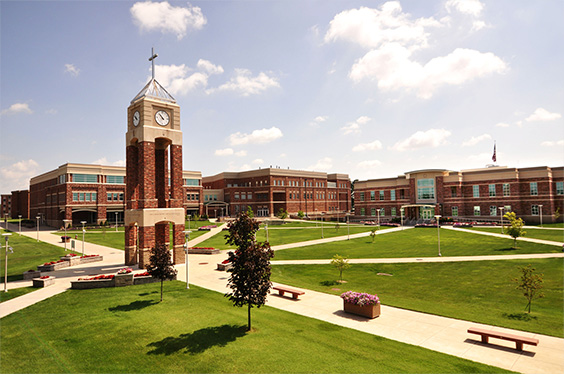
Life at Evangel is intensely communal and purpose-driven, described by students as 'wholesome and centered around community and spiritual growth rather than partying.' The campus enforces a strict code of conduct. It is primarily a residential campus for traditional-aged undergraduates, with 77% of students living in college-owned, -operated, or -affiliated housing. The vibe is 'vibrant,' fueled by dozens of clubs, chapel services, dorm devotionals, and sports teams. Service is a cornerstone of the experience; the Global Cultures and Compassion program provides every student with opportunities to minister and serve in 'culturally relevant ways,' both on and off campus. This creates a tightly-knit environment where social life orbits around shared faith and mission rather than traditional college nightlife.
Evangel's outcomes tell a story of resilience and upward mobility. Its six-year graduation rate is reported at 62%, and it has been ranked a 'Top Performer in Social Mobility' by U.S. News & World Report for three consecutive years—a designation that highlights its success in graduating students from lower-income backgrounds (Pell Grant recipients) and propelling them into the middle class. The university's first-year retention rate is 76%. The median earnings for graduates ten years after entry is $46,573. These metrics suggest Evangel is effective at supporting its students through to completion and launching them into sustainable careers, a key part of its mission-driven identity.
The published tuition and fees for Evangel University are $45,538. However, the university emphasizes that most students do not pay the full sticker price, encouraging them to use its Calculator to estimate academic scholarships and other financial aid. The average net price after aid—the canonical figure—is $18,669. Financial aid packages are comprised of scholarships, grants, and loans, with eligibility determined by the Student Aid Index (SAI). The university's promotional materials direct students to federal loan resources and outline eligibility requirements, but there is no indication in the provided sources of a 'no-loan' policy or a guarantee to meet 100% of demonstrated financial need without loans.
Evangel stands out as an institution fully committed to its identity. It is not a school with a Christian affiliation; it is a Christian school, where spiritual formation is integrated into dorm life, service projects, and classroom discussions. This creates a unique, all-encompassing culture that is a perfect fit for some and a non-starter for others. Its recent recognition as a 'Top Performer in Social Mobility' is a significant point of pride, demonstrating that its mission extends beyond the campus gates to effect tangible economic change in the lives of its graduates. Furthermore, its consistent enrollment growth—hitting a record 2,741 students in Fall 2025—signals a university that is confident in its niche and successfully attracting students who want this specific blend of faith, community, and career preparation.
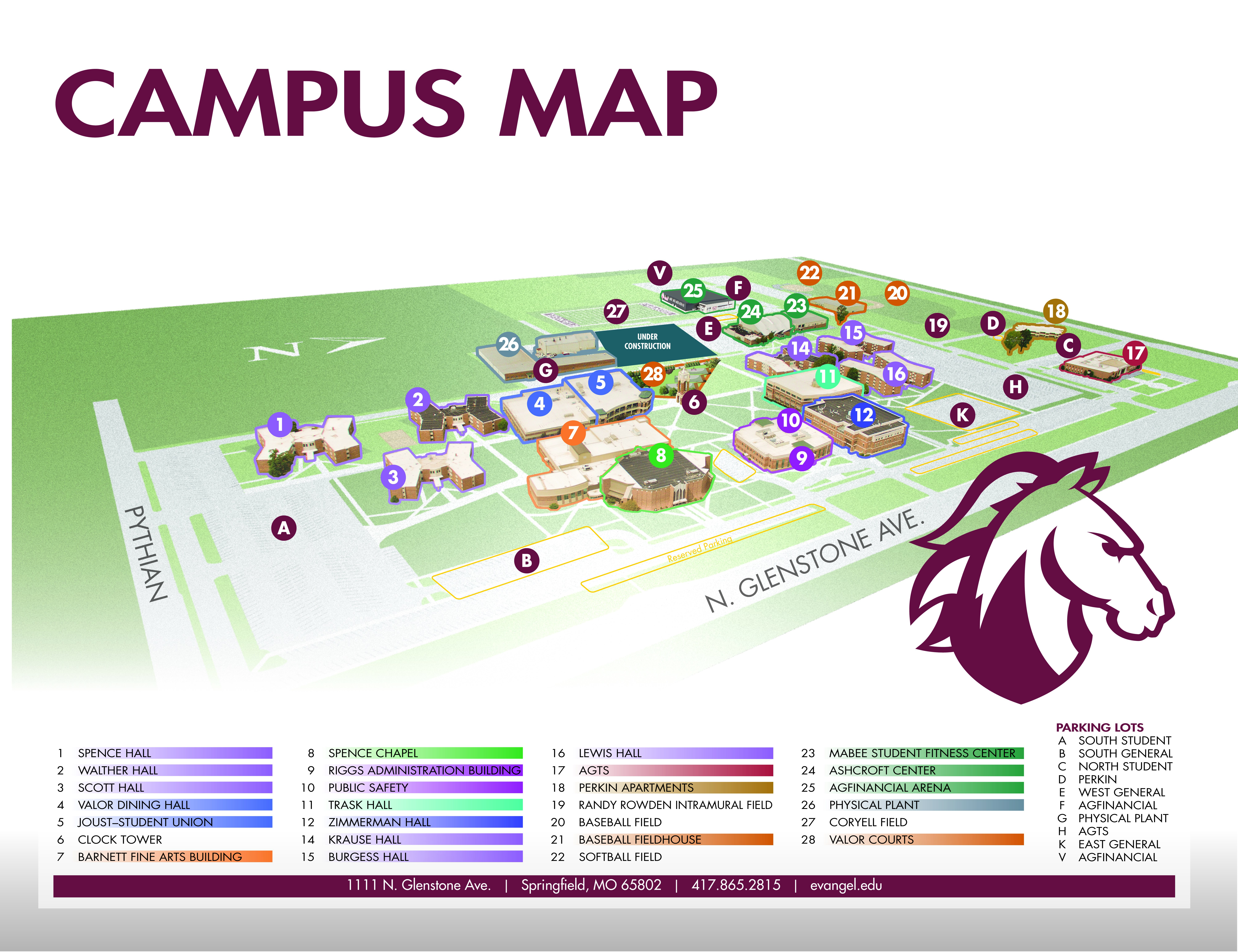
Evangel University seal · sourceEvangel University: A Private Christian University in Missouri · sourceCampus Map and Parking - Evangel University · sourceEvangel University: A Private Christian University in Missouri · source