Admit rate has ranged 69%–78% over the last 5 years — notably volatile. Source: IPEDS via Urban Institute.
Acceptance & SAT from Common Data Set / IPEDS; net price, earnings & graduation from the U.S. Dept. of Education College Scorecard. Figures lag ~1–2 years — verify with the school.
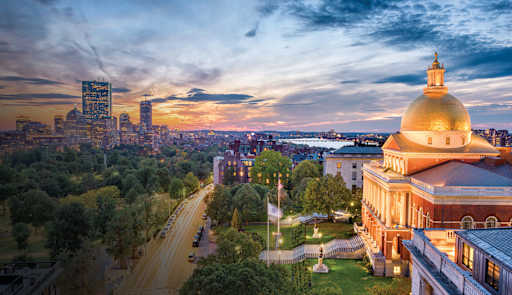
Fisher College is a small, urban private college in Boston that operates less as a traditional four-year residential enclave and more as a practical, career-focused launchpad for a predominantly local and commuter student body. Its academic identity is sharply defined by business, health sciences, and human services, delivered with a student-faculty ratio of 14:1 and a pronounced emphasis on flexibility. The vibe is unpretentious and street-smart, leveraging its Back Bay location as an extended campus, though its 28% graduation rate signals significant challenges with student persistence.
Admission requirements
Test-blind — scores not considered
Required
High school transcript
Grade point average
TOEFL (non-native English)
Source: IPEDS Admissions survey (2022) via Urban Institute. Covers formal factors only — it does not reflect essays, extracurriculars, or other holistic criteria.
More details
Undergrad enrollment
1,167
In-state tuition
$35,689
Out-of-state tuition
$35,689
Location
Boston, MA (Back Bay)
Popular Majors
Business Admin, Human Services, Health Sciences
Graduation Rate
28%
Student-Faculty Ratio
14:1
Median Earnings (10yr)
$49,669
Outcomes & value
Outcomes & value
Median earnings (10 yr)
$49,669
Value (earnings ÷ net price)
1.9×
Median debt at graduation
$25,000
Graduation rate
28%
First-year retention
55%
Reducing loan balance (3 yr)
44%
Pell (lower-income) share
40%
First-gen share (among federal-aid recipients)
47%
Financial health
3.0 / 3.0Meets the federal financial-responsibility standard
U.S. Dept. of Education Financial Responsibility Composite Score (FY2022-23). Scale −1.0 to 3.0; ≥1.5 meets the standard. Reported for private nonprofit & for-profit institutions only — public universities are state-backed and not scored, so this is a stability signal, not a ranking.
Top-earning majors
Median earnings by field of study (highest credential), ~2 years after completion.
Accounting and Related Services$55,964
Business Administration, Management and Operations$51,273
Health and Medical Administrative Services$45,715
Communication and Media Studies$39,927
Criminal Justice and Corrections$38,289
Specialized Sales, Merchandising and Marketing Operations
Campus & location
Campus safety
On-campus violent crimes (2024)
0
Per 1,000 students
0.00
On-campus criminal offenses classed as violent (murder/non-negligent manslaughter, rape, robbery, aggravated assault) for the most recent reported year. Source: U.S. Dept. of Education Campus Safety and Security (Clery Act). Counts reflect what’s reported to the school, and urban campuses often report more partly due to non-student incidents nearby — read alongside campus size and setting, not as a standalone safety verdict.
Climate
Pleasant days / yr
91
Summer high
81°F
Winter low
25°F
Annual rain
49"
Annual snow
31.4"
Natural-hazard risk
Relatively Moderate
Pleasant days counts days per year with a mean temperature of 55–75°F, a high at or below 90°F, a low at or above 45°F, and little precipitation — a transparent comfort measure, not a weighting we invented. Computed from Open-Meteo ERA5 daily history (2019–2023). Natural-hazard risk is the county’s composite rating from the FEMA National Risk Index.
Deep dive — research, future-scholar output & economic mobility▾
Research output
Institutional h-index
249
Scholarly works
3,114
Institutional research volume and impact from OpenAlex. The h-index reflects large research universities and will be low for teaching-focused liberal-arts colleges — not a measure of undergraduate quality.
Economic mobility
Mobility rate
2.3%
Bottom → top quintile
13%
From bottom quintile
19%
Mobility rate = the share of students who both start in the bottom household-income quintile and reach the top quintile; bottom → top is that chance conditional on starting at the bottom. Source: Opportunity Insights Mobility Report Cards (Chetty, Friedman, Saez, Turner & Yagan). Reflects 1980–82 birth cohorts, so it’s directional, not current.
Quick answers
What is the acceptance rate at Fisher College?
Fisher College's acceptance rate is approximately 71% (Boston, MA), based on the most recent figures we compiled from public and primary sources.
How much does Fisher College cost?
At Fisher College, the average net price (after aid) is about $26,649 per year. Actual cost varies with financial aid and residency.
How many undergraduates attend Fisher College?
Fisher College enrolls approximately 1,167 undergraduate students.
Where is Fisher College located?
Fisher College is located in Boston, MA.
Admissions
Fisher College's admissions process is characterized by its accessibility. With an of 71%, the college is classified as "less selective." Standardized test scores are "neither required nor recommended," though submitted scores typically fall within an SAT range of 870–1120 or an ACT range of 14–22. The admissions data applies to first-time, degree-seeking undergraduates, and the college does not have an open admissions policy. While the is a standard source for detailed factor importance (like demonstrated interest), the provided snippets for Fisher do not specify its rating for such factors. Applicants should direct specific procedural questions to the admissions office, with online and graduate inquiries handled separately.
Earnings = median of students working ~10 years after entry; debt = median of graduates. Value divides 10-yr earnings by one year’s net price — read it as earnings per dollar of annual cost, not a full lifetime ROI; it favors lower-cost schools. Source: U.S. Dept. of Education College Scorecard. Figures lag ~2 years and reflect all students, not your intended major.
$38,289
Human Services, General$34,793
Psychology, General$26,353
Source: U.S. Dept. of Education College Scorecard (field-of-study earnings). Figures cover graduates who received federal aid and lag ~2 years; not all programs report data.
The academic offering at Fisher is streamlined and pragmatic, designed for "excellence, flexibility, and student success." Undergraduate options include associate degrees, bachelor's degrees, courses, and certificates. The curriculum is dominated by a few key fields: the three most popular majors are Business Administration and Management, General; Human Services, General; and a third unspecified area. Data shows the most specialized majors (highest concentration of degrees awarded) are in Public Administration and Social Service, Psychology, and Protective Services. A notable program is the on-campus BS in Health Sciences, which combines biology, health, and public health to prepare students for diverse healthcare careers or advanced study. With a student-faculty ratio of 14:1, the college promotes a more personalized classroom environment, aligning with its commitment to hands-on, career-ready education.
Life at Fisher is deeply intertwined with its Boston setting. The college describes itself as "a place for students to live and learn together – an environment designed to foster conversation, collaboration, and critical thinking." The Office of Student Activities encourages involvement by providing opportunities for leadership and engagement on campus. The prime location is a major selling point; promotional material highlights "unlimited activities on and off campus," from a kayaking program to proximity to Fenway Park. The student center is a hub of activity. However, it's important to distinguish Fisher College in Boston from references to life at St. John Fisher College in Rochester, which are separate institutions.
Outcomes data reveals significant challenges alongside post-graduate earnings potential. The graduation rate is 28%, a figure notably below the 59% midpoint for four-year colleges. This places the college in the bottom 25% for outcomes among regional colleges in the North, where it is ranked #51-56 out of 67. Early-career earnings for graduates are reported around $32,000, though longer-term data shows more variation. One source reports median earnings of about $57,557 four years after graduation, which is about 5% below the national median. Another cites that the most lucrative alumni typically earn around $73,807 annually, with specific medians for Psychology ($53,480) and Business Administration (unspecified). The median earnings 10 years after entry is $49,669.
Fisher College is priced as a typical private institution, but it works to offset costs with financial aid. The average after aid is $26,649, which includes tuition, living costs, books, and supplies. A significant majority of full-time beginning undergraduates (94%) receive grant or scholarship aid, with an average aid package of $30,469. The college provides a Net Price Calculator to help families estimate their financial aid options and potential merit scholarships and . Most grants and scholarships funded directly by Fisher College require a demonstration of financial need. The college's financial aid policy does not mention a "no-loan" guarantee; its standard aid packages can include grants, scholarships, loans, and work-study. The administration states that students are not required to officially accept their aid offer in writing, as they will assume acceptance of the entire package.
Fisher College stands out for its unapologetically practical mission and its hyper-urban context. It doesn't try to be a sprawling, secluded liberal arts college; instead, it leverages its location in the heart of Boston as a foundational element of the student experience, offering the city itself as a laboratory for business, health sciences, and service learning. The academic model is built on flexibility and direct career pathways, with popular and specialized programs tightly focused on fields like business administration, human services, and health sciences. This creates a specific type of student: one who is likely career-minded, perhaps balancing work and study, and looking for a more hands-on, supportive environment (evidenced by the 14:1 student-faculty ratio) rather than a purely theoretical one. However, its standout characteristics are double-edged. The very openness that defines its admissions (71% ) correlates with a profound retention challenge, as seen in a 28% graduation rate—a stark figure that underscores the college's role as an access point for students who may need significant support to cross the finish line. For the right student—one who is self-directed, eager to engage with Boston, and clear about a career-oriented major—Fisher offers a direct, no-frills path. For others, the statistics serve as a clear warning to deeply evaluate personal readiness and the support systems needed to succeed.
Fisher College seal · sourceFisher College | Associate, Bachelor's & Master's Degrees | Boston, MA · sourceVisit Fisher | Fisher College of Business · sourceExperience Fisher College in Virtual Reality. · source