Admit rate has ranged 56%–81% over the last 5 years — notably volatile. Source: IPEDS via Urban Institute.
Acceptance & SAT from Common Data Set / IPEDS; net price, earnings & graduation from the U.S. Dept. of Education College Scorecard. Figures lag ~1–2 years — verify with the school.
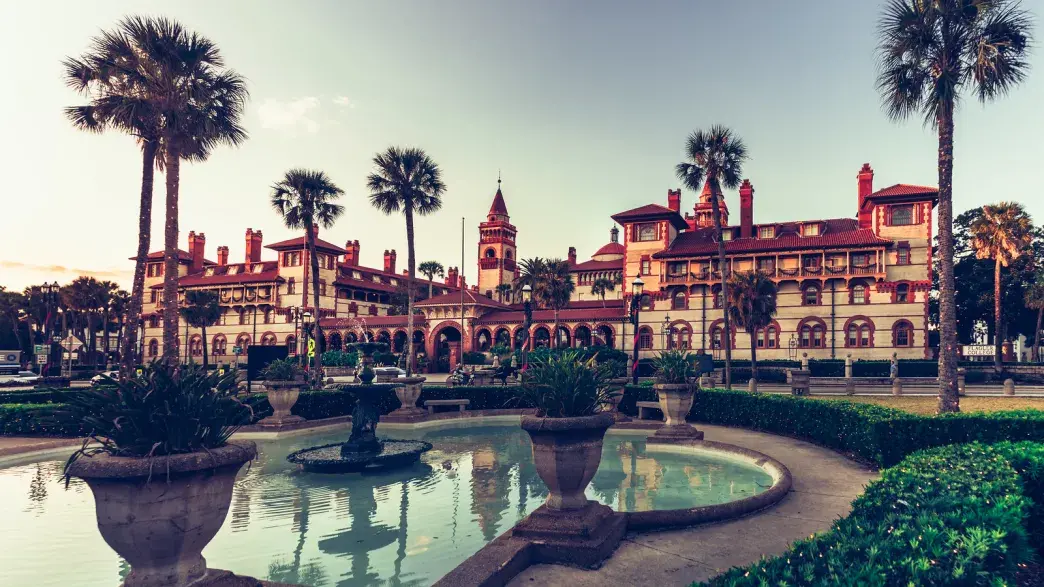
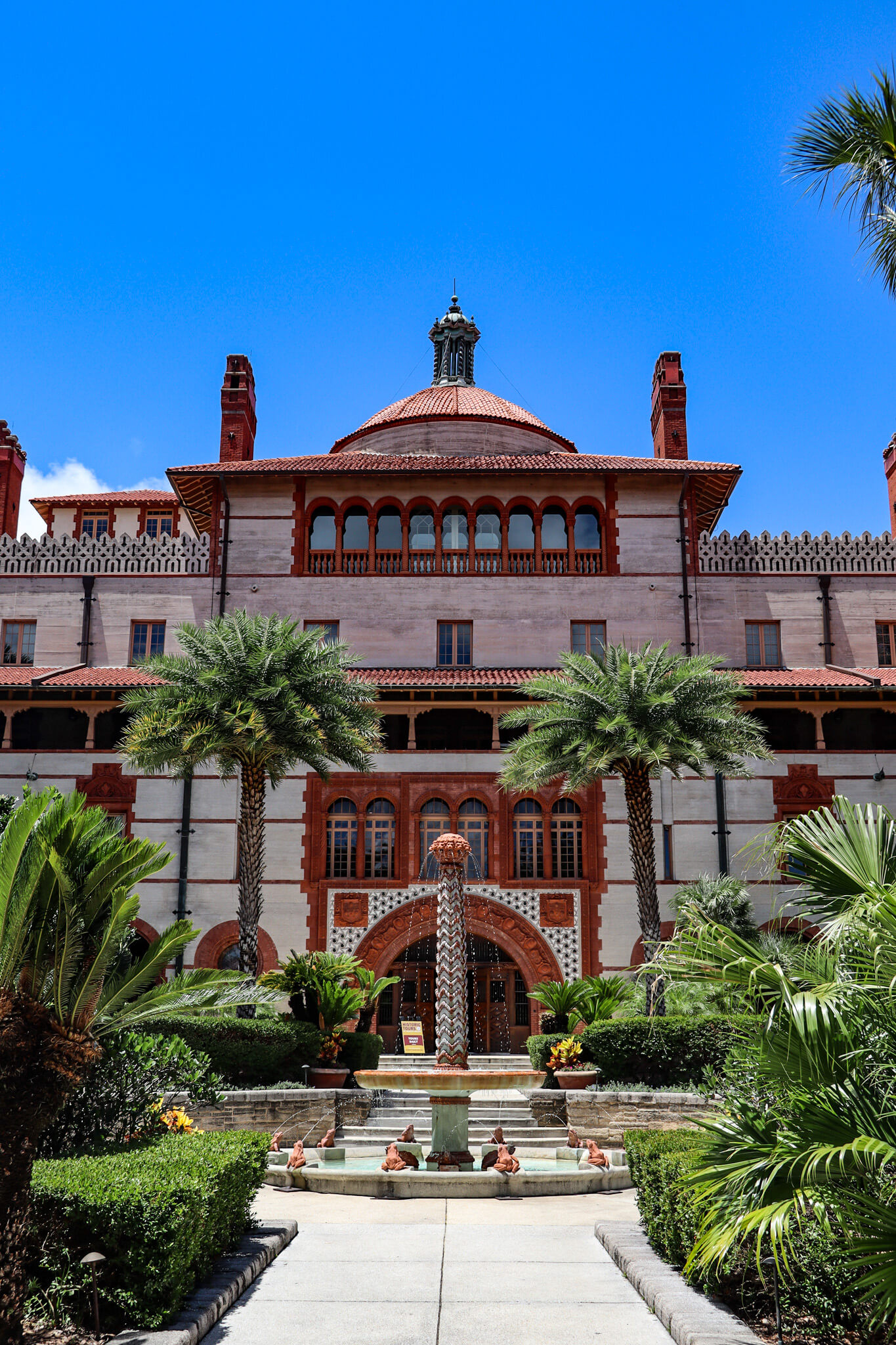
Flagler College is a small, private liberal arts school that feels less like a traditional campus and more like a cloistered, sun-drenched enclave within the nation's oldest city. Its identity is inextricably linked to its location in historic St. Augustine, Florida, and its stunning centerpiece—the former Hotel Ponce de León, a Gilded Age resort built by Henry Flagler. The vibe is coastal, social, and intimate, with academics leaning heavily toward practical, career-oriented majors in business, psychology, and criminology, all delivered at a pace that is notably less pressured than at more selective institutions.
Admission requirements
Test-optional — scores considered if submitted
Required
High school transcript
Grade point average
Letters of recommendation
College-prep program
TOEFL (non-native English)
Considered (not required)
Test scores (SAT/ACT)
Source: IPEDS Admissions survey (2022) via Urban Institute. Covers formal factors only — it does not reflect essays, extracurriculars, or other holistic criteria.
More details
Undergrad enrollment
2,391
In-state tuition
$29,900
Out-of-state tuition
$29,900
Early Decision
Offered, binding
No-Loan Policy
No
Meets Full Need
No indication
First-Year Retention
Not in sources
Demonstrated Interest
Not considered
Median Earnings (10yr)
$49,483
Graduation Rate (6-year)
56%
Outcomes & value
Outcomes & value
Median earnings (10 yr)
$49,483
Value (earnings ÷ net price)
1.6×
Median debt at graduation
$24,250
Graduation rate
56%
First-year retention
76%
Reducing loan balance (3 yr)
59%
Pell (lower-income) share
29%
First-gen share (among federal-aid recipients)
28%
Financial health
2.8 / 3.0Meets the federal financial-responsibility standard
U.S. Dept. of Education Financial Responsibility Composite Score (FY2022-23). Scale −1.0 to 3.0; ≥1.5 meets the standard. Reported for private nonprofit & for-profit institutions only — public universities are state-backed and not scored, so this is a stability signal, not a ranking.
Top-earning majors
Median earnings by field of study (highest credential), ~2 years after completion.
Economics$52,107
Accounting and Related Services$43,128
Public Administration$41,007
Education, General$37,054
Design and Applied Arts$37,054
Business Administration, Management and Operations$36,452
Campus & location
Campus safety
On-campus violent crimes (2024)
0
Per 1,000 students
0.00
On-campus criminal offenses classed as violent (murder/non-negligent manslaughter, rape, robbery, aggravated assault) for the most recent reported year. Source: U.S. Dept. of Education Campus Safety and Security (Clery Act). Counts reflect what’s reported to the school, and urban campuses often report more partly due to non-student incidents nearby — read alongside campus size and setting, not as a standalone safety verdict.
Climate
Pleasant days / yr
149
Summer high
86°F
Winter low
55°F
Annual rain
47.8"
Natural-hazard risk
Relatively Moderate
Pleasant days counts days per year with a mean temperature of 55–75°F, a high at or below 90°F, a low at or above 45°F, and little precipitation — a transparent comfort measure, not a weighting we invented. Computed from Open-Meteo ERA5 daily history (2019–2023). Natural-hazard risk is the county’s composite rating from the FEMA National Risk Index.
Deep dive — research, future-scholar output & economic mobility▾
Research output
Institutional h-index
101
Scholarly works
1,311
Institutional research volume and impact from OpenAlex. The h-index reflects large research universities and will be low for teaching-focused liberal-arts colleges — not a measure of undergraduate quality.
Economic mobility
Mobility rate
1.5%
Bottom → top quintile
32%
From bottom quintile
5%
Mobility rate = the share of students who both start in the bottom household-income quintile and reach the top quintile; bottom → top is that chance conditional on starting at the bottom. Source: Opportunity Insights Mobility Report Cards (Chetty, Friedman, Saez, Turner & Yagan). Reflects 1980–82 birth cohorts, so it’s directional, not current.
Quick answers
What is the acceptance rate at Flagler College?
Flagler College's acceptance rate is approximately 81% (Saint Augustine, FL), based on the most recent figures we compiled from public and primary sources.
What SAT score do you need for Flagler College?
Admitted students at Flagler College typically score 960–1190 on the SAT (the middle-50% range). Scores outside this band are still admitted, especially with strong applications.
How much does Flagler College cost?
At Flagler College, the average net price (after aid) is about $30,525 per year. Actual cost varies with financial aid and residency.
How many undergraduates attend Flagler College?
Flagler College enrolls approximately 2,391 undergraduate students.
Where is Flagler College located?
Flagler College is located in Saint Augustine, FL.
Admissions
Flagler's admissions process is best described as accessible, with a high that reflects its role as a regional, teaching-focused institution. For the Class of 2028, 5,011 students applied, 4,049 were accepted, and 663 enrolled, resulting in a of just over 16%. The process is largely numbers-driven for the majority of applicants. The middle 50% SAT range for admitted students is 960–1190, with an average SAT of 1157 and an average ACT of 25. The average high school GPA of enrolled first-years is 3.59. The college offers an Early Decision option, which is a binding commitment for admitted students. A key incentive for applying ED is that admitted students receive their financial aid package earlier than regular decision applicants, aiding in planning. The does not list 'demonstrated interest' as a considered factor in recent years, suggesting the evaluation focuses more squarely on academic credentials.
Earnings = median of students working ~10 years after entry; debt = median of graduates. Value divides 10-yr earnings by one year’s net price — read it as earnings per dollar of annual cost, not a full lifetime ROI; it favors lower-cost schools. Source: U.S. Dept. of Education College Scorecard. Figures lag ~2 years and reflect all students, not your intended major.
Teacher Education and Professional Development, Specific Levels and Methods
$34,526
Sports, Kinesiology, and Physical Education/Fitness$32,925
Source: U.S. Dept. of Education College Scorecard (field-of-study earnings). Figures cover graduates who received federal aid and lag ~2 years; not all programs report data.
Flagler offers a compact, career-focused curriculum through 42 undergraduate majors and two master's degree programs. The academic culture is pragmatic and teaching-centered, not driven by intense research or cutthroat competition. Class sizes are small, fostering direct interaction with professors.
The most popular majors consistently cluster in applied fields:
Business, Management, Marketing, and Related Support Services
Social Sciences (with Criminology being a standout)
Psychology
Visual and Performing Arts (including Graphic Design)
Education
This lineup reveals a student body largely oriented toward immediate professional pathways in business, human services, education, and creative fields. The college promotes its location as a living laboratory, particularly for history, coastal environmental science, and hospitality management students.
Life at Flagler is defined by its spectacular setting and intimate scale. The campus is anchored by the breathtaking Ponce de León Hall, a National Historic Landmark with Tiffany stained glass and ornate Spanish Renaissance architecture that feels more like a museum than a dormitory and dining hall. This creates a unique, almost storybook atmosphere. The student body of around 2,500 undergraduates lives in a tightly knit community where "friends who become family" is a promoted ideal. On-campus housing is a central experience, fostering late-night conversations and spontaneous gatherings.
Beyond the gates, students have the run of St. Augustine—the nation's oldest city—with its cobblestone streets, historic forts, cafes, and beaches serving as an extended campus. Student life includes a variety of clubs and themed events (like Harry Potter nights), but the social scene often blends seamlessly with the tourist-friendly downtown. The overall vibe, as noted by observers, is social, laid-back, and heavily integrated with the charming, walkable city surrounding it.
Flagler promotes strong short-term career placement, reporting that 96% of its graduates are employed, in graduate school, or in service within six months of graduation. Alumni have landed at recognizable organizations like Disney, CNN, and Harvard. The longer-term financial picture is more modest and aligns with its regional profile and popular majors. The median earnings ten years after entry are $49,483. Earlier post-graduation data shows earnings of about $36,632 one year out and $47,403 five years out.
The graduation rate is a notable point of consideration. The four-year graduation rate is 45%, while the six-year rate is 56%. This suggests many students take longer than the traditional four years to complete their degrees, which is a factor for families to weigh in terms of total cost and time to degree completion.
Flagler is a private institution with a sticker price that necessitates significant financial aid for most families. The average after aid is $30,525. The college awards over $13 million in aid annually, with a high percentage of students receiving some form of grant aid. The average student grant aid package is $13,368, with the average institutional grant being $8,553.
Financial aid is packaged using a combination of federal and institutional resources, including grants, loans, work-study, and scholarships. Flagler participates in the federal direct loan program. There is no indication in the provided sources that Flagler College has a 'no-loan' policy or meets 100% of demonstrated financial need for all admitted students without loans. Families are directed to use the Net Price Calculator and complete the FAFSA to estimate their individual out-of-pocket costs, which can vary widely.
Flagler College is utterly singular because of its physical plant and location. There is no other college in America where the central academic and residential building is a meticulously preserved 1888 luxury hotel built by a Rockefeller partner, complete with grand rotundas, original Tiffany windows, and courtyards of coquina stone. This isn't just a pretty campus; it's an immersive historical experience. That setting attracts a specific student: one who values a close-knit, socially vibrant community in a beautiful, walkable coastal town over the anonymity and sprawling resources of a large university. The trade-off is clear. You come for the unique atmosphere, the personalized attention in class, and the direct path to practical majors, not for cutthroat academic prestige or a vast research infrastructure. It's a college for students who want their undergraduate years to feel distinctive and anchored in a place with palpable character, even if that means a longer path to graduation and post-college earnings that start modestly.
Flagler College seal · sourceVisit Flagler | Flagler College · sourceFlagler College (St. Augustine, Florida) | Stephen Travels · sourceFlagler College - Profile, Rankings and Data | US News Best Colleges · source