Admit rate has ranged 67%–89% over the last 5 years — notably volatile, though the latest figure above (63%) falls outside that window. Source: IPEDS via Urban Institute.
Acceptance & SAT from Common Data Set / IPEDS; net price, earnings & graduation from the U.S. Dept. of Education College Scorecard. Figures lag ~1–2 years — verify with the school.
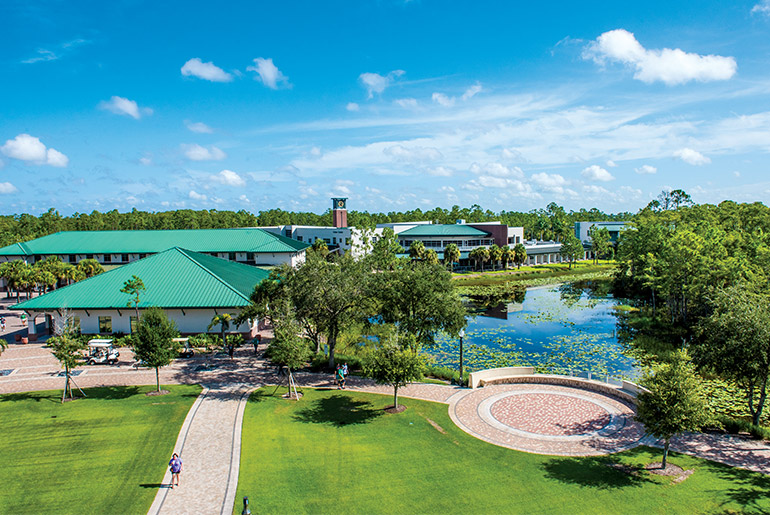
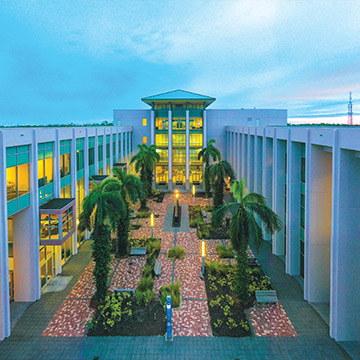
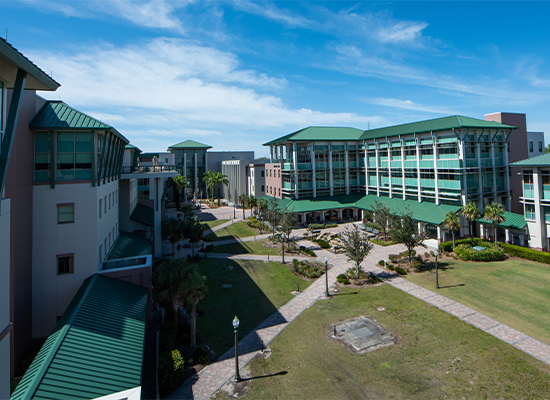
Florida Gulf Coast University (FGCU) is a public institution in Fort Myers that feels like a deliberate experiment in modern, accessible higher education. Opened in 1997, it’s a young, sprawling campus carved from cypress swamps and pine flatwoods, offering a pragmatic, career-focused curriculum to a largely regional student body. The vibe is outdoorsy, suburban, and academically straightforward, with a pronounced emphasis on environmental science, business, and health professions—a place where a 'very low tuition' and a reputation as one of the nation's safest campuses are central to its appeal.
Admission requirements
Test scores required
Required
High school transcript
Grade point average
Test scores (SAT/ACT)
College-prep program
TOEFL (non-native English)
Source: IPEDS Admissions survey (2022) via Urban Institute. Covers formal factors only — it does not reflect essays, extracurriculars, or other holistic criteria.
More details
Undergrad enrollment
13,874
In-state tuition
$6,118
Out-of-state tuition
$25,162
Campus Setting
Suburban, nature-surrounded
Graduation Rate
57%
Application Deadline
March 1
Median Earnings (10yr)
$54,560
Financial Aid Highlight
$121M in total aid awarded
Outcomes & value
Outcomes & value
Median earnings (10 yr)
$54,560
Value (earnings ÷ net price)
4.3×
Median debt at graduation
$17,622
Graduation rate
57%
First-year retention
83%
Reducing loan balance (3 yr)
59%
Pell (lower-income) share
28%
First-gen share (among federal-aid recipients)
36%
Top-earning majors
Median earnings by field of study (highest credential), ~2 years after completion.
Registered Nursing, Nursing Administration, Nursing Research and Clinical Nursing$62,409
Computer Engineering$59,722
Civil Engineering$57,318
Environmental/Environmental Health Engineering$57,318
Clinical/Medical Laboratory Science/Research and Allied Professions$54,869
Finance and Financial Management Services
Campus & location
Campus safety
On-campus violent crimes (2024)
3
Per 1,000 students
0.19
On-campus criminal offenses classed as violent (murder/non-negligent manslaughter, rape, robbery, aggravated assault) for the most recent reported year. Source: U.S. Dept. of Education Campus Safety and Security (Clery Act). Counts reflect what’s reported to the school, and urban campuses often report more partly due to non-student incidents nearby — read alongside campus size and setting, not as a standalone safety verdict.
Climate
Pleasant days / yr
117
Summer high
89°F
Winter low
59°F
Annual rain
59.5"
Natural-hazard risk
Relatively High
Pleasant days counts days per year with a mean temperature of 55–75°F, a high at or below 90°F, a low at or above 45°F, and little precipitation — a transparent comfort measure, not a weighting we invented. Computed from Open-Meteo ERA5 daily history (2019–2023). Natural-hazard risk is the county’s composite rating from the FEMA National Risk Index.
Deep dive — research, future-scholar output & economic mobility▾
Research output
Institutional h-index
144
Scholarly works
6,290
Institutional research volume and impact from OpenAlex. The h-index reflects large research universities and will be low for teaching-focused liberal-arts colleges — not a measure of undergraduate quality.
Economic mobility
Mobility rate
1.9%
Bottom → top quintile
22%
From bottom quintile
8%
Mobility rate = the share of students who both start in the bottom household-income quintile and reach the top quintile; bottom → top is that chance conditional on starting at the bottom. Source: Opportunity Insights Mobility Report Cards (Chetty, Friedman, Saez, Turner & Yagan). Reflects 1980–82 birth cohorts, so it’s directional, not current.
Quick answers
What is the acceptance rate at Florida Gulf Coast University?
Florida Gulf Coast University's acceptance rate is approximately 63% (Fort Myers, FL), based on the most recent figures we compiled from public and primary sources.
What SAT score do you need for Florida Gulf Coast University?
Admitted students at Florida Gulf Coast University typically score 1040–1200 on the SAT (the middle-50% range). Scores outside this band are still admitted, especially with strong applications.
How much does Florida Gulf Coast University cost?
At Florida Gulf Coast University, the average net price (after aid) is about $12,568 per year. Actual cost varies with financial aid and residency.
How many undergraduates attend Florida Gulf Coast University?
Florida Gulf Coast University enrolls approximately 13,874 undergraduate students.
Where is Florida Gulf Coast University located?
Florida Gulf Coast University is located in Fort Myers, FL.
Admissions
FGCU operates with a moderately selective admissions process, positioning itself as an accessible public option within the Florida state system. The university received applications from 20,422 prospective students for a recent cycle, admitting 63% of them. The middle 50% SAT range for admitted students is 1040–1200, while the ACT composite range is 20–25. The application deadline is March 1, with a $30 fee, and standardized test scores (SAT/ACT) are required for admission consideration. Notably, the rate—the percentage of admitted students who enroll—is reported to be around 17-22%, indicating that FGCU competes for students with other regional institutions. There is no mention of an Early Decision program in the provided sources, and the sections referenced suggest demonstrated interest is not a formal factor in admissions decisions. The process is geared toward first-time-in-college (FTIC) students, including high school seniors and homeschool graduates.
Earnings = median of students working ~10 years after entry; debt = median of graduates. Value divides 10-yr earnings by one year’s net price — read it as earnings per dollar of annual cost, not a full lifetime ROI; it favors lower-cost schools. Source: U.S. Dept. of Education College Scorecard. Figures lag ~2 years and reflect all students, not your intended major.
$47,520
Accounting and Related Services$47,260
Biomedical/Medical Engineering$46,769
Source: U.S. Dept. of Education College Scorecard (field-of-study earnings). Figures cover graduates who received federal aid and lag ~2 years; not all programs report data.
Academic life at FGCU is defined by a broad, practical curriculum with particular strengths in fields tied to the local environment and economy. The university offers a wide array of undergraduate programs, including popular majors like Accounting (B.S.), Analytics and Informatics (B.S.), Anthropology (B.A.), Art (B.A.), and Biochemistry. The Lutgert College of Business is a notable hub, and environmental science programs are frequently cited as being 'quite good.' A recurring sentiment among students and observers is that the school is 'more so academic focused' with a 'very broad curriculum,' suggesting a traditional, no-frills approach to undergraduate education. The Princeton Review notes that many students are drawn specifically by the 'very low tuition' and 'many opportunities for financial aid.' The academic structure appears to encourage professional preparation, with some discussions indicating that graduate school is 'almost mandatory' for certain career paths, pushing students toward further education.
With about 15,000 students, FGCU fosters a lively, nature-immersed campus community that proudly bills itself as 'one of the nation's safest campuses.' Student life is organized around extensive involvement opportunities, with over 250 clubs and organizations helping students 'define your passion, meet other students and find your chosen family.' The campus itself is repeatedly described as 'very clean and surrounded by nature,' contributing to a 'very calm and accepting' atmosphere. Students have access to 'tons of resources for education and health.' The university promotes an active campus life where 'students come first. Always,' and provides on-campus housing for a portion of its undergraduate population of 14,227. The overall vibe is suburban and engaged, with a focus on creating a welcoming environment. Social media portrayals reinforce this sense of campus pride and community belonging.
Outcomes for FGCU graduates reflect its role as a regional public university with a career-oriented mission. The six-year graduation rate is reported at 56-57%, with one source noting an eight-year rate of 62%. Early career earnings for graduates average around $37,000, though reported median earnings ten years after entry are $54,560. Specific program data from the Lutgert College of Business highlights 'top companies and positions where FGCU graduates are employed.' Notably, earnings can vary significantly by major; for example, Biology graduates were reported to earn roughly $24,244 on average early in their careers. The university tracks retention and graduation rates through federal reporting, and the overall outcome profile suggests graduates enter the workforce with solid, if not elite, earning potential, consistent with the mix of majors offered.
Affordability is a cornerstone of FGCU's identity. The average after aid is $12,568, and the university boasts that it has had 'no tuition increase in 9 years.' Financial aid is a major focus, with $121 million awarded in total aid and $6 million in Foundation scholarships. The average financial aid package is reported to be $6,238. To be eligible for most aid, students must be U.S. citizens or eligible non-citizens and demonstrate financial need. The university provides a Net Price Calculator for families to estimate their individual costs. It's important to note that while FGCU works to make education affordable, the provided sources do not indicate it has a 'no-loan' policy or that it meets 100% of demonstrated financial need for all admitted students. Its aid strategy appears centered on leveraging its low in-state tuition and offering substantial scholarship and grant opportunities.
FGCU stands out as a purpose-built, late-20th-century public university that has carved its niche by combining stark affordability with a unique environmental setting. It lacks the centuries-old traditions of flagship schools but offers something arguably more valuable to many Florida families: a safe, modern, career-focused education at a remarkably stable cost. Its identity is inextricably linked to its location—the campus isn't just near nature, it's built within it, shaping both the academic strengths (environmental science) and the student experience. The culture is pragmatic and community-oriented, less about cutthroat prestige and more about providing a clear path to a degree and a job. For students seeking a state-school education without the overwhelming size of a mega-university, and who appreciate an outdoorsy, suburban campus life, FGCU represents a compelling and calculated alternative.
.jpg?width=1600)