Admit rate has ranged 67%–77% over the last 5 years — notably volatile, though the latest figure above (58%) falls outside that window. Source: IPEDS via Urban Institute.
Acceptance & SAT from Common Data Set / IPEDS; net price, earnings & graduation from the U.S. Dept. of Education College Scorecard. Figures lag ~1–2 years — verify with the school.
Franciscan University of Steubenville is not your typical Catholic liberal arts college; it’s a magnet for devout, intellectually serious students who want their faith woven into every lecture, dorm conversation, and study abroad semester. With a campus culture so intensely Catholic that 94% of the faculty share the faith and half the student body opts for a transformative year at its Austrian study center, Franciscan offers a uniquely immersive formation. It balances this distinctive spiritual rigor with solid practical outcomes in nursing, theology, and the sciences, all set within a tight-knit, service-oriented community in the Ohio River Valley.
Admission requirements
Test-optional — scores considered if submitted
Required
High school transcript
Grade point average
College-prep program
TOEFL (non-native English)
Considered (not required)
Test scores (SAT/ACT)
Source: IPEDS Admissions survey (2022) via Urban Institute. Covers formal factors only — it does not reflect essays, extracurriculars, or other holistic criteria.
More details
Undergrad enrollment
2,901
In-state tuition
$34,100
Out-of-state tuition
$34,100
Top Majors
Theology, Psychology, Nursing
Early Action
Offered
Graduation Rate
75%
Catholic Faculty
94%
Signature Program
Austria Study Center (50% participation)
Student-Faculty Ratio
19:1
Median Earnings (10yr)
$50,030
Students Receiving Aid
99%
First-Year Retention Rate
85%
Outcomes & value
Outcomes & value
Median earnings (10 yr)
$50,030
Value (earnings ÷ net price)
2.1×
Median debt at graduation
$23,384
Graduation rate
75%
First-year retention
87%
Reducing loan balance (3 yr)
76%
Pell (lower-income) share
23%
First-gen share (among federal-aid recipients)
11%
Top-earning majors
Median earnings by field of study (highest credential), ~2 years after completion.
Registered Nursing, Nursing Administration, Nursing Research and Clinical Nursing$57,544
Business Administration, Management and Operations$42,682
Communication and Media Studies$33,993
Religious Education$33,637
Theological and Ministerial Studies$31,133
Psychology, General
Campus & location
Campus safety
On-campus violent crimes (2024)
2
Per 1,000 students
0.55
On-campus criminal offenses classed as violent (murder/non-negligent manslaughter, rape, robbery, aggravated assault) for the most recent reported year. Source: U.S. Dept. of Education Campus Safety and Security (Clery Act). Counts reflect what’s reported to the school, and urban campuses often report more partly due to non-student incidents nearby — read alongside campus size and setting, not as a standalone safety verdict.
Climate
Pleasant days / yr
96
Summer high
82°F
Winter low
27°F
Annual rain
45.4"
Annual snow
21.3"
Natural-hazard risk
Relatively Low
Pleasant days counts days per year with a mean temperature of 55–75°F, a high at or below 90°F, a low at or above 45°F, and little precipitation — a transparent comfort measure, not a weighting we invented. Computed from Open-Meteo ERA5 daily history (2019–2023). Natural-hazard risk is the county’s composite rating from the FEMA National Risk Index.
Deep dive — research, future-scholar output & economic mobility▾
Research output
Institutional h-index
75
Scholarly works
1,103
Institutional research volume and impact from OpenAlex. The h-index reflects large research universities and will be low for teaching-focused liberal-arts colleges — not a measure of undergraduate quality.
Economic mobility
Mobility rate
0.6%
Bottom → top quintile
17%
From bottom quintile
4%
Mobility rate = the share of students who both start in the bottom household-income quintile and reach the top quintile; bottom → top is that chance conditional on starting at the bottom. Source: Opportunity Insights Mobility Report Cards (Chetty, Friedman, Saez, Turner & Yagan). Reflects 1980–82 birth cohorts, so it’s directional, not current.
Quick answers
What is the acceptance rate at Franciscan University of Steubenville?
Franciscan University of Steubenville's acceptance rate is approximately 58% (Steubenville, OH), based on the most recent figures we compiled from public and primary sources.
What SAT score do you need for Franciscan University of Steubenville?
Admitted students at Franciscan University of Steubenville typically score 1110–1350 on the SAT (the middle-50% range). Scores outside this band are still admitted, especially with strong applications.
How much does Franciscan University of Steubenville cost?
At Franciscan University of Steubenville, the average net price (after aid) is about $23,589 per year. Actual cost varies with financial aid and residency.
How many undergraduates attend Franciscan University of Steubenville?
Franciscan University of Steubenville enrolls approximately 2,901 undergraduate students.
Where is Franciscan University of Steubenville located?
Franciscan University of Steubenville is located in Steubenville, OH.
Admissions
Franciscan's admissions process is selective but accessible, designed to identify students prepared for its rigorous academic and faith-based community. The university admits about 58% of applicants, placing it in the 'less selective' category that many families find approachable. Admitted students typically present strong academic credentials: the middle 50% SAT range is 1110–1350, the ACT range is 22–27, and a significant 64% of entering freshmen report a high school GPA of 3.75 or higher. The university offers Early Action, providing an option for motivated students to receive an earlier decision. While a minimum GPA of 2.4 (C+ average) is stated for consideration, the admitted pool skews much higher. The process appears to be largely metrics-driven, focusing on academic preparation, though the role of factors like demonstrated interest is not explicitly detailed in the available sources. Applicants are encouraged to use the university's Calculator alongside their application to understand financial aid possibilities early.
Earnings = median of students working ~10 years after entry; debt = median of graduates. Value divides 10-yr earnings by one year’s net price — read it as earnings per dollar of annual cost, not a full lifetime ROI; it favors lower-cost schools. Source: U.S. Dept. of Education College Scorecard. Figures lag ~2 years and reflect all students, not your intended major.
$30,771
Teacher Education and Professional Development, Specific Levels and Methods$29,685
English Language and Literature, General$28,960
Source: U.S. Dept. of Education College Scorecard (field-of-study earnings). Figures cover graduates who received federal aid and lag ~2 years; not all programs report data.
Academics at Franciscan are defined by a seamless integration of faith and reason across more than 40 majors. The curriculum is broad, encompassing everything from nursing and biology to political science and psychology, but it is unmistakably anchored in Catholic intellectual tradition. Popular majors include Theology/Theological Studies, Psychology, and Registered Nursing. The student-faculty ratio is 19:1, facilitating direct engagement. Two features are particularly signature:
The Austria Program: A defining experience where about 50% of students choose to spend a semester or year at the university's study center in Gaming, Austria. This program combines rigorous academics with cultural immersion and pilgrimage opportunities across Europe.
A Deeply Catholic Faculty: An extraordinary 94% of the faculty are Catholic, ensuring that the institution's mission is embodied in the classroom. This creates a learning environment where theological and philosophical perspectives are not sidelined but are central to discussions in all disciplines.
The university also notes that it is in the top 10% of America's top colleges, a claim reflecting its standing in certain rankings focused on value and outcomes.
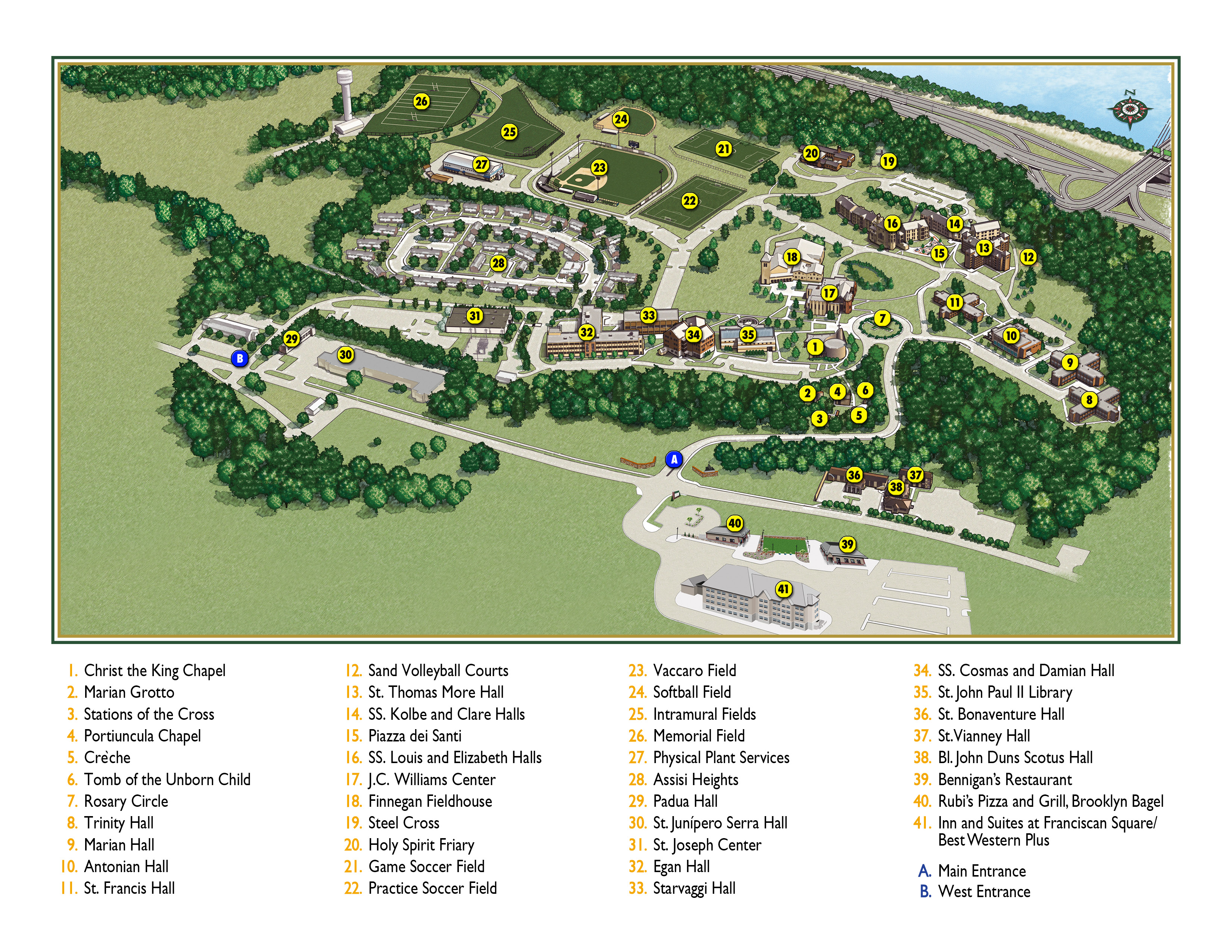
Life at Franciscan is an all-encompassing, vibrantly Catholic experience. The university explicitly aims to form students 'through lives of charity and ongoing conversion, to lead and to evangelize.' This isn't just rhetoric; it's the lived reality of a campus where spiritual life is the central organizing principle. The Christ the King Chapel is a hub of activity, and events like '24 Hour Praise' are promoted by the official Student Life office. Social life is active but distinct: according to student polls, the party scene is minimal, with only about 1% reporting 'tons of raging parties,' while most socializing happens in dorms, at campus events, and through service. The university has a history of student groups, with fraternities and sororities among the earliest organizations, helping to build community. Today, students describe a supportive environment focused on forming 'healthy connections.' The atmosphere is one of a close-knit family, supported by dedicated offices for Residence Life, Dining, and Athletics (the university competes in NCAA Division III). It's a place for students who want their faith to define their friendships and daily routine.
Franciscan graduates students who persist and earn solid returns on their investment. The first-year retention rate is a strong 85%, indicating high student satisfaction. The graduation rate is 75%, with 68% of students graduating within four years and 77% within six. These figures point to a supportive academic environment that helps students cross the finish line. Financially, outcomes are respectable for a liberal arts-focused institution. Early career earnings are around $37,285 one year after graduation, growing to approximately $49,632 after five years. The university's performance in these areas—affordability, educational quality, graduation rates, and alumni salaries—earned it a four-star rating and a place on Money Magazine's 2023 'Best Colleges' list. The data suggests Franciscan effectively prepares students for meaningful work, with many graduates entering fields like ministry, healthcare, and education where starting salaries may be lower but alignment with personal mission is high.
Franciscan is a private institution with a published total around $46,700. However, the university is aggressive with financial aid, making the actual far more manageable for most families. The average aid package awarded is $24,784, and a remarkable 99% of full-time beginning undergraduates receive grant or scholarship aid. The average need-based scholarship or grant award is $4,539. The university encourages all prospective students to use its Net Price Calculator to get a personalized estimate. It's important to note that while aid is generous, Franciscan does not advertise a 'no-loan' policy where loans are eliminated from packages for low-income students. Federal and institutional loans remain a component of aid packages for many, with annual federal loan limits for undergraduates ranging from $5,500 for freshmen to $7,500 for juniors and seniors. The key is that the gap between the sticker price and the net price is substantial, thanks to widespread scholarship distribution.
Franciscan University of Steubenville stands out as one of the most intentionally and pervasively Catholic campuses in the United States. It is not a school where faith is one club among many; it is the bedrock of the entire community. This is evidenced by the 94% Catholic faculty, the centrality of the chapel, and the curriculum that engages the Catholic intellectual tradition across all disciplines. The Austria study program is a unique differentiator, offering a deeply formative overseas experience that is woven into the fabric of the undergraduate journey for half the student body. Furthermore, it achieves this distinctive mission while delivering solid practical outcomes—strong retention and graduation rates, growing alumni earnings, and recognition on best-value lists. For a student seeking an undergraduate experience where spiritual formation, academic inquiry, and community life are fully integrated, Franciscan offers a coherent and immersive environment that few other institutions can match.
Franciscan University of Steubenville seal · sourceFranciscan University - Our Campus (Map) · sourceUniversity Starts Largest Fundraising Effort in School's History · sourceFranciscan University of Steubenville - Profile, Rankings and Data | US News Best Colleges · source