Loading…
← All schools
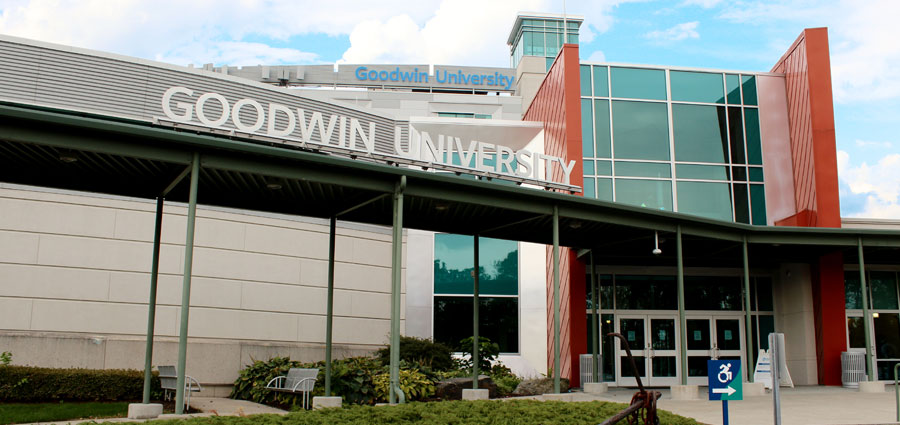
Goodwin University
East Hartford, CTprivate nonprofitwww.goodwin.edu/
Avg net price
$29,249
Earnings (10 yr)
$43,596
Graduation rate
58%
Acceptance & SAT from Common Data Set / IPEDS; net price, earnings & graduation from the U.S. Dept. of Education College Scorecard. Figures lag ~1–2 years — verify with the school.
Goodwin University is a career-focused, predominantly female institution in East Hartford, Connecticut, built for working adults and career-changers. With a 100% acceptance rate and a pragmatic, no-frills approach, it operates on a fast-paced, three-session academic calendar designed to get students into high-demand fields like nursing, health sciences, and business as efficiently as possible. Its identity is defined not by selectivity or campus tradition, but by accessibility, flexible scheduling, and a direct line to workforce outcomes.
More details
- Undergrad enrollment
- 2,693
- In-state tuition
- $21,198
- Out-of-state tuition
- $21,198
- Graduation Rate
- 58%
- Student-Faculty Ratio
- 14:1
- Median Earnings (10yr)
- $43,596
- Female Student Population
- 84.9%
- Students Receiving Grants/Scholarships
- 88%
Outcomes & value
Outcomes & value
- Median earnings (10 yr)
- $43,596
- Value (earnings ÷ net price)
- 1.5×
- Median debt at graduation
- $33,500
- Graduation rate
- 58%
- First-year retention
- 67%
- Reducing loan balance (3 yr)
- 34%
- Pell (lower-income) share
- 54%
- First-gen share (among federal-aid recipients)
- 53%
Financial health
2.9 / 3.0Meets the federal financial-responsibility standard
U.S. Dept. of Education Financial Responsibility Composite Score (FY2022-23). Scale −1.0 to 3.0; ≥1.5 meets the standard. Reported for private nonprofit & for-profit institutions only — public universities are state-backed and not scored, so this is a stability signal, not a ranking.
Top-earning majors
Median earnings by field of study (highest credential), ~2 years after completion.
- Registered Nursing, Nursing Administration, Nursing Research and Clinical Nursing$74,105
- Health Professions and Related Clinical Sciences, Other$38,906
- Human Development, Family Studies, and Related Services$35,060
Source: U.S. Dept. of Education College Scorecard (field-of-study earnings). Figures cover graduates who received federal aid and lag ~2 years; not all programs report data.
Compare on earnings: best colleges for Nursing
Campus & location
Campus safety
- On-campus violent crimes (2024)
- 0
- Per 1,000 students
- 0.00
On-campus criminal offenses classed as violent (murder/non-negligent manslaughter, rape, robbery, aggravated assault) for the most recent reported year. Source: U.S. Dept. of Education Campus Safety and Security (Clery Act). Counts reflect what’s reported to the school, and urban campuses often report more partly due to non-student incidents nearby — read alongside campus size and setting, not as a standalone safety verdict.
Climate
- Pleasant days / yr
- 89
- Summer high
- 83°F
- Winter low
- 25°F
- Annual rain
- 51.1"
- Annual snow
- 25.6"
Pleasant days counts days per year with a mean temperature of 55–75°F, a high at or below 90°F, a low at or above 45°F, and little precipitation — a transparent comfort measure, not a weighting we invented. Computed from Open-Meteo ERA5 daily history (2019–2023).
Quick answers
- How much does Goodwin University cost?
- At Goodwin University, the average net price (after aid) is about $29,249 per year. Actual cost varies with financial aid and residency.
- How many undergraduates attend Goodwin University?
- Goodwin University enrolls approximately 2,693 undergraduate students.
- Where is Goodwin University located?
- Goodwin University is located in East Hartford, CT.
Admissions
Goodwin University practices an open admissions policy, making it one of the most accessible four-year institutions in the region. The is 100%, and the process is built around minimal barriers to entry for non-traditional and returning students. The fundamental requirements are a high school diploma or GED and a successful interview; the university does not require SAT or ACT scores for admission. Applicants can use the Common Application, an undergraduate admissions tool that allows for applying to multiple schools with a single online application. The student body that results from this policy is overwhelmingly female (84.9%) and ethnically diverse, with significant representation from Hispanic/Latino (24.85%) and Black or African American (26.33%) students. The freshman retention rate is 67%, reflecting the challenges and transitions typical of a student population balancing education with work and life commitments.
Compare Goodwin University
See colleges similar to Goodwin University →Sources
- What is the Common Application?
- Common Data Set: Home
- The Common Data Set: What It Is & How to Use It In ...
- Common Data Set | Office of Institutional Research
- How To Use a Common Data Set
- Where to find Common Data Set (CDS) for college ...
- Goodwin University Admissions & Acceptance
- Goodwin University Tuition, Acceptance Rate, & Academics
- Goodwin University - Tuition and Acceptance Rate
- Admission Requirements
- Goodwin University SAT Scores, ACT Scores, Acceptance ...