Admit rate has ranged 24%–97% over the last 5 years — notably volatile. Source: IPEDS via Urban Institute.
Acceptance & SAT from Common Data Set / IPEDS; net price, earnings & graduation from the U.S. Dept. of Education College Scorecard. Figures lag ~1–2 years — verify with the school.
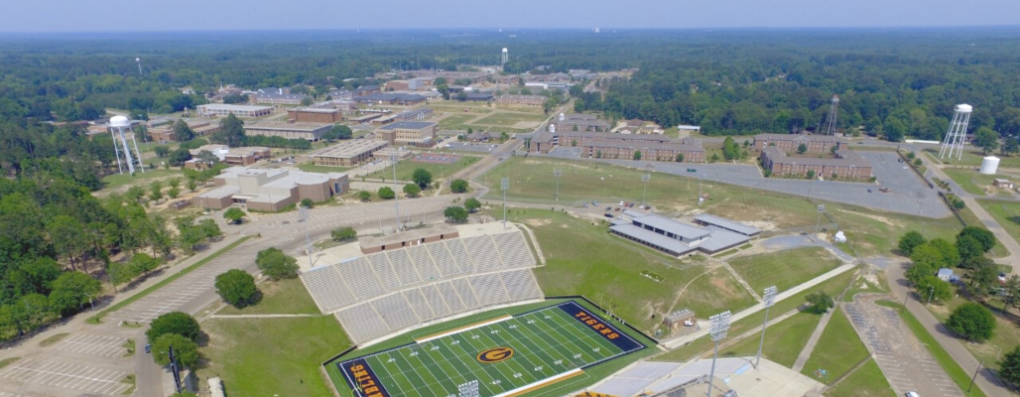
Grambling State University is a historically Black public university in northern Louisiana that operates with the soul of an HBCU and the practical mission of a regional powerhouse. It’s a place where school spirit runs deep—fueled by a legendary marching band and football tradition—and where the academic focus is squarely on launching careers in high-demand fields like nursing, criminal justice, and computer science. While it grapples with graduation rates below national averages, its identity is cemented as a vital engine of social mobility and Black professional achievement in the South.
Admission requirements
Test-optional — scores considered if submitted
Required
High school transcript
Grade point average
Class rank
College-prep program
TOEFL (non-native English)
Considered (not required)
Test scores (SAT/ACT)
Source: IPEDS Admissions survey (2022) via Urban Institute. Covers formal factors only — it does not reflect essays, extracurriculars, or other holistic criteria.
More details
Undergrad enrollment
4,164
In-state tuition
$7,683
Out-of-state tuition
$16,706
Top Producer
Computer Info Science grads in LA
Graduation Rate
36%
Median Earnings (10yr)
$41,109
Student-to-Faculty Ratio
25:1
First-Year Retention Rate
66%
Outcomes & value
Outcomes & value
Median earnings (10 yr)
$41,109
Value (earnings ÷ net price)
2.1×
Median debt at graduation
$36,500
Graduation rate
36%
First-year retention
66%
Reducing loan balance (3 yr)
41%
Pell (lower-income) share
75%
First-gen share (among federal-aid recipients)
39%
Top-earning majors
Median earnings by field of study (highest credential), ~2 years after completion.
Registered Nursing, Nursing Administration, Nursing Research and Clinical Nursing$68,219
Teacher Education and Professional Development, Specific Subject Areas$35,416
Accounting and Related Services$33,993
Business Administration, Management and Operations$30,771
Psychology, General
Campus & location
Campus safety
On-campus violent crimes (2024)
6
Per 1,000 students
1.20
On-campus criminal offenses classed as violent (murder/non-negligent manslaughter, rape, robbery, aggravated assault) for the most recent reported year. Source: U.S. Dept. of Education Campus Safety and Security (Clery Act). Counts reflect what’s reported to the school, and urban campuses often report more partly due to non-student incidents nearby — read alongside campus size and setting, not as a standalone safety verdict.
Climate
Pleasant days / yr
94
Summer high
93°F
Winter low
42°F
Annual rain
52"
Annual snow
2.2"
Natural-hazard risk
Relatively Low
Pleasant days counts days per year with a mean temperature of 55–75°F, a high at or below 90°F, a low at or above 45°F, and little precipitation — a transparent comfort measure, not a weighting we invented. Computed from Open-Meteo ERA5 daily history (2019–2023). Natural-hazard risk is the county’s composite rating from the FEMA National Risk Index.
Deep dive — research, future-scholar output & economic mobility▾
Research output
Institutional h-index
53
Scholarly works
1,028
Institutional research volume and impact from OpenAlex. The h-index reflects large research universities and will be low for teaching-focused liberal-arts colleges — not a measure of undergraduate quality.
Economic mobility
Mobility rate
4.6%
Bottom → top quintile
13%
From bottom quintile
34%
Mobility rate = the share of students who both start in the bottom household-income quintile and reach the top quintile; bottom → top is that chance conditional on starting at the bottom. Source: Opportunity Insights Mobility Report Cards (Chetty, Friedman, Saez, Turner & Yagan). Reflects 1980–82 birth cohorts, so it’s directional, not current.
Quick answers
What is the acceptance rate at Grambling State University?
Grambling State University's acceptance rate is approximately 45% (Grambling, LA), based on the most recent figures we compiled from public and primary sources.
What SAT score do you need for Grambling State University?
Admitted students at Grambling State University typically score 920–1080 on the SAT (the middle-50% range). Scores outside this band are still admitted, especially with strong applications.
How much does Grambling State University cost?
At Grambling State University, the average net price (after aid) is about $19,809 per year. Actual cost varies with financial aid and residency.
How many undergraduates attend Grambling State University?
Grambling State University enrolls approximately 4,164 undergraduate students.
Where is Grambling State University located?
Grambling State University is located in Grambling, LA.
Admissions
Grambling State's admissions process is moderately selective, with the university reporting an of 45%. The middle 50% of admitted students who submit test scores have an SAT range between 920 and 1080, or an ACT composite between 15 and 19. The university sets clear minimum thresholds for automatic admission: a 2.0 unweighted GPA with a minimum ACT of 20 (or an SAT equivalent of 1030-1050) or a GPA of 2.50. While the is referenced for detailed factors, specific weight given to items like demonstrated interest is not explicitly stated in the provided sources. The process appears to be largely formulaic, centered on meeting academic benchmarks.
Academic life at Grambling is defined by its role as a top producer of Black graduates and its focus on career-oriented programs. The university offers more than 800 courses and 68 degree programs across five colleges. Its most popular undergraduate majors, reflecting both student interest and regional job markets, include Nursing, Criminal Justice, Biology, Social Work, and Mass Communication. A particular point of pride is its Computer Information Science program, noted as the top producer of such graduates in Louisiana. The student-to-faculty ratio is 25:1, indicating larger class sizes. The academic structure supports a wide range of interests from Arts and Sciences to Business, Graduate Studies, and Professional Studies.
Earnings = median of students working ~10 years after entry; debt = median of graduates. Value divides 10-yr earnings by one year’s net price — read it as earnings per dollar of annual cost, not a full lifetime ROI; it favors lower-cost schools. Source: U.S. Dept. of Education College Scorecard. Figures lag ~2 years and reflect all students, not your intended major.
$27,642
Parks, Recreation, and Leisure Studies$27,048
Criminal Justice and Corrections$26,187
Source: U.S. Dept. of Education College Scorecard (field-of-study earnings). Figures cover graduates who received federal aid and lag ~2 years; not all programs report data.
The heartbeat of Grambling is its campus culture, which is overwhelmingly described as vibrant and rich with school spirit. This energy peaks around major events like homecoming and football games, often amplified by the world-renowned Tiger Marching Band. The Division of Student Affairs fosters this environment through activities and programs designed to support learning, healthy lifestyles, leadership, and career development. Students can engage with a diverse range of clubs and social organizations. The residential experience is a central component, with average annual room and board costs reported at $10,990. The student body is predominantly Black or African American, cementing its strong HBCU identity and community.
Post-graduation outcomes present a mixed picture that is crucial for prospective students to weigh. The university's four-year graduation rate is 36%, and its six-year rate has been reported at figures ranging from 29% to 40% across different sources. The first-year retention rate is 66%. For those who do graduate, the median earnings ten years after entering the university are $41,109. These metrics, particularly the graduation rates, place Grambling below national averages. The data underscores the university's mission as an access institution while highlighting the challenges a significant portion of its student body may face in persisting to degree completion.
The average for students after grant and scholarship aid is $19,809. The university offers an average financial aid package of $4,120. Institutional aid is awarded based on a combination of need, academic status, enrollment status, and athletic ability. To maintain eligibility for this aid, students must meet Satisfactory Academic Progress standards each year. The university provides net price calculators and detailed tuition information online, with tuition and related fees structured per credit hour. The provided sources do not indicate the existence of a no-loan policy or a commitment to meet 100% of demonstrated financial need for all admitted students; aid appears to be a mix of merit, need, and athletic awards.
Grambling State stands out not for elite selectivity or towering endowment, but for its unwavering identity and specific, impactful missions. First, it is a cultural institution: the home of the Tiger Marching Band and a football that makes school spirit a tangible, defining feature of daily life. Second, it is an engine of Black professional achievement. It's recognized as one of the country's top producers of Black graduates and the top producer of Computer Information Science graduates in Louisiana, directly feeding critical fields. Finally, it serves as a vital access point in higher education for its region, offering a classic HBCU experience—complete with its tight-knit community and vibrant traditions—focused on practical degrees in nursing, criminal justice, and business. Its character is rooted in community, celebration, and career preparation.
Grambling State University seal · sourceGrambling State University - Campus Overview · sourceGrambling State University - Maps · sourceGrambling State University Historic District - Wikipedia · source