Admit rate has ranged 60%–83% over the last 5 years — notably volatile. Source: IPEDS via Urban Institute.
Acceptance & SAT from Common Data Set / IPEDS; net price, earnings & graduation from the U.S. Dept. of Education College Scorecard. Figures lag ~1–2 years — verify with the school.
Grand Canyon University is a massive, for-profit Christian university in Phoenix that operates on two distinct tracks: a sprawling online division and a surprisingly vibrant, event-packed residential campus. It's a school of stark contrasts—praised for its career-focused curriculum and energetic student life, yet grappling with graduation rates well below national averages. For students seeking a faith-infused, sun-drenched campus experience with a practical bent, GCU offers a clear path; for those focused purely on outcomes, the numbers tell a more complicated story.
Admission requirements
Test-optional — scores considered if submitted
Required
High school transcript
Grade point average
TOEFL (non-native English)
Considered (not required)
Test scores (SAT/ACT)
Source: IPEDS Admissions survey (2022) via Urban Institute. Covers formal factors only — it does not reflect essays, extracurriculars, or other holistic criteria.
More details
Undergrad enrollment
73,371
In-state tuition
$17,850
Out-of-state tuition
$17,850
Campus Ranking
#20 Best College Campus (2026)
Graduation Rate
43%
Total Applicants
Over 51,000
Median Earnings (10yr)
$42,186
Students Receiving Aid
96%
Programs & Certificates
340+
Outcomes & value
Outcomes & value
Median earnings (10 yr)
$42,186
Value (earnings ÷ net price)
1.9×
Median debt at graduation
$22,114
Graduation rate
43%
First-year retention
72%
Reducing loan balance (3 yr)
35%
Pell (lower-income) share
46%
First-gen share (among federal-aid recipients)
47%
Financial health
1.8 / 3.0Meets the federal financial-responsibility standard
U.S. Dept. of Education Financial Responsibility Composite Score (FY2022-23). Scale −1.0 to 3.0; ≥1.5 meets the standard. Reported for private nonprofit & for-profit institutions only — public universities are state-backed and not scored, so this is a stability signal, not a ranking.
Top-earning majors
Median earnings by field of study (highest credential), ~2 years after completion.
Registered Nursing, Nursing Administration, Nursing Research and Clinical Nursing$77,476
Homeland Security$60,082
Clinical/Medical Laboratory Science/Research and Allied Professions$59,124
Finance and Financial Management Services$52,357
Business Administration, Management and Operations$45,455
Accounting and Related Services
Campus & location
Campus safety
On-campus violent crimes (2024)
17
Per 1,000 students
0.15
On-campus criminal offenses classed as violent (murder/non-negligent manslaughter, rape, robbery, aggravated assault) for the most recent reported year. Source: U.S. Dept. of Education Campus Safety and Security (Clery Act). Counts reflect what’s reported to the school, and urban campuses often report more partly due to non-student incidents nearby — read alongside campus size and setting, not as a standalone safety verdict.
Climate
Pleasant days / yr
97
Summer high
105°F
Winter low
43°F
Annual rain
12.2"
Natural-hazard risk
Very High
Pleasant days counts days per year with a mean temperature of 55–75°F, a high at or below 90°F, a low at or above 45°F, and little precipitation — a transparent comfort measure, not a weighting we invented. Computed from Open-Meteo ERA5 daily history (2019–2023). Natural-hazard risk is the county’s composite rating from the FEMA National Risk Index.
Deep dive — research, future-scholar output & economic mobility▾
Research output
Institutional h-index
57
Scholarly works
1,686
Institutional research volume and impact from OpenAlex. The h-index reflects large research universities and will be low for teaching-focused liberal-arts colleges — not a measure of undergraduate quality.
Economic mobility
Mobility rate
0.9%
Bottom → top quintile
14%
From bottom quintile
6%
Mobility rate = the share of students who both start in the bottom household-income quintile and reach the top quintile; bottom → top is that chance conditional on starting at the bottom. Source: Opportunity Insights Mobility Report Cards (Chetty, Friedman, Saez, Turner & Yagan). Reflects 1980–82 birth cohorts, so it’s directional, not current.
Quick answers
What is the acceptance rate at Grand Canyon University?
Grand Canyon University's acceptance rate is approximately 79% (Phoenix, AZ), based on the most recent figures we compiled from public and primary sources.
What SAT score do you need for Grand Canyon University?
Admitted students at Grand Canyon University typically score 1006–1113 on the SAT (the middle-50% range). Scores outside this band are still admitted, especially with strong applications.
How much does Grand Canyon University cost?
At Grand Canyon University, the average net price (after aid) is about $22,472 per year. Actual cost varies with financial aid and residency.
How many undergraduates attend Grand Canyon University?
Grand Canyon University enrolls approximately 73,371 undergraduate students.
Where is Grand Canyon University located?
Grand Canyon University is located in Phoenix, AZ.
Admissions
GCU's admissions process is characterized by high volume and relatively low barriers to entry, positioning it as an accessible option for a broad range of students. The university received over 51,000 applications for a recent cycle, admitting a large majority. The , as per our published canonical figure, is 79%. Test scores are considered but not the sole determinant; the middle 50% SAT range for admitted students is 1006–1113. For transfer students, the gateway is straightforward: those with at least a 2.25 GPA and 25 or more transferable credits from an accredited, GCU-approved program are welcome to apply. The admissions office encourages prospective students to stay ahead of trends, suggesting an awareness of the competitive landscape, though the process itself is not highly selective.
Academic life at GCU is defined by scale and a pronounced career orientation. The university offers a staggering array of over 340 academic programs, emphases, and certificates spread across 10 distinct colleges. This breadth ensures that whether a student's interest lies in business, nursing, computer science, or the humanities, there's likely a tailored path. The curriculum is explicitly designed to be "career-ready," heavily focused on meeting industry standards. Popular and well-regarded majors include Biology, Business Management, Computer Science, Criminal Justice, English, History, Political Science, and Psychology. The academic structure supports both traditional campus learners and a vast online student body, with programs built to be dynamic and informed by industry needs and student learning outcomes.
Earnings = median of students working ~10 years after entry; debt = median of graduates. Value divides 10-yr earnings by one year’s net price — read it as earnings per dollar of annual cost, not a full lifetime ROI; it favors lower-cost schools. Source: U.S. Dept. of Education College Scorecard. Figures lag ~2 years and reflect all students, not your intended major.
$43,207
Security Science and Technology$41,025
Health and Medical Administrative Services$40,341
Source: U.S. Dept. of Education College Scorecard (field-of-study earnings). Figures cover graduates who received federal aid and lag ~2 years; not all programs report data.
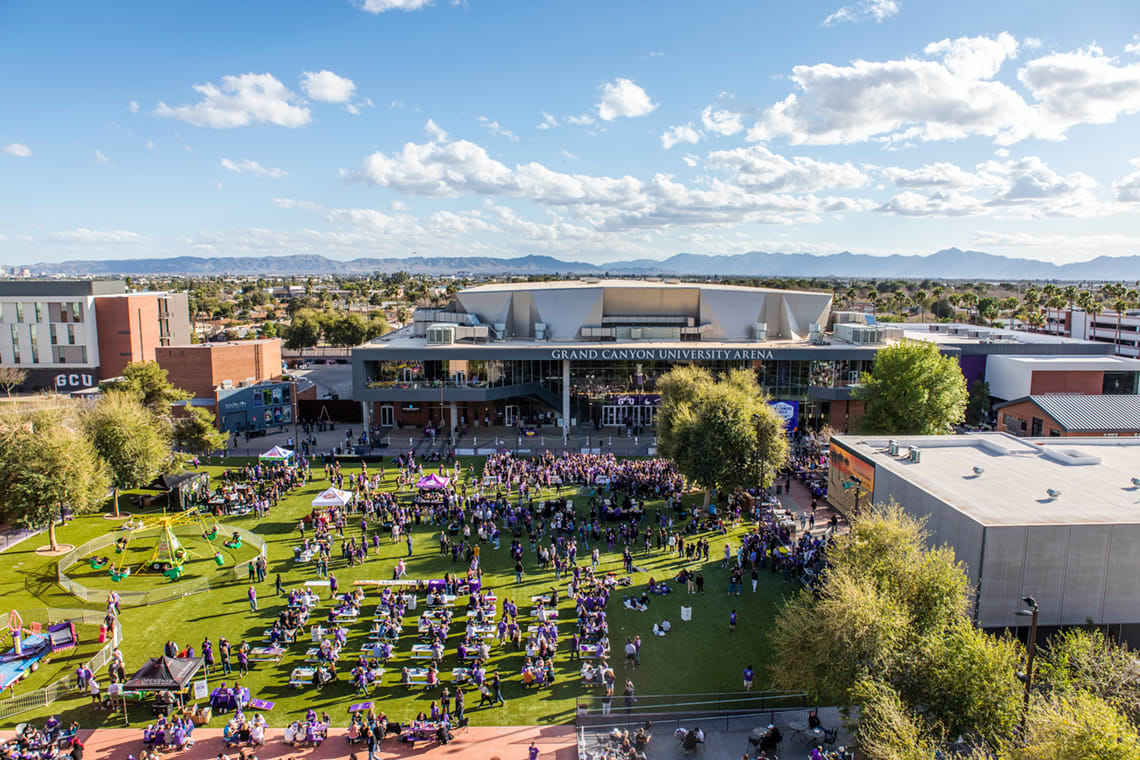
On its Phoenix campus, GCU cultivates a deliberately vibrant, all-encompassing community atmosphere that often surprises outsiders. The university spirit is fueled by a constant calendar of events—from concerts and NCAA Division I athletic events to student-led activities, service projects, and late-night gatherings. This active schedule has helped earn GCU a ranking as the #20 best college campus in America for 2026. While founded as a Christian university, the campus culture, as described by students, is one of "joy, faith and acceptance for all," with many noting that the religious aspect is a background presence rather than a restrictive force. The community is frequently described as supportive, with students sharing a desire to help one another. The modern facilities and emphasis on a well-rounded experience contribute to a social life that students characterize as having "it all."
Graduation and career outcomes at GCU present a mixed picture, with significant variance between its traditional campus and online populations. The overall graduation rate, per our canonical figure, is 43%, which is below the national average. However, the university reports a more promising four-year graduation rate of 58% specifically for its traditional, on-campus students, with online students graduating at a 65% rate. This suggests retention and completion challenges are not evenly distributed across its instructional models. Financially, the median earnings for alumni ten years after entry is $42,186. Some analyses indicate that early-career graduates earn about $36,000 on average, which is noted as being approximately $5,000 better than might be expected given the mix of majors and the institution's profile.
GCU actively uses institutional aid to make its sticker price more accessible. A overwhelming majority—96%—of full-time beginning undergraduates receive some form of grant or scholarship aid. The average after aid, as per our canonical figure, is $22,472. On average, traditional campus students qualify for approximately $7,500 in GCU-funded scholarships per academic year. The university encourages students to complete the FAFSA, and eligibility for certain grants, like state and federal programs, may require a minimum cumulative GPA (e.g., 3.25 for some). While the school promotes scholarships and grants, it also partners with financial institutions like Global Credit Union and Sallie Mae for private student loans, indicating that loans remain a component of many students' financial packages. There is no indication in the provided sources of a "no-loan" policy or a commitment to meet 100% of demonstrated financial need solely with grants.
Grand Canyon University stands out for its sheer operational scale and its dual identity. It is not merely a large university; it's a bifurcated institution running a high-energy, tradition-rich residential campus alongside one of the nation's most expansive online degree factories. This allows it to serve two very different student populations simultaneously. The Phoenix campus has successfully engineered a specific vibe—a sunny, event-driven, Christian-heritage community that feels inclusive even to non-religious students—which has garnered national recognition for campus life. Academically, it distinguishes itself through an unapologetic focus on career preparedness across a vast menu of programs. However, its standout nature is also defined by the tension between these vibrant campus offerings and its sobering overall graduation statistics, creating a clear choice for prospective students: prioritize the immersive college experience and career-focused curriculum, or weigh those against the likelihood of degree completion and long-term financial return.
Grand Canyon University seal · sourceCampus Locations | Grand Canyon University · sourceGCU Experience Campus - GCU Alumni · sourceGrand Canyon University ranked No. 7 on Best College Campus list · source
.jpg?width=1600)