Loading…
← All schools
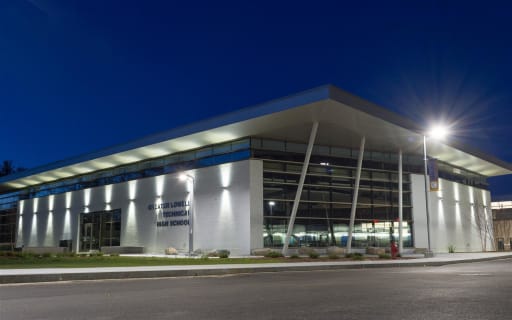
Greater Lowell Technical School
Tyngsboro, MApublicgltech.org
Acceptance
75%
Avg net price
$19,205
Admit rate has ranged 82%–100% over the last 5 years — notably volatile, though the latest figure above (75%) falls outside that window. Source: IPEDS via Urban Institute.
Acceptance & SAT from Common Data Set / IPEDS; net price, earnings & graduation from the U.S. Dept. of Education College Scorecard. Figures lag ~1–2 years — verify with the school.
Greater Lowell Technical School is not a university in the traditional sense, but a public vocational-technical high school in Tyngsboro, Massachusetts, that operates a post-secondary School of Practical Nursing. Its identity is defined by a robust, career-focused education model where students split their time between academic classrooms and hands-on technical shops, preparing them directly for skilled trades and healthcare professions. The school is known for its high graduation rates, strong post-graduation earnings for its nursing program graduates, and a selective admissions process that includes a lottery for in-district applicants.
Admission requirements
Test-blind — scores not considered
Required
- High school transcript
- Letters of recommendation
Source: IPEDS Admissions survey (2022) via Urban Institute. Covers formal factors only — it does not reflect essays, extracurriculars, or other holistic criteria.
More details
- Undergrad enrollment
- 80
- Core Values
- Respect, Effort, Accountability, Courage, Honesty (REACH)
- Median Earnings (10yr)
- $69,121
- Graduation Rate (High School)
- 97%
- Graduation Rate (Nursing Program)
- 84%
Outcomes & value
Outcomes & value
- Reducing loan balance (3 yr)
- 79%
- Pell (lower-income) share
- 30%
- First-gen share (among federal-aid recipients)
- 63%
Earnings = median of students working ~10 years after entry; debt = median of graduates. Value divides 10-yr earnings by one year’s net price — read it as earnings per dollar of annual cost, not a full lifetime ROI; it favors lower-cost schools. Source: U.S. Dept. of Education College Scorecard. Figures lag ~2 years and reflect all students, not your intended major.
Campus & location
Campus safety
- On-campus violent crimes (2024)
- 0
On-campus criminal offenses classed as violent (murder/non-negligent manslaughter, rape, robbery, aggravated assault) for the most recent reported year. Source: U.S. Dept. of Education Campus Safety and Security (Clery Act). Counts reflect what’s reported to the school, and urban campuses often report more partly due to non-student incidents nearby — read alongside campus size and setting, not as a standalone safety verdict.
Climate
- Pleasant days / yr
- 91
- Summer high
- 82°F
- Winter low
- 23°F
- Annual rain
- 50.1"
- Annual snow
- 43.2"
- Natural-hazard risk
- Relatively High
Pleasant days counts days per year with a mean temperature of 55–75°F, a high at or below 90°F, a low at or above 45°F, and little precipitation — a transparent comfort measure, not a weighting we invented. Computed from Open-Meteo ERA5 daily history (2019–2023). Natural-hazard risk is the county’s composite rating from the FEMA National Risk Index.
Quick answers
- What is the acceptance rate at Greater Lowell Technical School?
- Greater Lowell Technical School's acceptance rate is approximately 75% (Tyngsboro, MA), based on the most recent figures we compiled from public and primary sources.
- How much does Greater Lowell Technical School cost?
- At Greater Lowell Technical School, the average net price (after aid) is about $19,205 per year. Actual cost varies with financial aid and residency.
- How many undergraduates attend Greater Lowell Technical School?
- Greater Lowell Technical School enrolls approximately 80 undergraduate students.
- Where is Greater Lowell Technical School located?
- Greater Lowell Technical School is located in Tyngsboro, MA.
Admissions
Admission to Greater Lowell Technical High School is a competitive, multi-step process governed by a formal district policy. For the incoming 9th-grade class, initial acceptance letters are mailed in March or April to 8th graders who applied before the February 2nd deadline. The process is currently at full capacity for in-district Grade 10 applications for the 2026-2027 school year. A key feature of the policy is a tiered admissions system: 70% of Lowell admissions offers are based on reaching certain scores, while 30% are set aside for promising students who may not meet those score thresholds. The school does not require SAT or ACT scores for admission. For its post-secondary School of Practical Nursing, the undergraduate is reported as 75%, with a remarkably high rate of 100%, meaning every student who is admitted chooses to enroll.
Compare Greater Lowell Technical School
vs SUNY Maritime Collegevs Thaddeus Stevens College of Technologyvs St. Mary's College of Marylandvs SUNY College at Potsdam
See colleges similar to Greater Lowell Technical School →Sources
- [PDF] Common Data Set 2023-2024 - Texas Tech University Departments
- Common Data Set: Home
- [PDF] 2025-2026 GLTHS Admissions Policy - English
- Admissions - Greater Lowell Technical High School
- How To Use a Common Data Set - The College Solution
- Is there a common data set for graduate schools? - Facebook
- Choosing A High School - Greater Lowell Technical High School
- Greater Lowell Technical School - Niche
- Greater Lowell Technical High School: Home
- Enrollment Data (2025-26) - Greater Lowell Regional Vocational ...