Admit rate has ranged 2%–75% over the last 5 years — notably volatile. Source: IPEDS via Urban Institute.
Acceptance & SAT from Common Data Set / IPEDS; net price, earnings & graduation from the U.S. Dept. of Education College Scorecard. Figures lag ~1–2 years — verify with the school.
Hampshire College is not a college for the conventional. It’s an intellectual and creative sandbox where students design their own interdisciplinary majors, culminating in a year-long thesis project. The campus culture in Amherst is famously quirky, intellectually vibrant, and politically engaged, attracting students who prefer small-group poetry discussions over lecture halls. While its open curriculum offers immense freedom, it demands a high degree of self-direction, reflected in a graduation rate that asks families to weigh its unique educational model against traditional outcomes.
Admission requirements
Test-blind — scores not considered
Required
High school transcript
Letters of recommendation
TOEFL (non-native English)
Considered (not required)
Grade point average
Class rank
College-prep program
Demonstrated competencies
Source: IPEDS Admissions survey (2022) via Urban Institute. Covers formal factors only — it does not reflect essays, extracurriculars, or other holistic criteria.
More details
Undergrad enrollment
839
In-state tuition
$58,896
Out-of-state tuition
$58,896
No-Loan Policy
No
Graduation Rate
54%
Meets Full Need
Data not provided in sources
ED Share of Class
Data not provided in sources
On-Campus Housing
91%
Most Popular Major
Visual and Performing Arts (33%)
First-Year Retention
72%
Demonstrated Interest
Considered
Median Earnings (10yr)
$46,938
Outcomes & value
Outcomes & value
Median earnings (10 yr)
$46,938
Value (earnings ÷ net price)
2.0×
Median debt at graduation
$26,893
Graduation rate
54%
First-year retention
78%
Reducing loan balance (3 yr)
73%
Pell (lower-income) share
39%
First-gen share (among federal-aid recipients)
14%
Financial health
0.6 / 3.0Below the federal standard — financial stress
U.S. Dept. of Education Financial Responsibility Composite Score (FY2022-23). Scale −1.0 to 3.0; ≥1.5 meets the standard. Reported for private nonprofit & for-profit institutions only — public universities are state-backed and not scored, so this is a stability signal, not a ranking.
Top-earning majors
Median earnings by field of study (highest credential), ~2 years after completion.
Liberal Arts and Sciences, General Studies and Humanities$19,829
Source: U.S. Dept. of Education College Scorecard (field-of-study earnings). Figures cover graduates who received federal aid and lag ~2 years; not all programs report data.
Campus & location
Campus safety
On-campus violent crimes (2024)
0
On-campus criminal offenses classed as violent (murder/non-negligent manslaughter, rape, robbery, aggravated assault) for the most recent reported year. Source: U.S. Dept. of Education Campus Safety and Security (Clery Act). Counts reflect what’s reported to the school, and urban campuses often report more partly due to non-student incidents nearby — read alongside campus size and setting, not as a standalone safety verdict.
Climate
Pleasant days / yr
87
Summer high
82°F
Winter low
22°F
Annual rain
52.5"
Annual snow
36.7"
Natural-hazard risk
Relatively Low
Pleasant days counts days per year with a mean temperature of 55–75°F, a high at or below 90°F, a low at or above 45°F, and little precipitation — a transparent comfort measure, not a weighting we invented. Computed from Open-Meteo ERA5 daily history (2019–2023). Natural-hazard risk is the county’s composite rating from the FEMA National Risk Index.
Deep dive — research, future-scholar output & economic mobility▾
Research output
Institutional h-index
113
Scholarly works
2,364
Institutional research volume and impact from OpenAlex. The h-index reflects large research universities and will be low for teaching-focused liberal-arts colleges — not a measure of undergraduate quality.
Share of this school’s graduates who go on to earn research doctorates (2010–20), by national rank and per-capita yield (NSF institutional-yield ratio). A signal of a research-oriented student culture — not a causal promise, since it partly reflects who enrolls. Only top producers appear. Source: NSF NCSES, Baccalaureate Origins of U.S. Research Doctorate Recipients.
Economic mobility
Mobility rate
0.7%
Bottom → top quintile
Quick answers
What is the acceptance rate at Hampshire College?
Hampshire College's acceptance rate is approximately 75% (Amherst, MA), based on the most recent figures we compiled from public and primary sources.
How much does Hampshire College cost?
At Hampshire College, the average net price (after aid) is about $24,034 per year. Actual cost varies with financial aid and residency.
How many undergraduates attend Hampshire College?
Hampshire College enrolls approximately 839 undergraduate students.
Where is Hampshire College located?
Hampshire College is located in Amherst, MA.
Admissions
Hampshire's admissions process is notably accessible, with a high that reflects its mission to serve self-directed learners rather than chase selectivity. The college offers Early Decision I (November 15) and Early Decision II (February 15) deadlines, and data suggests applying early can be advantageous, with one source noting Early Decision acceptance rates are typically 70% compared to a 70% overall rate, and another stating ED yields "85-95% admits typically." Demonstrated interest is a factor in admissions, as indicated by resources that track which colleges consider it and a spreadsheet listing Hampshire College under "Demonstrated Interest Considered?" The application deadline for regular decision is January 15. While test scores are not a central focus, admitted students often present a mid-range academic profile.
Earnings = median of students working ~10 years after entry; debt = median of graduates. Value divides 10-yr earnings by one year’s net price — read it as earnings per dollar of annual cost, not a full lifetime ROI; it favors lower-cost schools. Source: U.S. Dept. of Education College Scorecard. Figures lag ~2 years and reflect all students, not your intended major.
13%
From bottom quintile
6%
Mobility rate = the share of students who both start in the bottom household-income quintile and reach the top quintile; bottom → top is that chance conditional on starting at the bottom. Source: Opportunity Insights Mobility Report Cards (Chetty, Friedman, Saez, Turner & Yagan). Reflects 1980–82 birth cohorts, so it’s directional, not current.
Hampshire College has no traditional majors, departments, or grades. Instead, students chart a personalized academic path through a divisional system, moving "across, between, and beyond" conventional disciplines to design their own course of study. The curriculum is built around developing "lifelong skills central to a liberal arts education: creative problem-solving, applied critical thinking, entrepreneurialism, and agility for dealing with complexity." This culminates in a final year dedicated entirely to a major independent project, akin to a senior thesis. The most popular fields of study reflect this interdisciplinary, creative ethos: Visual and Performing Arts accounts for 33% of graduates, followed by English Language and Literature/Letters (15%), Biological and Biomedical Sciences (12%), and Area, Ethnic, Cultural, Gender, and Group Studies. Annually, the most commonly awarded degree is in Art/Art Studies, General. The college's official 'Areas of Study' list is expansive and unconventional, ranging from Africana Studies and Agricultural Studies to Animation and Digital Art and Animal Behavior and Cognition.
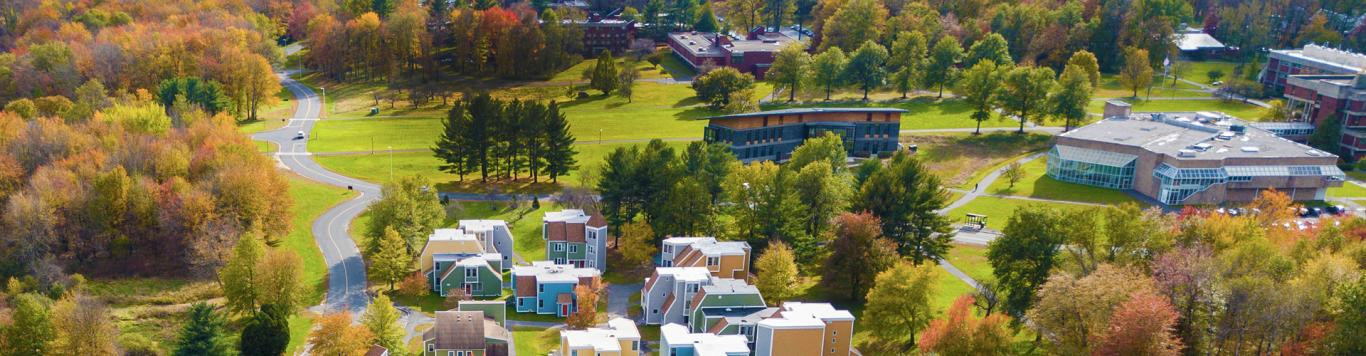
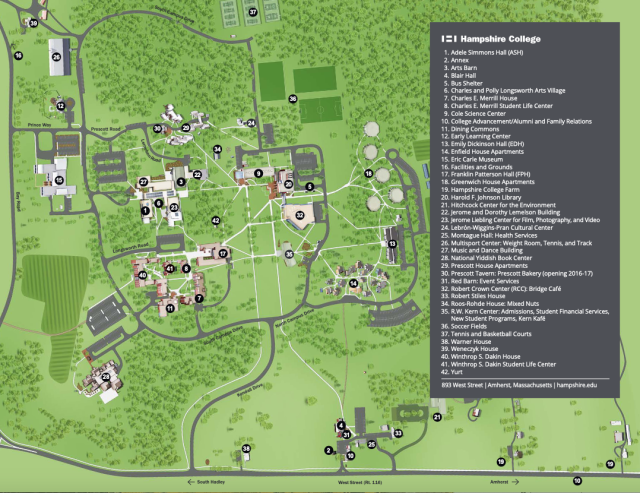
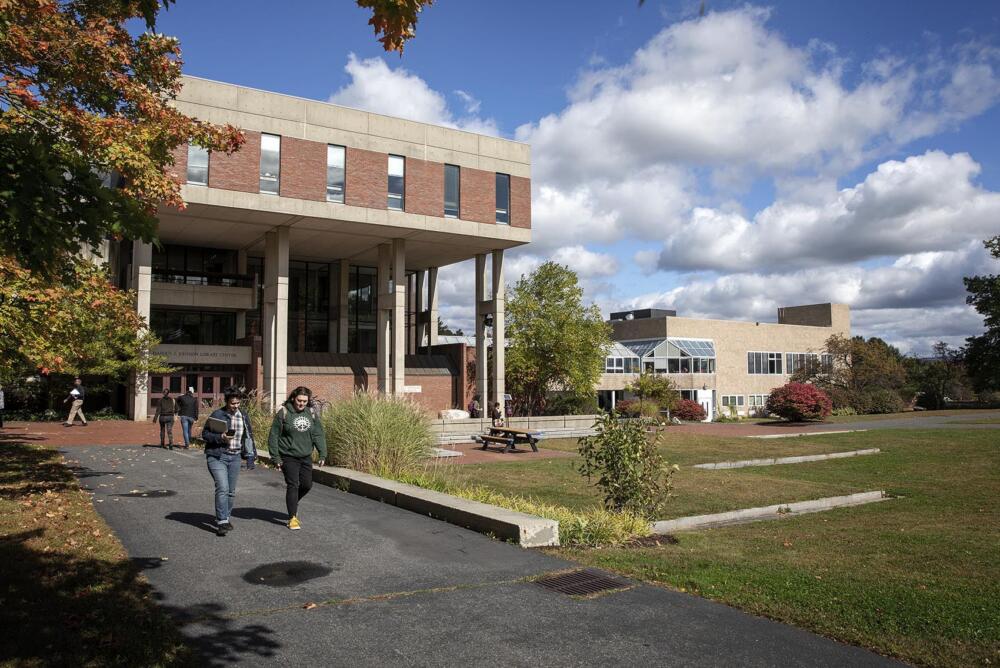
Life at Hampshire is as self-directed as its academics. The campus is described by the college itself as "unconventional, definitely quirky, and always welcoming." It fosters an intensely intellectual and socially conscious community where conversations about "philosophy, politics, art, literature, and social change" happen informally everywhere. This culture attracts "smart, quirky students who prefer small group poetry discussions over" more traditional collegiate social scenes. Residential life is a central part of the experience, with 91% of students living in college-owned, -operated, or -affiliated housing. The physical campus provides "room to grow," and students are encouraged to create a life that blends their academic and personal passions.
Hampshire's outcomes are a direct reflection of its demanding, unstructured model. The four-year graduation rate is notably low, with sources reporting figures of 47%, 54.8%, and 56%. The six-year graduation rate is higher, reported at 63% (2022), 65%, and 72% in different sources. First-year retention rates are reported as 72% and 78%. Where Hampshire alumni truly excel is in pursuing advanced degrees; the college proudly states it is "in the top 2% of institutions for producing graduates that go on to earn Ph.D.s." For those entering the workforce directly, median earnings ten years after entry are reported as $46,938. A significant portion of graduates (54%) borrow to finance their education, with average debt at graduation reported as $26,911.
Hampshire is a high-tuition institution that commits significant resources to . For the 2023-24 year, the average need-based grant and the average total financial aid package were both $51,250. The college reports that 100% of full-time beginning undergraduates receive grant or scholarship aid, with 38% benefiting from federal Pell Grants. The —the cost after grants and scholarships—is reported variably as $24,087, $28,165, and an average of $24,034 (the canonical figure). The college offers a Net Price Calculator for families to estimate their individual cost. Its aid policies note that students who decline their student loans are not eligible for additional institutional grants, indicating loans are a standard part of aid packages and that Hampshire does not have a universal "no-loan" policy for all students.
Hampshire College stands out as one of the most radically experimental liberal arts colleges in America. It is defined by the complete absence of traditional structure: no majors, no grades, no required core curriculum. This places extraordinary agency—and responsibility—on the student to craft an education from the ground up. The payoff is a uniquely deep preparation for independent research, creative work, and interdisciplinary thinking, evidenced by its stellar record of producing PhDs. The campus culture is its own ecosystem: a tight-knit, politically active, and intellectually fervent community in the progressive Five College consortium. It's a college for the self-starter, the artist-scientist, the activist-scholar—for whom the freedom to explore without boundaries is worth the challenge of navigating without a map. Its outcomes, from graduation rates to debt levels, underscore that this model is not for everyone, but for the right student, it can be transformative.
Hampshire College seal · sourceCampus Map | Hampshire College · sourceCampus Map | Hampshire College · sourceSoon to close, Hampshire College holds 'transfer fair' for students who wish to complete degrees | WBUR News · source