Admit rate has ranged 36%–80% over the last 5 years — notably volatile. Source: IPEDS via Urban Institute.
Acceptance & SAT from Common Data Set / IPEDS; net price, earnings & graduation from the U.S. Dept. of Education College Scorecard. Figures lag ~1–2 years — verify with the school.
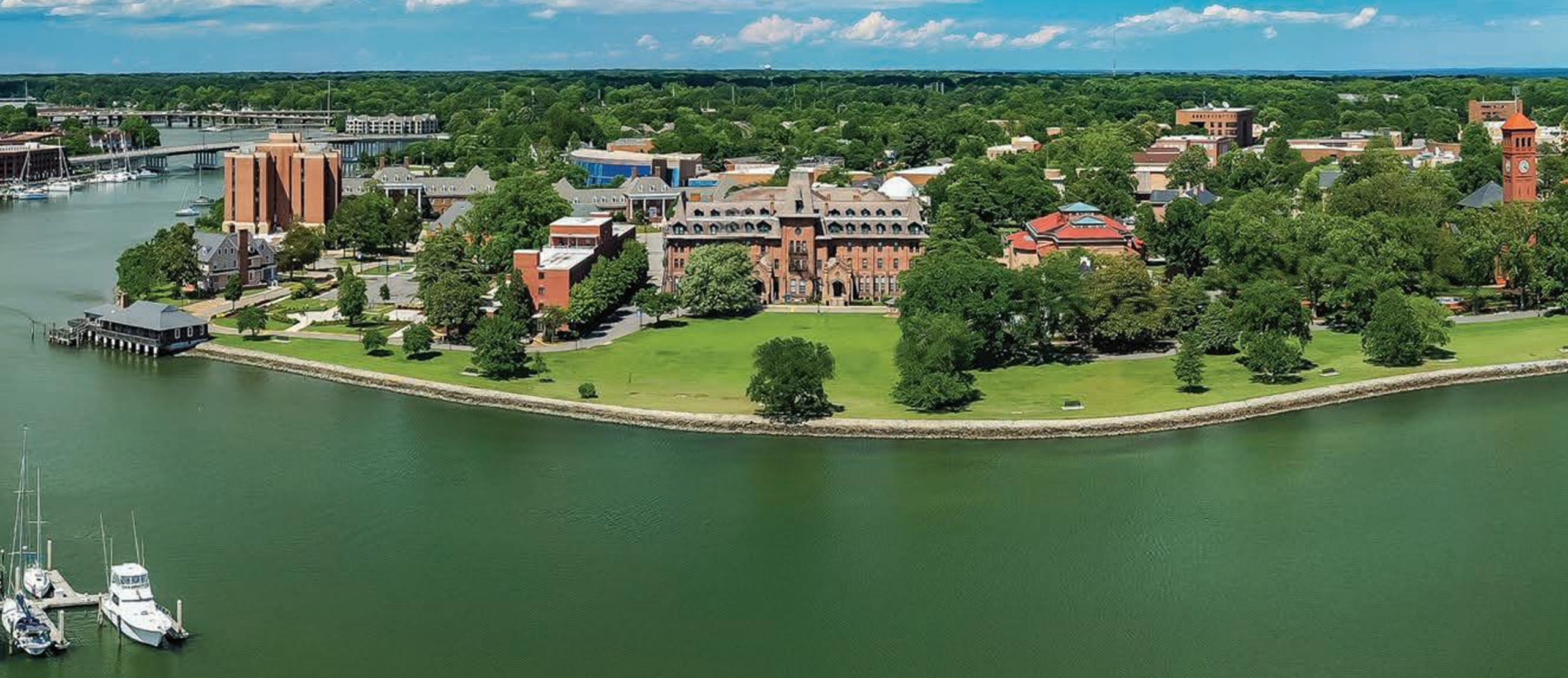
Hampton University is a historic, private HBCU on the Virginia coast that blends a deep sense of tradition with a pragmatic, career-focused education. Known for its close-knit, family-like campus vibe and a curriculum spanning from engineering to journalism, Hampton offers a distinctive, supportive environment where professional preparation and personal development are tightly interwoven. It's a place where legacy is palpable, but the focus is squarely on building futures.
Admission requirements
Test-optional — scores considered if submitted
Required
High school transcript
Grade point average
Letters of recommendation
College-prep program
TOEFL (non-native English)
Considered (not required)
Test scores (SAT/ACT)
Source: IPEDS Admissions survey (2022) via Urban Institute. Covers formal factors only — it does not reflect essays, extracurriculars, or other holistic criteria.
More details
Undergrad enrollment
3,727
In-state tuition
$30,592
Out-of-state tuition
$30,592
Graduation Rate
57%
On-Campus Housing
74% of students
Most Popular Major
Psychology
Student Organizations
Over 55
Median Earnings (10yr)
$59,159
Regular Decision Deadline
March 1
Students Receiving Financial Aid
56.82%
Outcomes & value
Outcomes & value
Median earnings (10 yr)
$59,159
Value (earnings ÷ net price)
2.3×
Median debt at graduation
$25,442
Graduation rate
57%
First-year retention
85%
Reducing loan balance (3 yr)
43%
Pell (lower-income) share
39%
First-gen share (among federal-aid recipients)
20%
Financial health
2.3 / 3.0Meets the federal financial-responsibility standard
U.S. Dept. of Education Financial Responsibility Composite Score (FY2022-23). Scale −1.0 to 3.0; ≥1.5 meets the standard. Reported for private nonprofit & for-profit institutions only — public universities are state-backed and not scored, so this is a stability signal, not a ranking.
Top-earning majors
Median earnings by field of study (highest credential), ~2 years after completion.
Registered Nursing, Nursing Administration, Nursing Research and Clinical Nursing$61,859
Accounting and Related Services$40,485
Business Administration, Management and Operations$39,369
Political Science and Government$36,992
Marketing$33,993
Psychology, General
Campus & location
Campus safety
On-campus violent crimes (2024)
2
Per 1,000 students
0.47
On-campus criminal offenses classed as violent (murder/non-negligent manslaughter, rape, robbery, aggravated assault) for the most recent reported year. Source: U.S. Dept. of Education Campus Safety and Security (Clery Act). Counts reflect what’s reported to the school, and urban campuses often report more partly due to non-student incidents nearby — read alongside campus size and setting, not as a standalone safety verdict.
Climate
Pleasant days / yr
107
Summer high
86°F
Winter low
39°F
Annual rain
45.1"
Annual snow
3.5"
Natural-hazard risk
Relatively Low
Pleasant days counts days per year with a mean temperature of 55–75°F, a high at or below 90°F, a low at or above 45°F, and little precipitation — a transparent comfort measure, not a weighting we invented. Computed from Open-Meteo ERA5 daily history (2019–2023). Natural-hazard risk is the county’s composite rating from the FEMA National Risk Index.
Deep dive — research, future-scholar output & economic mobility▾
Research output
Institutional h-index
276
Scholarly works
6,703
Institutional research volume and impact from OpenAlex. The h-index reflects large research universities and will be low for teaching-focused liberal-arts colleges — not a measure of undergraduate quality.
Economic mobility
Mobility rate
2.1%
Bottom → top quintile
27%
From bottom quintile
8%
Mobility rate = the share of students who both start in the bottom household-income quintile and reach the top quintile; bottom → top is that chance conditional on starting at the bottom. Source: Opportunity Insights Mobility Report Cards (Chetty, Friedman, Saez, Turner & Yagan). Reflects 1980–82 birth cohorts, so it’s directional, not current.
Quick answers
What is the acceptance rate at Hampton University?
Hampton University's acceptance rate is approximately 62% (Hampton, VA), based on the most recent figures we compiled from public and primary sources.
What SAT score do you need for Hampton University?
Admitted students at Hampton University typically score 790–1090 on the SAT (the middle-50% range). Scores outside this band are still admitted, especially with strong applications.
How much does Hampton University cost?
At Hampton University, the average net price (after aid) is about $25,319 per year. Actual cost varies with financial aid and residency.
How many undergraduates attend Hampton University?
Hampton University enrolls approximately 3,727 undergraduate students.
Where is Hampton University located?
Hampton University is located in Hampton, VA.
Admissions
Hampton University operates with a moderately selective admissions process, admitting a majority of its applicants but with a clear academic benchmark for its incoming class. The university received 17,885 applications for a recent cycle and admitted 62% of them. For those admitted, the middle 50% SAT score range is 790–1090, and the middle 50% ACT range is 14–22. The university reports an early of 71.5%, significantly higher than its regular decision rate.
Admission requirements recommend a strong college-preparatory curriculum: four units of English, three of math, two each of science, social studies, and a foreign language. The university employs a test-flexible policy for high-achieving students; those with an unweighted cumulative GPA of at least 3.60 or who rank in the top 10% of their high school class have the option to submit SAT or ACT scores, but it is not a requirement for them. For other applicants, test scores are typically required. The regular decision deadline is March 1.
Earnings = median of students working ~10 years after entry; debt = median of graduates. Value divides 10-yr earnings by one year’s net price — read it as earnings per dollar of annual cost, not a full lifetime ROI; it favors lower-cost schools. Source: U.S. Dept. of Education College Scorecard. Figures lag ~2 years and reflect all students, not your intended major.
$31,133
Public Relations, Advertising, and Applied Communication$29,685
Criminal Justice and Corrections$29,685
Source: U.S. Dept. of Education College Scorecard (field-of-study earnings). Figures cover graduates who received federal aid and lag ~2 years; not all programs report data.
Hampton offers a career-oriented education through over 80 academic programs across its undergraduate and graduate schools. The curriculum is designed to help students "reach your career goals – and exceed your expectations." The most popular majors reflect a blend of the liberal arts and professional studies. Psychology is the institution's most popular major, with about 42 degrees awarded annually. Other top programs include Broadcast Journalism, Liberal Arts and Sciences/Liberal Studies, Political Science, and Social Work.
The university is organized into distinct schools, including the School of Business (offering a BS in Accounting, among others) and the School of Engineering, Architecture and Aviation. Graduate programs include fields like Applied Mathematics. Students report that companies visit campus "pretty often" and that there are two major career fairs, indicating a strong institutional focus on connecting academics with professional opportunities. The atmosphere within majors is described as supportive, with peers and faculty being "great."
Life at Hampton is defined by a close-knit, supportive, and family-like atmosphere on a historic campus. The university fosters this community through over 55 student organizations, which help students "learn new things, meet new people, and build a wealth of memorable experiences." The campus is primarily residential, with 74% of students living in college-owned, -operated, or -affiliated housing, while 26% live off-campus.
Students describe the general vibe as "chill" and note that while the campus and student body are relatively small, "there's always something to do." The university's identity as an HBCU is a central part of the campus culture, contributing to a strong sense of shared identity and belonging. The official Instagram account portrays a campus life that is both vibrant and steeped in history, showcasing everything from daily student activities to the iconic grounds.
Hampton University is actively working to improve student success metrics, with a stated goal to reach a graduation rate between 80% and 90%. Recent data shows significant progress: the six-year graduation rate rose from 54% to 64% between 2022 and 2025. The current overall graduation rate is 57%.
Financial outcomes for graduates are strong. The median earnings for students working and not enrolled 10 years after entry is $59,159. Earlier career earnings data shows graduates earning approximately $36,100 one year after graduation and about $59,100 five years after graduation, indicating substantial salary growth in the first half-decade post-graduation.
As a private institution, Hampton University's comprehensive fee (tuition and required fees) totals $29,162, with an additional $12,986 for room and board. However, the average —what students actually pay after grants and scholarships—is $25,319. A significant majority of students (56.82%) receive financial aid, with the average aid package being $3,784.
The university offers a variety of scholarships and grants through its Office of Financial Aid & Scholarships and provides an online Net Price Calculator for families to estimate their actual cost. Financial aid includes federal loan programs, such as PLUS Loans for parents, and the university provides information on alternative, credit-based private loans. The institution's materials detail loan programs and application processes but do not advertise a "no-loan" policy that replaces all loans with grants for qualifying students.
Hampton University stands out for its powerful synthesis of historic and forward-looking, pragmatic education. It's not just an HBCU; it's one of the oldest, with a campus that feels like a living museum of Black achievement and a community that students consistently describe as a "family." This supportive environment is actively leveraged for professional gain. The academic structure—over 80 programs with clear pipelines to careers in business, engineering, journalism, and health—is explicitly designed to translate learning into earning, a focus validated by strong post-graduate salary growth.
Unlike institutions that hide behind low , Hampton is accessible yet purposeful, using its test-flexible policy to reward high school achievement while maintaining academic standards. Its recent, dramatic improvement in graduation rates signals an institution seriously committed to student success, not just enrollment. The result is a unique educational proposition: the deep cultural connection and personal attention of a tight-knit HBCU, delivered with the career-focused urgency of a private professional school, all set against the backdrop of its storied history "by the sea."
Hampton University seal · sourceHampton University - Virginia Private Colleges · sourceMap - Hampton University Visitors · sourceStudent Life - Homepage - Hampton University Activities · source