Admit rate has ranged 71%–100% over the last 5 years — notably volatile, though the latest figure above (57%) falls outside that window. Source: IPEDS via Urban Institute.
Acceptance & SAT from Common Data Set / IPEDS; net price, earnings & graduation from the U.S. Dept. of Education College Scorecard. Figures lag ~1–2 years — verify with the school.
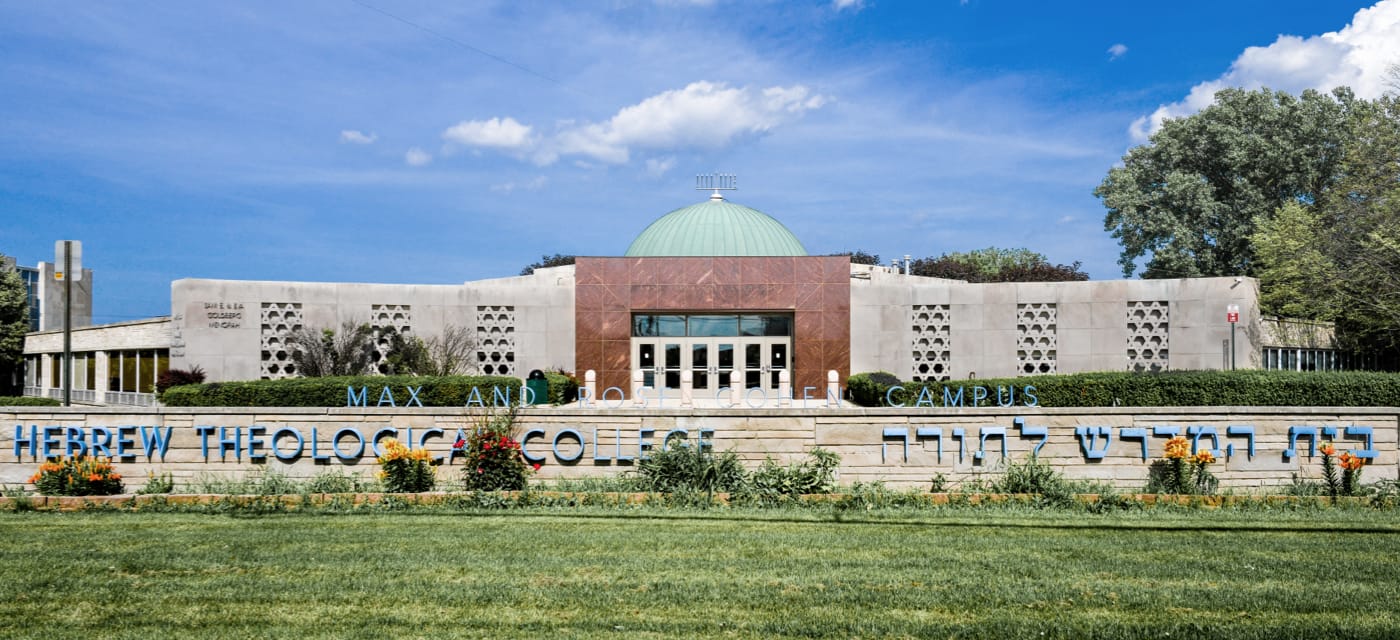
Hebrew Theological College is a singular institution: a Modern Orthodox Jewish college in Skokie, Illinois, where the rhythms of religious observance and intensive Talmudic study define daily life. Its academic model is a dual-track fusion, preparing students for professional careers while grounding them deeply in Jewish law and tradition. This is a tight-knit, purpose-driven community—small in size, with an undergraduate enrollment under 200—where the campus extends into the surrounding vibrant Jewish neighborhoods of suburban Chicago.
Admission requirements
Test-optional — scores considered if submitted
Required
High school transcript
Grade point average
Letters of recommendation
TOEFL (non-native English)
Considered (not required)
Test scores (SAT/ACT)
College-prep program
Demonstrated competencies
Source: IPEDS Admissions survey (2022) via Urban Institute. Covers formal factors only — it does not reflect essays, extracurriculars, or other holistic criteria.
Earnings = median of students working ~10 years after entry; debt = median of graduates. Value divides 10-yr earnings by one year’s net price — read it as earnings per dollar of annual cost, not a full lifetime ROI; it favors lower-cost schools. Source: U.S. Dept. of Education College Scorecard. Figures lag ~2 years and reflect all students, not your intended major.
Financial health
2.9 / 3.0Meets the federal financial-responsibility standard
U.S. Dept. of Education Financial Responsibility Composite Score (FY2022-23). Scale −1.0 to 3.0; ≥1.5 meets the standard. Reported for private nonprofit & for-profit institutions only — public universities are state-backed and not scored, so this is a stability signal, not a ranking.
Campus & location
Campus safety
On-campus violent crimes (2024)
0
On-campus criminal offenses classed as violent (murder/non-negligent manslaughter, rape, robbery, aggravated assault) for the most recent reported year. Source: U.S. Dept. of Education Campus Safety and Security (Clery Act). Counts reflect what’s reported to the school, and urban campuses often report more partly due to non-student incidents nearby — read alongside campus size and setting, not as a standalone safety verdict.
Climate
Pleasant days / yr
86
Summer high
80°F
Winter low
22°F
Annual rain
45.5"
Annual snow
32.9"
Natural-hazard risk
Very High
Pleasant days counts days per year with a mean temperature of 55–75°F, a high at or below 90°F, a low at or above 45°F, and little precipitation — a transparent comfort measure, not a weighting we invented. Computed from Open-Meteo ERA5 daily history (2019–2023). Natural-hazard risk is the county’s composite rating from the FEMA National Risk Index.
Deep dive — research, future-scholar output & economic mobility▾
Research output
Institutional h-index
18
Scholarly works
35
Institutional research volume and impact from OpenAlex. The h-index reflects large research universities and will be low for teaching-focused liberal-arts colleges — not a measure of undergraduate quality.
Quick answers
What is the acceptance rate at Hebrew Theological College?
Hebrew Theological College's acceptance rate is approximately 57% (Skokie, IL), based on the most recent figures we compiled from public and primary sources.
How much does Hebrew Theological College cost?
At Hebrew Theological College, the average net price (after aid) is about $26,861 per year. Actual cost varies with financial aid and residency.
How many undergraduates attend Hebrew Theological College?
Hebrew Theological College enrolls approximately 90 undergraduate students.
Where is Hebrew Theological College located?
Hebrew Theological College is located in Skokie, IL.
Admissions
Admission to Hebrew Theological College is realistic for prepared applicants, with an of 57%. The process is ; SAT and ACT scores are considered but not required. For those who do submit scores, the middle 50% SAT range is 940-1170, and the ACT range is 20-23. The average high school GPA of admitted students is 3.66. The college does not offer an Early Decision or Early Action plan. While the outlines standard admission factors, specific institutional priorities for HTC—such as religious commitment or background—are not detailed in the provided sources. Demonstrated interest is a factor measured in the Common Data Set (Section C7) and can improve a student's chance of acceptance, though the sources do not specify HTC's specific policy on whether it is 'Considered' or 'Not considered.'
The academic experience at HTC is bifurcated by gender and deeply rooted in Jewish studies. The Men's Division features a Beis Midrash program with an intensive Talmud focus, where students can earn a B.A. while following a religiously observant lifestyle. The Sarah Hartman Women's College offers a Bachelor of Arts degree requiring 120 semester hours, with no less than 36 credit hours in Judaic Studies. The three most popular majors across the college are Jewish/Judaic Studies, Talmudic Studies, and Accounting, reflecting the institution's dual mission of religious and secular preparation. The curriculum is designed to integrate rigorous Torah learning with academic advancement, though specific details on class sizes or unique pedagogical approaches are not provided in the sources.
Life at HTC is defined by its Orthodox Jewish character and its location in a dense Jewish community. With a total undergraduate enrollment of 197 (as of Fall 2023), the student body is 69% female and 31% male. The college describes itself as fostering a 'warm and friendly atmosphere' where students are 'enthusiastic learners with a passionate commitment to their Torah learning, academic advancement and service.' The campus is not isolated; HTC is 'located in a warm and vibrant Jewish community with numerous shuls, schools, organizations and kosher establishments' in Skokie, effectively blending campus life with neighborhood life. A Student Handbook is provided to help navigate academic, administrative, and social aspects of campus life, though specific clubs, athletics, or housing details are not enumerated in the provided sources.
Graduation rates at HTC show significant volatility. The four-year graduation rate for the Fall 2019 cohort was 86.4%, but it fell to 56.5% for the 2020 cohort. The six-year graduation rate is 50%. Post-graduation earnings for alumni are modest; the median earnings ten years after entry are $33,291, and median earnings six years out are $25,800. The college's own consumer information page and the College Scorecard are the primary sources for this outcomes data. Retention rates are not consistently reported across the provided sources.
The cost structure at HTC is presented per semester. Tuition is $8,775 per semester for a standard 12-18 credit load. When factoring in room, board, textbooks, and other expenses, the typical total cost for on-campus students is estimated at $35,430 per year. The average after grants and scholarships—the amount students actually pay—is reported as $26,861. Financial aid is available in the form of grants, scholarships, student loans, and work-study, with grants and scholarships not requiring repayment. The college offers a maximum scholarship award of $500 per semester, but the sources do not indicate the existence of a no-loan policy or a commitment to meet full demonstrated financial need.
Hebrew Theological College stands out as a deeply immersive Modern Orthodox Jewish institution where higher education is inseparable from religious formation. It is not simply a liberal arts college with a Jewish studies department; it is a Beis Midrash and a college fused into one. The location in Skokie is integral, embedding the small campus within one of America's most robust Orthodox communities—the 'campus' extends into local synagogues, kosher eateries, and schools. This model creates a uniquely sheltered yet engaged environment for students committed to living a religiously observant lifestyle while pursuing a bachelor's degree. The academic focus is unapologetically dual-track: producing accountants, writers, and professionals who are also, first and foremost, learned Jews. It serves a specific niche with a clarity of purpose that few other American colleges can claim.