Admit rate has ranged 53%–71% over the last 5 years — notably volatile. Source: IPEDS via Urban Institute.
Acceptance & SAT from Common Data Set / IPEDS; net price, earnings & graduation from the U.S. Dept. of Education College Scorecard. Figures lag ~1–2 years — verify with the school.
Hendrix College is a small, private liberal arts school in Conway, Arkansas, that punches above its weight with a distinctive, hands-on curriculum and a fiercely close-knit community. It’s the kind of place where the academic rigor is real—expect a ton of writing—but so is the support, with nearly everyone living on a campus described as clean, friendly, and beautifully landscaped. While its acceptance rate is more accessible than many elite liberal arts colleges, Hendrix delivers solid outcomes, with graduates often landing in the $50,000-$75,000 income bracket shortly after leaving.
Admission requirements
Test-optional — scores considered if submitted
Required
High school transcript
Grade point average
College-prep program
Considered (not required)
Class rank
Letters of recommendation
Test scores (SAT/ACT)
Source: IPEDS Admissions survey (2022) via Urban Institute. Covers formal factors only — it does not reflect essays, extracurriculars, or other holistic criteria.
More details
Undergrad enrollment
1,100
In-state tuition
$38,200
Out-of-state tuition
$38,200
No-Loan Policy
Yes, incomes < $60k
Graduation Rate
72%
On-Campus Housing
87%
Median Alumni Earnings (10yr)
$60,376
Meets Full Need for AR Students
Yes
Outcomes & value
Outcomes & value
Median earnings (10 yr)
$60,376
Value (earnings ÷ net price)
2.5×
Median debt at graduation
$26,688
Graduation rate
72%
First-year retention
80%
Reducing loan balance (3 yr)
76%
Pell (lower-income) share
23%
First-gen share (among federal-aid recipients)
19%
Financial health
3.0 / 3.0Meets the federal financial-responsibility standard
U.S. Dept. of Education Financial Responsibility Composite Score (FY2022-23). Scale −1.0 to 3.0; ≥1.5 meets the standard. Reported for private nonprofit & for-profit institutions only — public universities are state-backed and not scored, so this is a stability signal, not a ranking.
Top-earning majors
Median earnings by field of study (highest credential), ~2 years after completion.
Economics$38,289
English Language and Literature, General$25,194
Psychology, General$22,652
Romance Languages, Literatures, and Linguistics$16,478
Source: U.S. Dept. of Education College Scorecard (field-of-study earnings). Figures cover graduates who received federal aid and lag ~2 years; not all programs report data.
On-campus criminal offenses classed as violent (murder/non-negligent manslaughter, rape, robbery, aggravated assault) for the most recent reported year. Source: U.S. Dept. of Education Campus Safety and Security (Clery Act). Counts reflect what’s reported to the school, and urban campuses often report more partly due to non-student incidents nearby — read alongside campus size and setting, not as a standalone safety verdict.
Climate
Pleasant days / yr
79
Summer high
90°F
Winter low
36°F
Annual rain
53.4"
Annual snow
3.1"
Natural-hazard risk
Relatively Moderate
Pleasant days counts days per year with a mean temperature of 55–75°F, a high at or below 90°F, a low at or above 45°F, and little precipitation — a transparent comfort measure, not a weighting we invented. Computed from Open-Meteo ERA5 daily history (2019–2023). Natural-hazard risk is the county’s composite rating from the FEMA National Risk Index.
Deep dive — research, future-scholar output & economic mobility▾
Research output
Institutional h-index
84
Scholarly works
1,100
Institutional research volume and impact from OpenAlex. The h-index reflects large research universities and will be low for teaching-focused liberal-arts colleges — not a measure of undergraduate quality.
Share of this school’s graduates who go on to earn research doctorates (2010–20), by national rank and per-capita yield (NSF institutional-yield ratio). A signal of a research-oriented student culture — not a causal promise, since it partly reflects who enrolls. Only top producers appear. Source: NSF NCSES, Baccalaureate Origins of U.S. Research Doctorate Recipients.
Economic mobility
Quick answers
What is the acceptance rate at Hendrix College?
Hendrix College's acceptance rate is approximately 56% (Conway, AR), based on the most recent figures we compiled from public and primary sources.
What SAT score do you need for Hendrix College?
Admitted students at Hendrix College typically score 1123–1348 on the SAT (the middle-50% range). Scores outside this band are still admitted, especially with strong applications.
How much does Hendrix College cost?
At Hendrix College, the average net price (after aid) is about $24,149 per year. Actual cost varies with financial aid and residency.
How many undergraduates attend Hendrix College?
Hendrix College enrolls approximately 1,100 undergraduate students.
Where is Hendrix College located?
Hendrix College is located in Conway, AR.
Admissions
Hendrix College operates with a moderately selective admissions process. According to the canonical figures, the is 56%, with the middle 50% SAT range for admitted students falling between 1123 and 1348. Other sources corroborate this selectivity, reporting acceptance rates around 55-56% from a pool of thousands of applicants. The academic profile of an entering class is strong, with an average high school GPA of 3.75 and an average ACT composite score of 27. The college has a Regular Decision deadline of February 1. The rate—the percentage of admitted students who choose to enroll—is reported to be in the range of 18% to 20%, which is considered medium for a college of its type. While specific data on Early Decision or Early Action plans is not fully detailed in the provided sources, the overall admissions landscape suggests Hendrix is a realistic target for well-prepared students with solid academic records.
Earnings = median of students working ~10 years after entry; debt = median of graduates. Value divides 10-yr earnings by one year’s net price — read it as earnings per dollar of annual cost, not a full lifetime ROI; it favors lower-cost schools. Source: U.S. Dept. of Education College Scorecard. Figures lag ~2 years and reflect all students, not your intended major.
Mobility rate
0.6%
Bottom → top quintile
10%
From bottom quintile
6%
Mobility rate = the share of students who both start in the bottom household-income quintile and reach the top quintile; bottom → top is that chance conditional on starting at the bottom. Source: Opportunity Insights Mobility Report Cards (Chetty, Friedman, Saez, Turner & Yagan). Reflects 1980–82 birth cohorts, so it’s directional, not current.
Academics at Hendrix are defined by a classic, rigorous liberal arts model with a practical edge. The college offers a Bachelor of Arts degree across 32 majors and 33 minors, alongside a Master of Arts in Accounting. The curriculum emphasizes writing and personalized attention; students and reviewers note that "there is a ton of writing" and "a lot of time must be devoted to studying," creating an "exceptionally rigorous" atmosphere in typically small classes. Popular majors span the liberal arts spectrum, including Health Service Preparatory Studies, English, Psychology, Economics, and Biochemistry. The Social Sciences represent a significant portion of degrees conferred (10%), followed by Computer and Information Sciences and Multi/Interdisciplinary Studies (5% each). The academic philosophy blends classroom learning with hands-on experience, aiming to prepare students for meaningful careers directly from their undergraduate studies.
Life at Hendrix is intensely residential and community-oriented, unfolding on a beautiful campus in the small town of Conway, Arkansas. The college cultivates a highly engaged, on-campus experience, with 87% of students living in college-owned, -operated, or -affiliated housing. Descriptions of campus life are overwhelmingly positive, highlighting happy students, friendly staff, clean buildings, and "top-notch" landscaping. The college actively works to foster an inclusive campus culture through its Student Life division, aiming to develop "compassionate leaders." Traditions, athletics, and a wide array of activities contribute to a sense of belonging, with the environment designed to make students feel "supported, connected, and at home." While social life is active, the focus remains on building a tight-knit community where students can easily form lasting connections.
Hendrix College produces solid graduation and career outcomes for its graduates. The canonical graduation rate is 72%. Other sources report a four-year graduation rate that has reached 70%, with a six-year rate between 70-72%, placing Hendrix in the top 30% of institutions nationally for overall graduation outcomes. Financially, alumni find reasonable success. The median annual income of alumni falls between $50,000 and $74,999, with more than a third earning over $75,000. Early-career earnings data shows a typical trajectory: about $26,349 one year after graduation, rising to approximately $49,579 five years out. These figures suggest Hendrix provides a strong return on investment, effectively preparing graduates for the workforce and graduate school.
Hendrix is a private college with a comprehensive price tag, but it counters this with a robust financial aid program designed to increase accessibility. A key statistic: 100% of Hendrix's full-time beginning undergraduates receive some form of grant or scholarship aid. The average after aid—the canonical figure—is $24,149, which includes tuition, living costs, books, and supplies. Merit scholarships are a significant component of the aid package, with awards for the 2026-27 academic year ranging from $20,000 to $30,000 based on the student's profile. The college has also implemented targeted need-based initiatives, notably a pledge to meet 100% of the demonstrated financial need for any qualifying Arkansas high school senior who enrolls. Furthermore, the college has a no-loan policy for students from families with incomes below $60,000, meaning loans are not included in their initial financial aid package.
Hendrix College stands out as a quintessential, high-engagement liberal arts college that delivers a premium educational experience without the cutthroat selectivity of its Northeastern peers. Its distinct character is forged in the contrast between its demanding academic culture—noted for intense writing requirements and rigorous small classes—and its exceptionally warm, supportive, and residential community in Conway, Arkansas. The college doesn't just talk about hands-on learning; it's baked into the curriculum, directly linking liberal arts study to career preparation. Financially, Hendrix makes a serious commitment to accessibility through its universal aid distribution, generous merit scholarships, and pioneering no-loan policy for lower-income Arkansas families. The result is a school that feels both ambitious and unpretentious, producing graduates with strong writing chops, practical skills, and earnings that reliably land in the $50,000-$75,000 range—a compelling value proposition in the world of private liberal arts education.
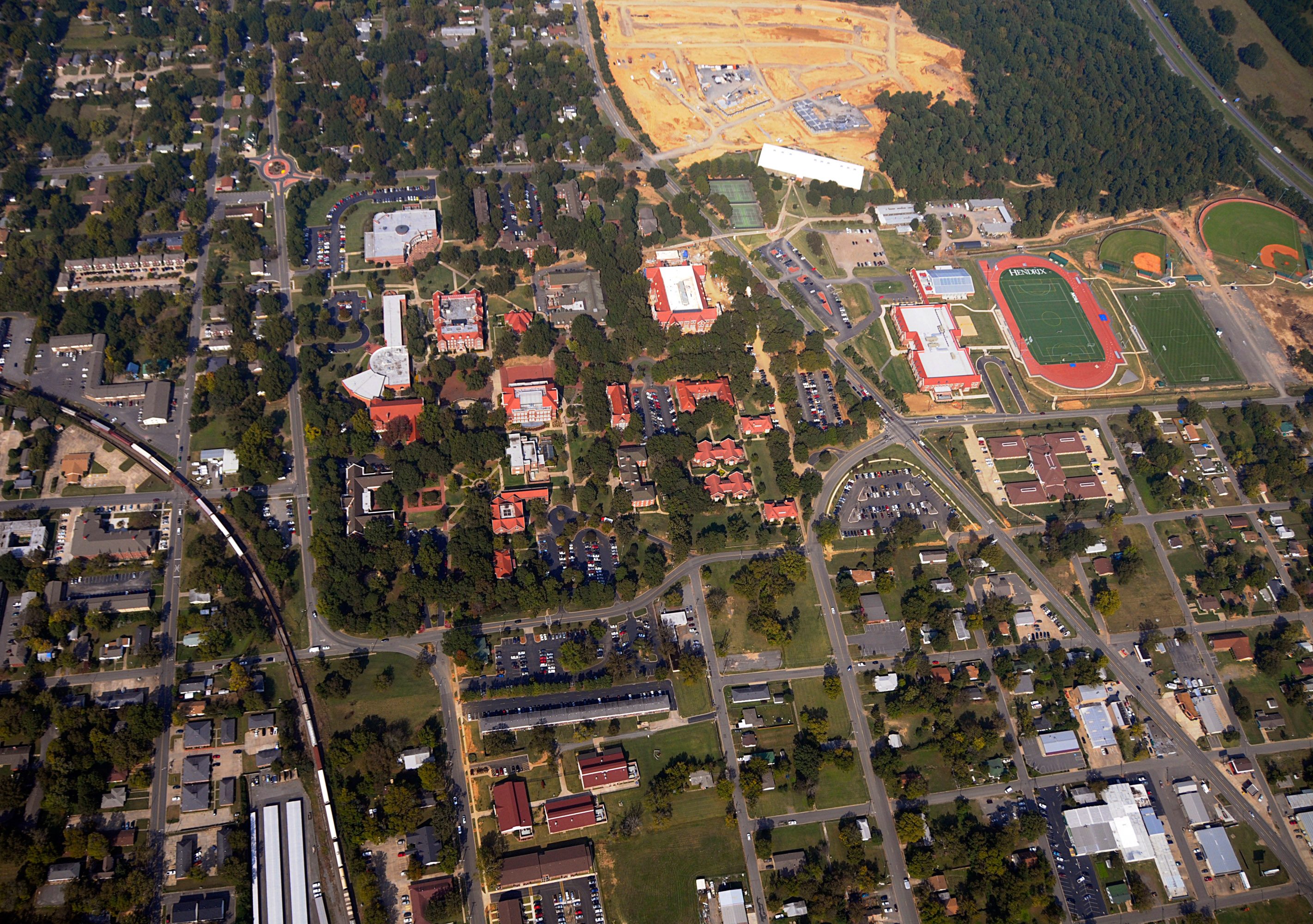
Hendrix College seal · sourceHendrix College | Campus Map · sourceLocation | Hendrix College · sourceAerial View of Hendrix College | Hendrix College · source


_Fall%202025.png)