Admit rate has ranged 74%–80% over the last 5 years. Source: IPEDS via Urban Institute.
Acceptance & SAT from Common Data Set / IPEDS; net price, earnings & graduation from the U.S. Dept. of Education College Scorecard. Figures lag ~1–2 years — verify with the school.
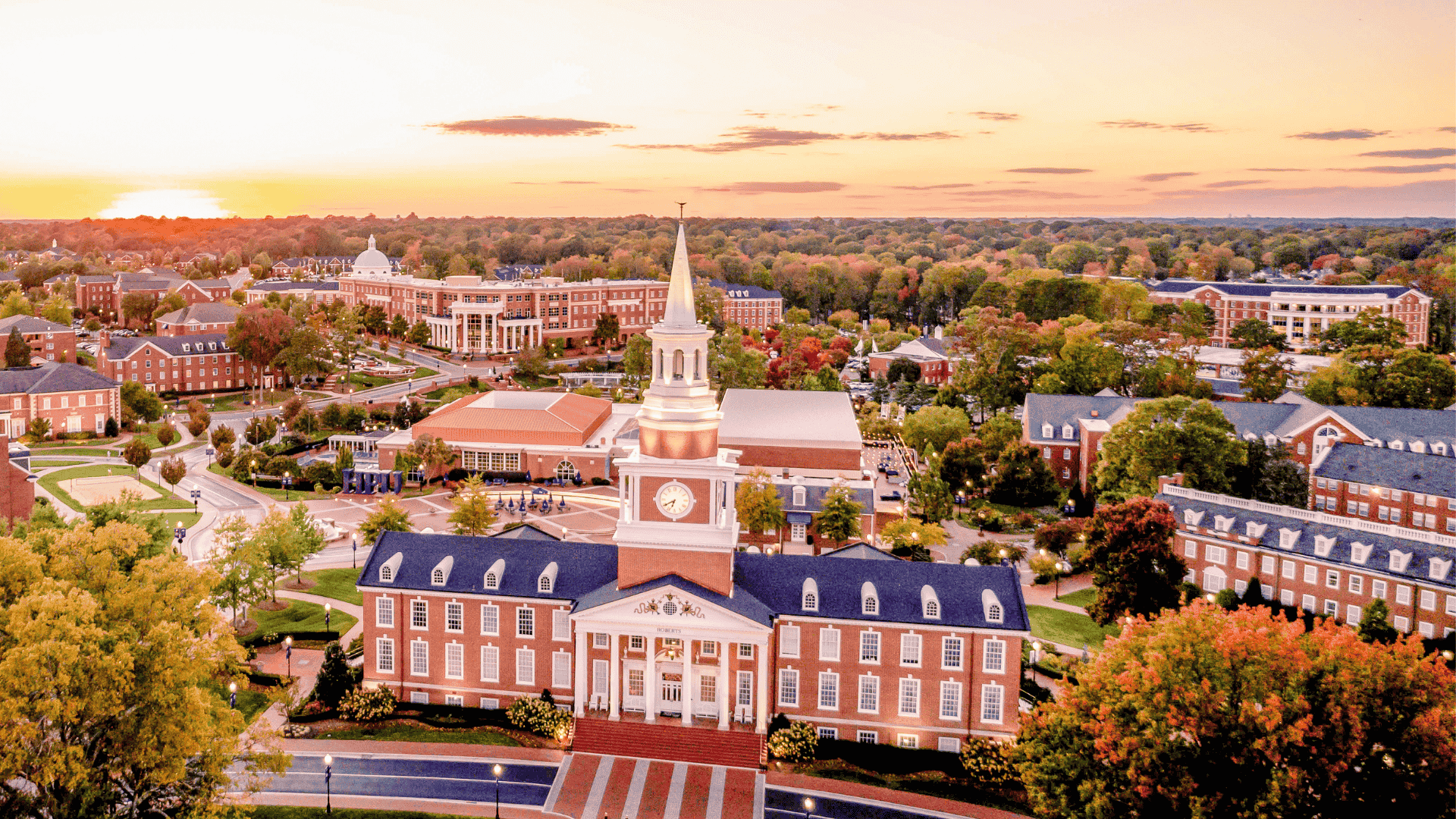
High Point University is a private institution in North Carolina that has aggressively cultivated a reputation as a 'luxury' campus experience, complete with concierge services, free campus snacks, and a focus on career outcomes. It's a place where business and communications majors thrive in a highly structured, amenity-rich environment that feels more like a resort than a traditional college. The school's marketing is slick and its selectivity is increasing, but its core identity is built on a promise of professional preparation and a polished, supportive student life.
Admission requirements
Test-optional — scores considered if submitted
Required
High school transcript
Grade point average
Letters of recommendation
College-prep program
TOEFL (non-native English)
Considered (not required)
Test scores (SAT/ACT)
Demonstrated competencies
Source: IPEDS Admissions survey (2022) via Urban Institute. Covers formal factors only — it does not reflect essays, extracurriculars, or other holistic criteria.
More details
Undergrad enrollment
5,129
In-state tuition
$45,312
Out-of-state tuition
$45,312
Graduation Rate
74%
Student Organizations
130+
Median Earnings (10yr)
$61,389
Freshmen Living On Campus
99%
Most Popular Major Cluster
Business (40%)
Career Outcomes Rate (Class of 2024)
99.2%
Outcomes & value
Outcomes & value
Median earnings (10 yr)
$61,389
Value (earnings ÷ net price)
1.6×
Median debt at graduation
$24,575
Graduation rate
74%
First-year retention
85%
Reducing loan balance (3 yr)
70%
Pell (lower-income) share
12%
First-gen share (among federal-aid recipients)
15%
Financial health
3.0 / 3.0Meets the federal financial-responsibility standard
U.S. Dept. of Education Financial Responsibility Composite Score (FY2022-23). Scale −1.0 to 3.0; ≥1.5 meets the standard. Reported for private nonprofit & for-profit institutions only — public universities are state-backed and not scored, so this is a stability signal, not a ranking.
Campus & location
Campus safety
On-campus violent crimes (2024)
14
Per 1,000 students
2.21
On-campus criminal offenses classed as violent (murder/non-negligent manslaughter, rape, robbery, aggravated assault) for the most recent reported year. Source: U.S. Dept. of Education Campus Safety and Security (Clery Act). Counts reflect what’s reported to the school, and urban campuses often report more partly due to non-student incidents nearby — read alongside campus size and setting, not as a standalone safety verdict.
Climate
Pleasant days / yr
103
Summer high
87°F
Winter low
35°F
Annual rain
45.6"
Annual snow
4.1"
Natural-hazard risk
Relatively Moderate
Pleasant days counts days per year with a mean temperature of 55–75°F, a high at or below 90°F, a low at or above 45°F, and little precipitation — a transparent comfort measure, not a weighting we invented. Computed from Open-Meteo ERA5 daily history (2019–2023). Natural-hazard risk is the county’s composite rating from the FEMA National Risk Index.
Deep dive — research, future-scholar output & economic mobility▾
Research output
Institutional h-index
103
Scholarly works
2,925
Institutional research volume and impact from OpenAlex. The h-index reflects large research universities and will be low for teaching-focused liberal-arts colleges — not a measure of undergraduate quality.
Economic mobility
Mobility rate
1.7%
Bottom → top quintile
21%
From bottom quintile
8%
Mobility rate = the share of students who both start in the bottom household-income quintile and reach the top quintile; bottom → top is that chance conditional on starting at the bottom. Source: Opportunity Insights Mobility Report Cards (Chetty, Friedman, Saez, Turner & Yagan). Reflects 1980–82 birth cohorts, so it’s directional, not current.
Quick answers
What is the acceptance rate at High Point University?
High Point University's acceptance rate is approximately 75% (High Point, NC), based on the most recent figures we compiled from public and primary sources.
What SAT score do you need for High Point University?
Admitted students at High Point University typically score 1110–1320 on the SAT (the middle-50% range). Scores outside this band are still admitted, especially with strong applications.
How much does High Point University cost?
At High Point University, the average net price (after aid) is about $38,707 per year. Actual cost varies with financial aid and residency.
How many undergraduates attend High Point University?
High Point University enrolls approximately 5,129 undergraduate students.
Where is High Point University located?
High Point University is located in High Point, NC.
Admissions
High Point's admissions process is becoming more selective, with the university itself touting a decline in its admit rate from 80% to 68% over a recent five-year period while enrollment hit an all-time high. The university does not publish a , which limits transparency into the precise weight given to factors like demonstrated interest. For the Class of 2029, the average admitted student presented an unweighted GPA of 3.52. The average SAT score for admitted students is 1280, and the average ACT composite is 27. The university offers an Early Decision option, which promises a decision by November 24, and data suggests applying ED can provide a significant advantage; the early is 84.6%, compared to the overall rate. The regular decision deadline is March 1. Nearly all (99%) of freshmen live on campus, underscoring the school's highly residential, immersive model.
Earnings = median of students working ~10 years after entry; debt = median of graduates. Value divides 10-yr earnings by one year’s net price — read it as earnings per dollar of annual cost, not a full lifetime ROI; it favors lower-cost schools. Source: U.S. Dept. of Education College Scorecard. Figures lag ~2 years and reflect all students, not your intended major.
Academics
HPU offers a broad undergraduate curriculum with 64 majors and 74 minors, though the academic culture is dominated by a few key areas. A full 40% of undergraduates concentrate their studies in Business, Management, Marketing, and related support services. Parks, Recreation, Leisure, Fitness, and Kinesiology (which includes the popular Exercise Science major) accounts for another 10%. Other popular majors include Communications, Education, Biology, and Interior Design. The university emphasizes experiential learning and academic innovation, with newer programs like Business Analytics & Economics, Mechanical Engineering, and Mechatronics rounding out its offerings. The academic approach is pragmatic and career-focused, designed to align with the university's strong outcomes in job placement.
Life at HPU is engineered for engagement and comfort, creating a distinctively polished and social campus atmosphere. With over 130 student organizations, activities range from campus recreation and religious life to a robust Greek system featuring 17 nationally recognized fraternities and sororities, including Alpha Chi Omega, Sigma Nu, and Zeta Tau Alpha. The campus culture is frequently described as driven yet supportive, a place where students are encouraged to dream big and try new things. The university actively promotes its extensive amenities and a vibrant social scene, positioning itself as one of the most fun campuses. This curated experience is a central part of HPU's brand, fostering a tight-knit, residential community where nearly every freshman lives on campus.
Career preparation is HPU's undisputed flagship product, and the numbers back up the marketing. An independently verified 99.2% of the Class of 2024 were employed or enrolled in graduate school within 180 days of graduation. This builds on a strong track record, with 98% of the Class of 2021 achieving the same milestone within six months—a rate the university notes is 14 points higher than the national average. The median salary for alumni six years after graduation is reported as $47,613, with earnings five years out at $59,043. The university claims the top spot in North Carolina for career placement, making its outcomes a primary selling point for prospective students and families investing in the HPU experience.
Attending High Point University requires a significant financial commitment, with a published total reaching $73,712 for tuition and fees. The average after aid is substantial. Financial aid is widely distributed, with 99% of students receiving some form of scholarship or grant, and the average financial aid package is $26,086. The university offers a range of merit scholarships, from $5,000 up to full tuition, and automatically awards an additional $3,000 per year merit scholarship to every accepted and enrolling student. is determined by the FAFSA, and students must maintain Satisfactory Academic Progress to retain institutional aid. The university's policies explicitly state it does not engage in revenue-sharing with lenders. There is no indication in the provided sources that HPU has a no-loan policy or meets full demonstrated financial need for all admitted students.
High Point University stands out for its unabashed, all-in commitment to a premium, service-oriented undergraduate experience explicitly tied to career results. It is less a traditional liberal arts college and more a professionally focused institution wrapped in a luxury resort's amenities. The campus vibe is meticulously curated—from the prevalence of free snacks to concierge services—creating an environment that feels both supportive and aspirational. Its identity is built on a powerful feedback loop: a rising admissions profile (selectivity is increasing), investment in flashy facilities and student life, and then marketing its near-perfect career placement rate to justify the premium cost. For students seeking a structured, socially vibrant path from freshman year to a first job, HPU offers a clear, high-touch proposition that few other schools match with such singular focus.
High Point University seal · sourceVisitor Information | High Point University · sourceHPU Named Among Nation's Best for Student Housing and Recreation | High Point University · sourceHigh Point University | The Nation's #1 Best Run College | High Point University · source