Admit rate has ranged 53%–76% over the last 5 years — notably volatile. Source: IPEDS via Urban Institute.
Acceptance & SAT from Common Data Set / IPEDS; net price, earnings & graduation from the U.S. Dept. of Education College Scorecard. Figures lag ~1–2 years — verify with the school.
John Brown University carves out a distinct niche as a Christian liberal arts institution in northwest Arkansas that takes its practical, career-oriented mission seriously. It's a place where faith, community, and professional preparation converge, producing graduates who land jobs and earn salaries that punch above the state average. With a notably accessible admissions process and a focus on hands-on learning, JBU attracts students looking for a tight-knit, purpose-driven education that delivers tangible results.
Admission requirements
Test-optional — scores considered if submitted
Required
High school transcript
Grade point average
TOEFL (non-native English)
Considered (not required)
Class rank
Letters of recommendation
Test scores (SAT/ACT)
Demonstrated competencies
Source: IPEDS Admissions survey (2022) via Urban Institute. Covers formal factors only — it does not reflect essays, extracurriculars, or other holistic criteria.
More details
Undergrad enrollment
1,471
In-state tuition
$31,756
Out-of-state tuition
$31,756
Top Majors
Business, Nursing, Engineering, Visual Arts
Graduation Rate
72%
Financial Aid Reach
99% of students receive aid
Housing (On-Campus)
69% live in college housing
Median Earnings (10yr)
$53,907
Outcomes & value
Outcomes & value
Median earnings (10 yr)
$53,907
Value (earnings ÷ net price)
2.6×
Median debt at graduation
$21,250
Graduation rate
72%
First-year retention
81%
Reducing loan balance (3 yr)
75%
Pell (lower-income) share
24%
First-gen share (among federal-aid recipients)
29%
Financial health
3.0 / 3.0Meets the federal financial-responsibility standard
U.S. Dept. of Education Financial Responsibility Composite Score (FY2022-23). Scale −1.0 to 3.0; ≥1.5 meets the standard. Reported for private nonprofit & for-profit institutions only — public universities are state-backed and not scored, so this is a stability signal, not a ranking.
Top-earning majors
Median earnings by field of study (highest credential), ~2 years after completion.
Engineering, General$65,573
Construction Management$65,517
Business Administration, Management and Operations$55,813
Marketing$42,682
Business/Commerce, General$42,402
Design and Applied Arts$37,748
Campus & location
Campus safety
On-campus violent crimes (2024)
1
Per 1,000 students
0.53
On-campus criminal offenses classed as violent (murder/non-negligent manslaughter, rape, robbery, aggravated assault) for the most recent reported year. Source: U.S. Dept. of Education Campus Safety and Security (Clery Act). Counts reflect what’s reported to the school, and urban campuses often report more partly due to non-student incidents nearby — read alongside campus size and setting, not as a standalone safety verdict.
Climate
Pleasant days / yr
83
Summer high
89°F
Winter low
32°F
Annual rain
53.2"
Annual snow
7"
Natural-hazard risk
Relatively Moderate
Pleasant days counts days per year with a mean temperature of 55–75°F, a high at or below 90°F, a low at or above 45°F, and little precipitation — a transparent comfort measure, not a weighting we invented. Computed from Open-Meteo ERA5 daily history (2019–2023). Natural-hazard risk is the county’s composite rating from the FEMA National Risk Index.
Deep dive — research, future-scholar output & economic mobility▾
Research output
Institutional h-index
431
Scholarly works
48,164
Institutional research volume and impact from OpenAlex. The h-index reflects large research universities and will be low for teaching-focused liberal-arts colleges — not a measure of undergraduate quality.
Economic mobility
Mobility rate
2.1%
Bottom → top quintile
25%
From bottom quintile
8%
Mobility rate = the share of students who both start in the bottom household-income quintile and reach the top quintile; bottom → top is that chance conditional on starting at the bottom. Source: Opportunity Insights Mobility Report Cards (Chetty, Friedman, Saez, Turner & Yagan). Reflects 1980–82 birth cohorts, so it’s directional, not current.
Quick answers
What is the acceptance rate at John Brown University?
John Brown University's acceptance rate is approximately 76% (Siloam Springs, AR), based on the most recent figures we compiled from public and primary sources.
What SAT score do you need for John Brown University?
Admitted students at John Brown University typically score 1070–1340 on the SAT (the middle-50% range). Scores outside this band are still admitted, especially with strong applications.
How much does John Brown University cost?
At John Brown University, the average net price (after aid) is about $20,397 per year. Actual cost varies with financial aid and residency.
How many undergraduates attend John Brown University?
John Brown University enrolls approximately 1,471 undergraduate students.
Where is John Brown University located?
John Brown University is located in Siloam Springs, AR.
Admissions
JBU's admissions process is notably accessible, with an of 76%. The university is categorized as "less selective," making it a realistic target for a broad range of applicants. The middle 50% SAT range for admitted students who submit scores is 1070–1340, though scoring significantly above that range can nearly guarantee admission. The university does not appear to offer an Early Decision program, and none of the provided sources mention an Early Decision acceptance rate or the share of a class filled via Early Decision. Similarly, the sources do not specify whether JBU considers demonstrated interest in its admissions decisions, nor do they provide a rate (the percentage of admitted students who enroll).
The academic experience at JBU is defined by a blend of Christian commitment and professional pragmatism. The university offers over 50 undergraduate majors, with particular strength in fields that lead directly to careers. Its top programs are repeatedly cited as business, nursing, visual arts, engineering, teacher education, psychology, and computer science. This focus on applied learning is central to its identity, aiming to equip students "for a successful career and a life of purpose." Popular majors among graduates reflect this, with Family and Consumer Sciences/Human Sciences, Engineering, Education, and Biological and Biomedical Sciences being notable areas of study. The curriculum is described as rigorous, emphasizing hands-on experiences alongside its foundational Christian worldview.
Earnings = median of students working ~10 years after entry; debt = median of graduates. Value divides 10-yr earnings by one year’s net price — read it as earnings per dollar of annual cost, not a full lifetime ROI; it favors lower-cost schools. Source: U.S. Dept. of Education College Scorecard. Figures lag ~2 years and reflect all students, not your intended major.
Teacher Education and Professional Development, Specific Subject Areas
$37,208
Teacher Education and Professional Development, Specific Levels and Methods$33,993
Source: U.S. Dept. of Education College Scorecard (field-of-study earnings). Figures cover graduates who received federal aid and lag ~2 years; not all programs report data.
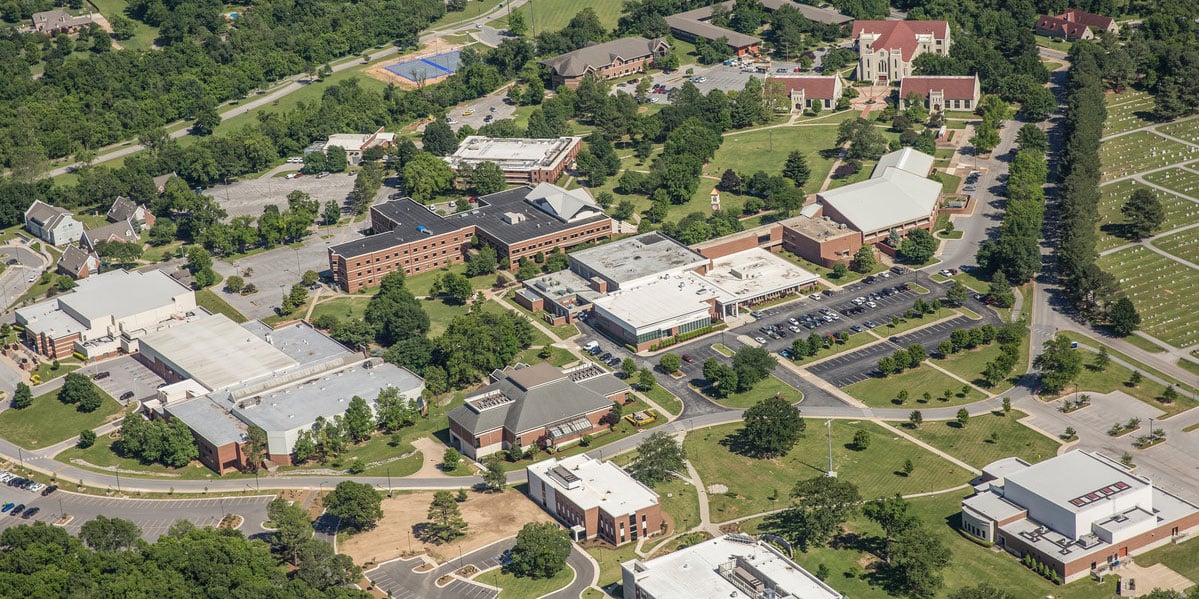
Life at JBU revolves around an intentionally close-knit, residential community. A significant majority of students—69%—live in college-owned, -operated, or -affiliated housing, fostering a campus-centric experience. The university actively cultivates this community through organized Student Events and Activities (SEA), which are designed to "cultivate community, culture and creativity." Campus traditions, like the annual Toilet Paper Game, provide shared touchstones and a sense of belonging. Social life is anchored around common spaces such as the Quad and the Walker Student Center. The overarching vibe, as promoted by the university, is one of being "welcomed into a community of good friends and caring mentors that will help you thrive and enjoy life."
JBU's focus on career-ready education pays off in strong post-graduation results. The university boasts a high knowledge rate of 98% for its graduates, meaning it has reliable data on what they do next. Within six months of graduation, the vast majority of graduates have landed—either in employment, graduate school, military service, or volunteer work. This performance contributed to JBU being ranked No. 1 in Arkansas by The Wall Street Journal in a ranking heavily weighted toward student outcomes like graduation rates and graduate salaries. The four-year graduation rate is 57%, and the six-year rate is a solid 72%. Financially, graduates see a strong return: median earnings five years after graduation are $54,645, and the median earnings ten years after entry are $53,907.
JBU encourages families to look beyond the sticker price, emphasizing that published costs "don't tell the full story." The university provides a Calculator to help families estimate their actual cost after aid. The average net price after aid is $20,397. Financial aid is widespread, with 99% of students receiving some form of it, and the average aid package is $20,300. The university's official financial aid materials discuss Direct Unsubsidized Loans as a component of aid packages for undergraduates, but none of the provided sources indicate that JBU has a "no-loan" policy for low-income students or that it meets 100% of demonstrated financial need without loans. Tuition increases have historically been kept low, averaging less than 3% annually.
John Brown University stands out for its potent combination of Christian identity, community intensity, and career-focused outcomes. It’s not a theoretical liberal arts college; it’s a practical training ground where faith informs vocation. This mission resonates in its top-ranked outcomes within Arkansas, where its graduates' earnings significantly outpace the state average. The campus culture is deliberately engineered for connection—through traditions, residential life, and organized activities—creating an environment where students are known and supported. For students seeking a values-based education that doesn’t sacrifice marketability, JBU offers a clear, proven path: a rigorous, hands-on curriculum in high-demand fields, wrapped in a tight-knit community, leading to a high rate of employment and solid earning potential.
John Brown University seal · sourceVisitor Information · sourceJohn Brown University - Students | Britannica Kids | Homework Help · sourceJohn Brown University - Profile, Rankings and Data | US News Best Colleges · source