Loading…
← All schools
Kentucky Horseshoeing School
Richmond, KYprivate forprofitkhs.edu/
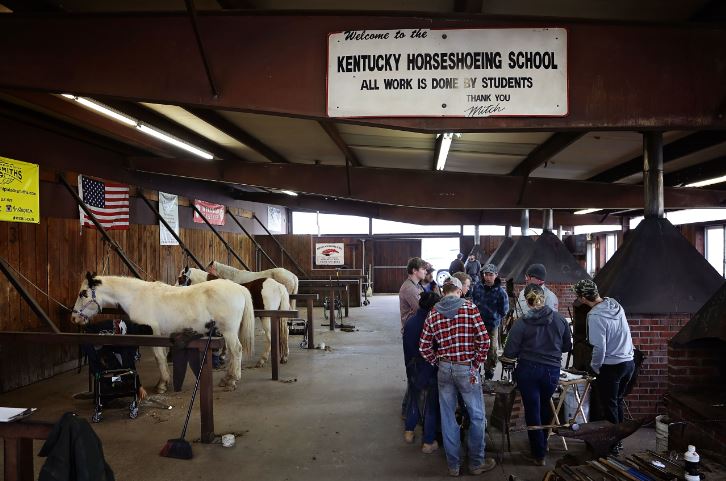
Kentucky Horseshoeing School (KHS) is not a university but a singular, hyper-focused trade school dedicated entirely to the art and science of farriery. In the heart of Kentucky horse country, it operates with a 100% acceptance rate for qualified applicants, offering a rigorous, hands-on 36-week program that transforms novices into skilled farriers. It stands out as the only horseshoeing school in the U.S. approved for federal financial aid, creating a direct, unadorned pipeline into a physically demanding but vital trade.
More details
- Undergrad enrollment
- 31
- Primary Program
- 36-Week Farrier Course
- Minimum Requirement
- High School Diploma/GED
- Federal Financial Aid
- Yes, the only approved horseshoeing school
- Median Earnings (1yr after)
- $36,427
- Student Demographics (Full-time)
- Predominantly White (56.4% Male, 34.5% Female)
Outcomes & value
Outcomes & value
- Pell (lower-income) share
- 37%
Earnings = median of students working ~10 years after entry; debt = median of graduates. Value divides 10-yr earnings by one year’s net price — read it as earnings per dollar of annual cost, not a full lifetime ROI; it favors lower-cost schools. Source: U.S. Dept. of Education College Scorecard. Figures lag ~2 years and reflect all students, not your intended major.
Financial health
-0.7 / 3.0Below the federal standard — financial stress
U.S. Dept. of Education Financial Responsibility Composite Score (FY2022-23). Scale −1.0 to 3.0; ≥1.5 meets the standard. Reported for private nonprofit & for-profit institutions only — public universities are state-backed and not scored, so this is a stability signal, not a ranking.
Campus & location
Campus safety
- On-campus violent crimes (2024)
- 0
On-campus criminal offenses classed as violent (murder/non-negligent manslaughter, rape, robbery, aggravated assault) for the most recent reported year. Source: U.S. Dept. of Education Campus Safety and Security (Clery Act). Counts reflect what’s reported to the school, and urban campuses often report more partly due to non-student incidents nearby — read alongside campus size and setting, not as a standalone safety verdict.
Climate
- Pleasant days / yr
- 97
- Summer high
- 85°F
- Winter low
- 32°F
- Annual rain
- 38.3"
- Annual snow
- 8.6"
- Natural-hazard risk
- Relatively Low
Pleasant days counts days per year with a mean temperature of 55–75°F, a high at or below 90°F, a low at or above 45°F, and little precipitation — a transparent comfort measure, not a weighting we invented. Computed from Open-Meteo ERA5 daily history (2019–2023). Natural-hazard risk is the county’s composite rating from the FEMA National Risk Index.
Quick answers
- How much does Kentucky Horseshoeing School cost?
- At Kentucky Horseshoeing School, the average net price (after aid) is about $29,405 per year. Actual cost varies with financial aid and residency.
- How many undergraduates attend Kentucky Horseshoeing School?
- Kentucky Horseshoeing School enrolls approximately 31 undergraduate students.
- Where is Kentucky Horseshoeing School located?
- Kentucky Horseshoeing School is located in Richmond, KY.
Admissions
The admissions philosophy at Kentucky Horseshoeing School is refreshingly straightforward and utilitarian. There is no , no essay prompts, and no consideration of extracurricular activities. The barrier to entry is clear and minimal: a prospective student must possess a high school diploma, GED, or equivalent certificate. This open-access policy results in a 100% for those who meet this basic requirement. The process is direct: after application, each accepted student is sent a digital copy of the school catalog along with their acceptance materials. The student body that emerges from this process is predominantly White and male, with full-time undergraduate enrollment reported as 56.4% White Male and 34.5% White Female. This is a school for those who have already decided on their trade; there is no need to demonstrate interest beyond applying.
Academics
Academics at KHS mean one thing: the comprehensive, physically intensive 36-week farrier program. This is not a liberal arts curriculum with distribution requirements; it is a total immersion in a craft. The program is designed to build a strong foundational understanding of equine anatomy, physiology, biomechanics, lameness, pathology, and locomotion, with a particular emphasis on analyzing movement and gait. The education is intensely hands-on, moving swiftly from theory to the forge and the hoof. Students spend their days mastering the intricate craft of horseshoeing under the guidance of experienced instructors. The school's own materials frame this as developing a "strong understanding" of complex subjects, but the core of the experience, as noted in student discussions, is the relentless practical application—honing skills in state-of-the-art facilities with the goal of achieving professional competency. There are no electives, no minors; the entire educational offering is this single, deep dive into farriery.
Compare Kentucky Horseshoeing School
See colleges similar to Kentucky Horseshoeing School →Sources
- Common Data Set - IRADS - University of Kentucky
- [PDF] Common Data Set 2021-2022 - Colorado Department of Education
- [PDF] Common Data Set 2018-2019 - AWS
- Common Data Set - GradGPT
- Kentucky Horseshoeing School - Sallie
- Kentucky Horseshoeing School | Data USA
- [PDF] Kentucky Horseshoeing School 2025
- Kentucky Horseshoeing School - Niche
- Kentucky Horseshoeing School Acceptance Rate, SAT, GPA & ACT ...
- Admissions - Kentucky Horseshoeing School
- Kentucky Horseshoeing School