Admit rate has ranged 60%–69% over the last 5 years — notably volatile, though the latest figure above (72%) falls outside that window. Source: IPEDS via Urban Institute.
Acceptance & SAT from Common Data Set / IPEDS; net price, earnings & graduation from the U.S. Dept. of Education College Scorecard. Figures lag ~1–2 years — verify with the school.
Kentucky Wesleyan College is a small, private liberal arts college in Owensboro, Kentucky, where the campus culture is defined by its tight-knit community and a palpable focus on career readiness. With an acceptance rate of 72%, it offers a notably accessible pathway to a four-year degree, particularly for students interested in business, psychology, and the sciences. The college stakes its reputation on a high-touch, 13:1 student-faculty environment and a clear-eyed promise that 88% of graduates are employed or in grad school within six months.
Admission requirements
Test-optional — scores considered if submitted
Required
High school transcript
Grade point average
TOEFL (non-native English)
Considered (not required)
Class rank
Test scores (SAT/ACT)
Source: IPEDS Admissions survey (2022) via Urban Institute. Covers formal factors only — it does not reflect essays, extracurriculars, or other holistic criteria.
More details
Undergrad enrollment
842
In-state tuition
$34,673
Out-of-state tuition
$34,673
Graduation Rate
47%
On-Campus Housing
55%
Median Earnings (10yr)
$46,747
Student-to-Faculty Ratio
13:1
Graduates Working in Field
91%
6-Month Career Outcomes Rate
88%
Outcomes & value
Outcomes & value
Median earnings (10 yr)
$46,747
Value (earnings ÷ net price)
2.7×
Median debt at graduation
$23,250
Graduation rate
47%
First-year retention
53%
Reducing loan balance (3 yr)
57%
Pell (lower-income) share
50%
First-gen share (among federal-aid recipients)
38%
Financial health
1.5 / 3.0Meets the federal financial-responsibility standard
U.S. Dept. of Education Financial Responsibility Composite Score (FY2022-23). Scale −1.0 to 3.0; ≥1.5 meets the standard. Reported for private nonprofit & for-profit institutions only — public universities are state-backed and not scored, so this is a stability signal, not a ranking.
Top-earning majors
Median earnings by field of study (highest credential), ~2 years after completion.
Business/Commerce, General$28,236
Criminal Justice and Corrections$25,580
Source: U.S. Dept. of Education College Scorecard (field-of-study earnings). Figures cover graduates who received federal aid and lag ~2 years; not all programs report data.
On-campus criminal offenses classed as violent (murder/non-negligent manslaughter, rape, robbery, aggravated assault) for the most recent reported year. Source: U.S. Dept. of Education Campus Safety and Security (Clery Act). Counts reflect what’s reported to the school, and urban campuses often report more partly due to non-student incidents nearby — read alongside campus size and setting, not as a standalone safety verdict.
Climate
Pleasant days / yr
89
Summer high
86°F
Winter low
31°F
Annual rain
48.4"
Annual snow
6.3"
Natural-hazard risk
Relatively Moderate
Pleasant days counts days per year with a mean temperature of 55–75°F, a high at or below 90°F, a low at or above 45°F, and little precipitation — a transparent comfort measure, not a weighting we invented. Computed from Open-Meteo ERA5 daily history (2019–2023). Natural-hazard risk is the county’s composite rating from the FEMA National Risk Index.
Deep dive — research, future-scholar output & economic mobility▾
Research output
Institutional h-index
20
Scholarly works
148
Institutional research volume and impact from OpenAlex. The h-index reflects large research universities and will be low for teaching-focused liberal-arts colleges — not a measure of undergraduate quality.
Economic mobility
Mobility rate
1.4%
Bottom → top quintile
17%
From bottom quintile
9%
Mobility rate = the share of students who both start in the bottom household-income quintile and reach the top quintile; bottom → top is that chance conditional on starting at the bottom. Source: Opportunity Insights Mobility Report Cards (Chetty, Friedman, Saez, Turner & Yagan). Reflects 1980–82 birth cohorts, so it’s directional, not current.
Quick answers
What is the acceptance rate at Kentucky Wesleyan College?
Kentucky Wesleyan College's acceptance rate is approximately 72% (Owensboro, KY), based on the most recent figures we compiled from public and primary sources.
What SAT score do you need for Kentucky Wesleyan College?
Admitted students at Kentucky Wesleyan College typically score 890–1130 on the SAT (the middle-50% range). Scores outside this band are still admitted, especially with strong applications.
How much does Kentucky Wesleyan College cost?
At Kentucky Wesleyan College, the average net price (after aid) is about $17,131 per year. Actual cost varies with financial aid and residency.
How many undergraduates attend Kentucky Wesleyan College?
Kentucky Wesleyan College enrolls approximately 842 undergraduate students.
Where is Kentucky Wesleyan College located?
Kentucky Wesleyan College is located in Owensboro, KY.
Admissions
Kentucky Wesleyan College operates with a moderately selective admissions process, admitting a majority of its applicants. The college does not have an open admission policy and reviews applications for first-time, degree-seeking undergraduates. While the initiative is a standard tool for reporting admissions data, the specific Common Data Set for Kentucky Wesleyan College was not provided in the sources. External sources report varying , but the canonical figure for the institution is 72%. The middle 50% SAT score range for admitted students is 890–1130, and the middle 50% ACT score range is 16–23. The average high school GPA of admitted students is reported as 3.30. Notably, only about 15% of applicants submitted SAT scores in a recent cycle. The college charges no application fee. There is no information in the provided sources regarding Early Decision plans, demonstrated interest as an admissions factor, or rate for Kentucky Wesleyan College.
Earnings = median of students working ~10 years after entry; debt = median of graduates. Value divides 10-yr earnings by one year’s net price — read it as earnings per dollar of annual cost, not a full lifetime ROI; it favors lower-cost schools. Source: U.S. Dept. of Education College Scorecard. Figures lag ~2 years and reflect all students, not your intended major.
Academics
Kentucky Wesleyan promotes an intimate academic environment centered on "Fewer Classes. Deeper Learning," backed by a 13:1 student-to-faculty ratio. The college offers over 40 academic programs, including 15 online degrees and certificates. The curriculum is a mix of traditional liberal arts and career-focused majors. The most popular major is Business/Commerce, which awards about 26 degrees annually and accounts for a significant portion of graduates. Other popular majors include Psychology, Kinesiology and Exercise Science, Communications, and Graphic Design. Programs also span fields like Accounting, Animation, Art, Art Education, American Civics and Civilization, and Zoology/Animal Biology. The college's program list suggests a practical orientation, with associate-level options in Business Administration alongside bachelor's degrees.
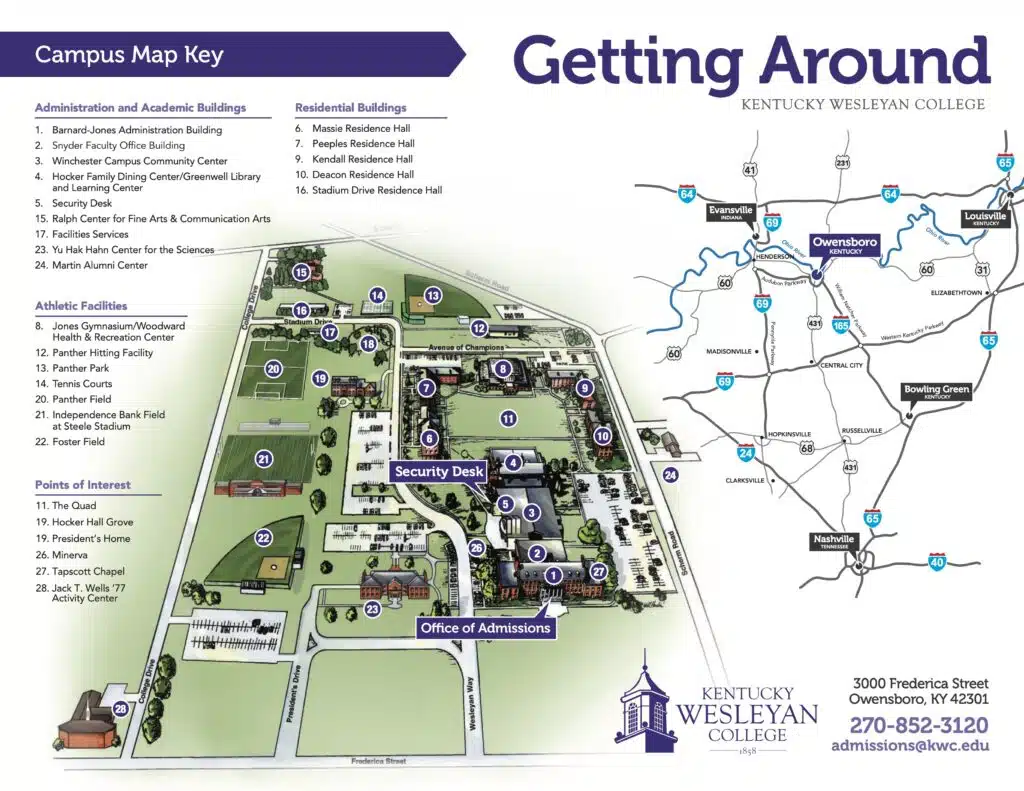
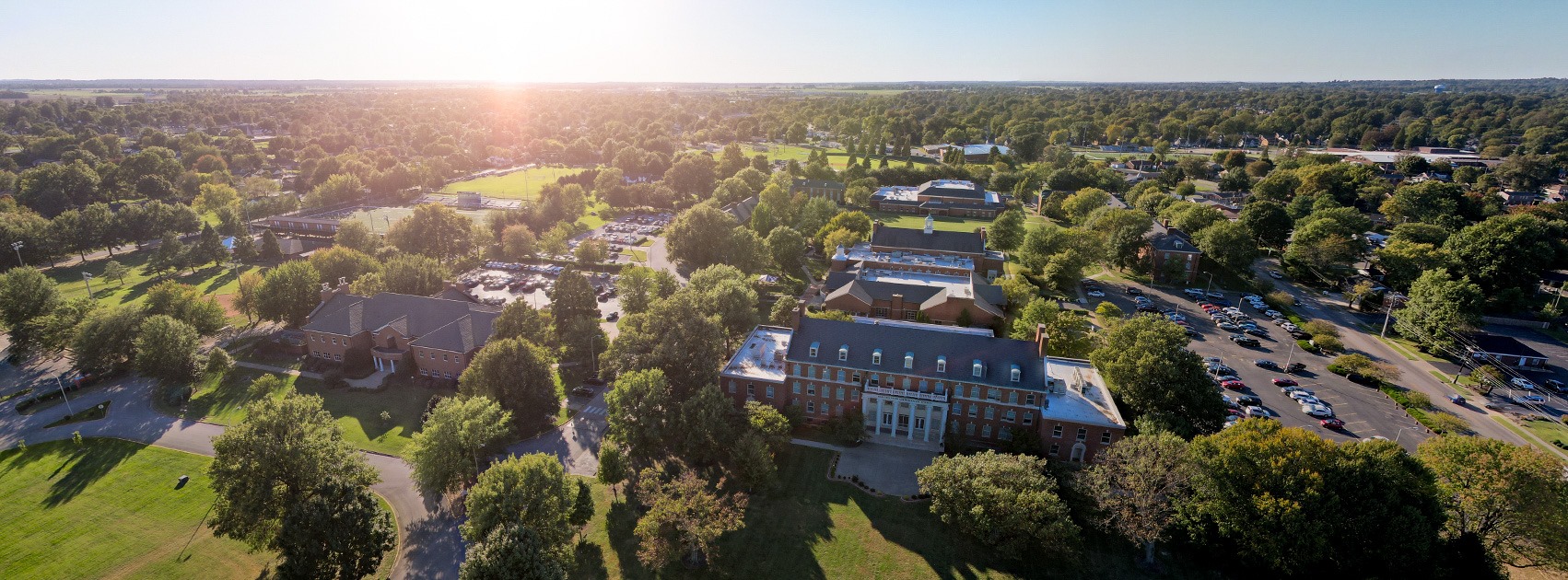
Life on the Owensboro campus is described as "full of energy, purpose, and people who care." The compact campus layout, with buildings close together, fosters an easy, communal atmosphere that students find friendly and welcoming. More than 30 student clubs and organizations form the "heartbeat of campus life," providing opportunities in academics, service, faith, and fun. A majority of students (55%) live in college-owned, -operated, or -affiliated housing, while 45% live off-campus. The Residence Life staff aims to create communities where students can "live, learn, lead, and love." Campus events are fueled by spirited athletic competitions and spontaneous gatherings on the Quad.
Kentucky Wesleyan College heavily promotes its career outcomes, reporting that 88% of the Class of 2025 graduates were employed, in graduate school, or both within six months of earning their degree. Furthermore, 91% of those employed were working in their field of study. The six-year graduation rate is reported by external sources at 53%, with a notable gender gap: a 41% rate for male students and a higher rate for female students. The median earnings for graduates ten years after entry is $46,747. Other data suggests median earnings rise from around $35,200 six years after graduation to $38,505 at a later point. Retention and graduation rates are key factors in the college's recognition by ranking organizations like U.S. News & World Report.
Kentucky Wesleyan College emphasizes affordability through scholarships and aid, offering some awards that range up to full tuition. The average after aid—the cost after scholarships and grants are applied—is $17,131. The college provides a net price calculator for prospective students to estimate their financial aid eligibility. Aid packages include grants and loans, with specific need-based grants like the Supplemental Educational Opportunity Grant (SEOG) for undergraduates demonstrating extreme financial need (determined by FAFSA), which provides $550 per year and does not have to be repaid. The college's financial aid policies state they meet federal guidelines but may differ from other academic institutions' policies. There is no information in the provided sources indicating a no-loan policy or a commitment to meet 100% of demonstrated financial need at Kentucky Wesleyan College.
Kentucky Wesleyan College stands out for its unapologetically practical mission wrapped in a classic small-college package. It’s not trying to be an ultra-selective liberal arts citadel; instead, it focuses on accessibility and clear post-graduate ROI. The 13:1 student-faculty ratio ensures students aren't lost in the crowd, a claim many colleges make but few with such a high can genuinely deliver. Its singular selling point is a compelling outcomes narrative: nearly 9 out of 10 graduates are swiftly employed or in graduate school, with over 90% of those working in their field. This creates a tangible through-line from the classroom to a career, a promise that resonates deeply in a region where practical education is highly valued. The campus vibe—friendly, compact, and active with over 30 clubs—complements this no-nonsense approach, offering a supportive community where the goal isn't just a degree, but a launched life.
Kentucky Wesleyan College seal · sourceCampus Map – Kentucky Wesleyan College · sourceVisit – Kentucky Wesleyan College · sourceKentucky Wesleyan College | Owensboro KY · source