Admit rate has ranged 86%–94% over the last 5 years — notably volatile, though the latest figure above (68%) falls outside that window. Source: IPEDS via Urban Institute.
Acceptance & SAT from Common Data Set / IPEDS; net price, earnings & graduation from the U.S. Dept. of Education College Scorecard. Figures lag ~1–2 years — verify with the school.
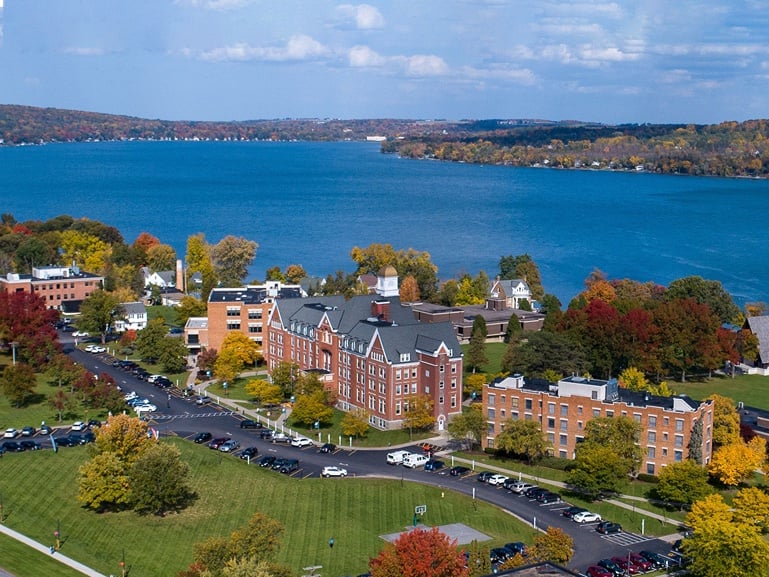
Keuka College is a small, residential liberal arts college perched on the western shore of Keuka Lake in New York's Finger Lakes region. It operates with a clear, pragmatic mission: to deliver career-focused, hands-on education across more than 40 programs, particularly in health professions, business, and human services. While its graduation rates are modest, the college has earned a surprising and significant national reputation for propelling its graduates—many of whom are first-generation—up the economic ladder, landing it in the top 10% of U.S. colleges for economic mobility.
Admission requirements
Test-optional — scores considered if submitted
Required
Grade point average
TOEFL (non-native English)
Considered (not required)
High school transcript
Letters of recommendation
Test scores (SAT/ACT)
College-prep program
Source: IPEDS Admissions survey (2022) via Urban Institute. Covers formal factors only — it does not reflect essays, extracurriculars, or other holistic criteria.
More details
Undergrad enrollment
966
In-state tuition
$39,332
Out-of-state tuition
$39,332
Housing Policy
Residential requirement all four years
Graduation Rate
58%
Median Earnings (10yr)
$58,289
Economic Mobility Ranking
Top 10% nationally
Institutional Aid Awarded Annually
>$19 million
Outcomes & value
Outcomes & value
Median earnings (10 yr)
$58,289
Value (earnings ÷ net price)
2.4×
Median debt at graduation
$27,000
Graduation rate
58%
First-year retention
73%
Reducing loan balance (3 yr)
60%
Pell (lower-income) share
50%
First-gen share (among federal-aid recipients)
38%
Top-earning majors
Median earnings by field of study (highest credential), ~2 years after completion.
Registered Nursing, Nursing Administration, Nursing Research and Clinical Nursing$71,015
Business Administration, Management and Operations$39,639
Social Work$35,060
Criminal Justice and Corrections$32,569
Source: U.S. Dept. of Education College Scorecard (field-of-study earnings). Figures cover graduates who received federal aid and lag ~2 years; not all programs report data.
On-campus criminal offenses classed as violent (murder/non-negligent manslaughter, rape, robbery, aggravated assault) for the most recent reported year. Source: U.S. Dept. of Education Campus Safety and Security (Clery Act). Counts reflect what’s reported to the school, and urban campuses often report more partly due to non-student incidents nearby — read alongside campus size and setting, not as a standalone safety verdict.
Climate
Pleasant days / yr
96
Summer high
80°F
Winter low
23°F
Annual rain
40.9"
Annual snow
44"
Natural-hazard risk
Relatively Low
Pleasant days counts days per year with a mean temperature of 55–75°F, a high at or below 90°F, a low at or above 45°F, and little precipitation — a transparent comfort measure, not a weighting we invented. Computed from Open-Meteo ERA5 daily history (2019–2023). Natural-hazard risk is the county’s composite rating from the FEMA National Risk Index.
Deep dive — research, future-scholar output & economic mobility▾
Research output
Institutional h-index
50
Scholarly works
233
Institutional research volume and impact from OpenAlex. The h-index reflects large research universities and will be low for teaching-focused liberal-arts colleges — not a measure of undergraduate quality.
Economic mobility
Mobility rate
2.3%
Bottom → top quintile
18%
From bottom quintile
13%
Mobility rate = the share of students who both start in the bottom household-income quintile and reach the top quintile; bottom → top is that chance conditional on starting at the bottom. Source: Opportunity Insights Mobility Report Cards (Chetty, Friedman, Saez, Turner & Yagan). Reflects 1980–82 birth cohorts, so it’s directional, not current.
Quick answers
What is the acceptance rate at Keuka College?
Keuka College's acceptance rate is approximately 68% (Keuka Park, NY), based on the most recent figures we compiled from public and primary sources.
How much does Keuka College cost?
At Keuka College, the average net price (after aid) is about $24,338 per year. Actual cost varies with financial aid and residency.
How many undergraduates attend Keuka College?
Keuka College enrolls approximately 966 undergraduate students.
Where is Keuka College located?
Keuka College is located in Keuka Park, NY.
Admissions
Keuka College is a moderately selective institution where the majority of applicants are admitted. The admissions process is described as "somewhat competitive," with an of 68%. For the middle 50% of admitted students, SAT scores typically range from 940 to 1130, and the average high school GPA is around 3.4. The college utilizes the to report its admissions statistics, which provides a standardized look at quantitative factors like acceptance rates and test scores. Notably, the college has reported acceptance rates for early decision applicants that are significantly higher than the overall rate, hovering between 90% and 94% in recent years. While the provided sources reference the Common Data Set's factor importance grid (section C7) for evaluating elements like demonstrated interest, the specific rating Keuka assigns to demonstrated interest is not detailed in the available snippets.
Earnings = median of students working ~10 years after entry; debt = median of graduates. Value divides 10-yr earnings by one year’s net price — read it as earnings per dollar of annual cost, not a full lifetime ROI; it favors lower-cost schools. Source: U.S. Dept. of Education College Scorecard. Figures lag ~2 years and reflect all students, not your intended major.
The academic identity of Keuka College is built on a promise of applied, real-world experience. The college states that every program provides hands-on experience in the student's field every year they are enrolled. With over 40 academic programs spanning the liberal arts, health and human services, education, and business, the curriculum is designed to be directly career-relevant. The most popular majors cluster in Business, Management, Marketing, and Related Support Services, as well as Health Professions and Related Programs. Specific programs in Occupational Therapy and American Sign Language interpreting are noted as particularly well-regarded. This practical focus is recognized externally; Keuka College has earned its 11th straight designation as a 'College of Distinction,' praised for engaged students, great teaching, vibrant community, and successful outcomes. For undecided students, the college promotes its wide variety of majors and minors as tools to develop communication, creativity, and analytical thinking.
Life at Keuka is intensely residential and community-oriented, defined by its stunning—but somewhat remote—location on Keuka Lake. The college has a residential requirement, mandating that all students live in college-owned housing through their senior year. Data shows approximately 74% of students live in college-owned, -operated, or -affiliated housing. This creates a tight-knit, all-in campus atmosphere. The Office of Campus Life aims to provide meaningful learning experiences that support student development within the residence halls and across campus. Student opinions reflect this duality: the campus is widely praised for its natural beauty and strong community spirit, but some find the social scene to be "quite subdued," with limited nightlife and activity options, a common characteristic of a small college in a rural setting. The administrative structure includes a Vice President for Student Development/Dean of Students and a Student Life Manager to oversee this residential experience.
Keuka College presents a compelling narrative of transformation, where traditional graduation metrics tell one story, but post-graduate economic mobility tells another. The institution's most powerful outcome claim is its standing in economic mobility. The New York Times has ranked Keuka College in the top 10% nationally for the economic mobility of its graduates, measuring the likelihood that a graduate will move up between 20% and 40% in income. This indicates the college is highly effective at serving as an engine of upward mobility, particularly for students from lower-income backgrounds. In terms of completion, the six-year graduation rate is reported at 49%, with other sources noting a 61% rate. Early-career earnings data shows a median income of $36,427 one year after graduation. The college's inclusion in U.S. News rankings often highlights this mobility metric as a key strength.
Keuka College is a private institution with a published total cost of $50,294. However, the college emphasizes its commitment to making education accessible through institutional aid. It awards more than $19 million in scholarships and financial aid each year. Merit-based scholarships for incoming full-time freshmen and transfer students can reach up to $28,000. The —the average cost after aid and scholarships are applied—is a critical figure for families. While sources provide varying net price estimates, the college promotes the use of its online Net Price Calculator for personalized estimates, with the caveat that the financial aid office has the final authority on awards. A significant majority of students (89.03%) receive financial aid, with an average aid package of $5,898 reported by one source. The college provides resources and guidance on completing the FAFSA, which is the gateway to federal and institutional .
Keuka College stands out not for cutthroat selectivity or Ivy-covered gothic halls, but for its potent, demonstrable impact on a specific type of student. Its defining characteristic is its extraordinary effectiveness as an engine of economic mobility. Ranking in the top 10% of all U.S. colleges on this metric, it reliably lifts graduates into a higher economic bracket, fulfilling a core promise of the American dream. This outcome is forged through a no-nonsense, experiential academic model—hands-on learning every single year—in fields like health sciences, business, and occupational therapy that directly connect to stable, in-demand careers. The experience is immersive and communal, enforced by a four-year residential requirement on the serene shores of Keuka Lake, which fosters strong bonds but acknowledges a quiet social pace. For students—particularly or those seeking a clear path to a professional career—Keuka offers a tangible return on investment: a supportive, focused environment designed not for prestige, but for pragmatic advancement.
Keuka College seal · sourceKeuka College - A premier educational institution in New York's spectacular Finger Lakes wine country. · sourceKeuka College Announces $6M in Improvements to Campus Facilities | Keuka College · sourceVisitors and Guests to Keuka College | Keuka College · source