Admit rate has ranged 95%–97% over the last 5 years, though the latest figure above (56%) falls outside that window. Source: IPEDS via Urban Institute.
Acceptance & SAT from Common Data Set / IPEDS; net price, earnings & graduation from the U.S. Dept. of Education College Scorecard. Figures lag ~1–2 years — verify with the school.
Lancaster Bible College is not a typical liberal arts school; it's a purpose-built training ground for Christian ministry and service, where every academic program is intentionally fused with biblical studies. The campus vibe is tight-knit and residential, with a clear 'life-on-life' ethos that governs both community standards and daily interactions. For students seeking a career-oriented education explicitly framed by a Christian worldview—whether in social work, business, or pastoral ministry—LBC offers a singular, focused alternative to more secular or broadly evangelical colleges.
Admission requirements
Test-optional — scores considered if submitted
Required
High school transcript
Grade point average
Letters of recommendation
TOEFL (non-native English)
Considered (not required)
Test scores (SAT/ACT)
Source: IPEDS Admissions survey (2022) via Urban Institute. Covers formal factors only — it does not reflect essays, extracurriculars, or other holistic criteria.
More details
Undergrad enrollment
1,569
In-state tuition
$29,990
Out-of-state tuition
$29,990
Graduation Rate
67%
On-Campus Living
~60% of undergrads
Demonstrated Interest
Not considered (per CDS)
Student-Faculty Ratio
18:1
Median Earnings (10yr)
$44,096
First-Year Retention Rate
79%
Outcomes & value
Outcomes & value
Median earnings (10 yr)
$44,096
Value (earnings ÷ net price)
1.7×
Median debt at graduation
$20,500
Graduation rate
67%
First-year retention
79%
Reducing loan balance (3 yr)
62%
Pell (lower-income) share
35%
First-gen share (among federal-aid recipients)
35%
Financial health
2.4 / 3.0Meets the federal financial-responsibility standard
U.S. Dept. of Education Financial Responsibility Composite Score (FY2022-23). Scale −1.0 to 3.0; ≥1.5 meets the standard. Reported for private nonprofit & for-profit institutions only — public universities are state-backed and not scored, so this is a stability signal, not a ranking.
Top-earning majors
Median earnings by field of study (highest credential), ~2 years after completion.
Bible/Biblical Studies$36,668
Sports, Kinesiology, and Physical Education/Fitness$32,925
Teacher Education and Professional Development, Specific Levels and Methods$27,295
Music$25,194
Pastoral Counseling and Specialized Ministries$24,615
Source: U.S. Dept. of Education College Scorecard (field-of-study earnings). Figures cover graduates who received federal aid and lag ~2 years; not all programs report data.
Campus & location
Campus safety
On-campus violent crimes (2024)
0
Per 1,000 students
0.00
On-campus criminal offenses classed as violent (murder/non-negligent manslaughter, rape, robbery, aggravated assault) for the most recent reported year. Source: U.S. Dept. of Education Campus Safety and Security (Clery Act). Counts reflect what’s reported to the school, and urban campuses often report more partly due to non-student incidents nearby — read alongside campus size and setting, not as a standalone safety verdict.
Climate
Pleasant days / yr
88
Summer high
84°F
Winter low
29°F
Annual rain
46.9"
Annual snow
16.1"
Natural-hazard risk
Relatively High
Pleasant days counts days per year with a mean temperature of 55–75°F, a high at or below 90°F, a low at or above 45°F, and little precipitation — a transparent comfort measure, not a weighting we invented. Computed from Open-Meteo ERA5 daily history (2019–2023). Natural-hazard risk is the county’s composite rating from the FEMA National Risk Index.
Deep dive — research, future-scholar output & economic mobility▾
Research output
Institutional h-index
10
Scholarly works
69
Institutional research volume and impact from OpenAlex. The h-index reflects large research universities and will be low for teaching-focused liberal-arts colleges — not a measure of undergraduate quality.
Economic mobility
Mobility rate
0.9%
Bottom → top quintile
14%
From bottom quintile
7%
Mobility rate = the share of students who both start in the bottom household-income quintile and reach the top quintile; bottom → top is that chance conditional on starting at the bottom. Source: Opportunity Insights Mobility Report Cards (Chetty, Friedman, Saez, Turner & Yagan). Reflects 1980–82 birth cohorts, so it’s directional, not current.
Quick answers
What is the acceptance rate at Lancaster Bible College?
Lancaster Bible College's acceptance rate is approximately 56% (Lancaster, PA), based on the most recent figures we compiled from public and primary sources.
What SAT score do you need for Lancaster Bible College?
Admitted students at Lancaster Bible College typically score 1070–1280 on the SAT (the middle-50% range). Scores outside this band are still admitted, especially with strong applications.
How much does Lancaster Bible College cost?
At Lancaster Bible College, the average net price (after aid) is about $25,480 per year. Actual cost varies with financial aid and residency.
How many undergraduates attend Lancaster Bible College?
Lancaster Bible College enrolls approximately 1,569 undergraduate students.
Where is Lancaster Bible College located?
Lancaster Bible College is located in Lancaster, PA.
Admissions
Lancaster Bible College is moderately selective, admitting just over half of its applicants. The college operates under a policy, allowing students to choose whether to submit SAT, ACT, or CLT scores. For those who do submit, the middle 50% SAT range is 1070–1280. The admissions process appears to be straightforward, with the primary institutional goal being to 'educate Christian students,' suggesting a self-selecting applicant pool aligned with the college's mission. There is no evidence in the provided sources that the college employs an Early Decision program or that it tracks 'demonstrated interest' as a formal factor in admissions decisions.
Earnings = median of students working ~10 years after entry; debt = median of graduates. Value divides 10-yr earnings by one year’s net price — read it as earnings per dollar of annual cost, not a full lifetime ROI; it favors lower-cost schools. Source: U.S. Dept. of Education College Scorecard. Figures lag ~2 years and reflect all students, not your intended major.
Every academic program at LBC is built on the foundation of a biblical worldview. The college's explicit mission is to 'educate Christian students to think and live a Biblical worldview and to proclaim Christ by serving Him in the Church and society.' This integrative approach is applied across its bachelor's programs, which include practical, career-oriented fields like Business Administration, Early Childhood Education, AI Systems & Technology Management, and Social Work, alongside traditional ministry-focused degrees in Biblical & Theological Studies. The student-faculty ratio is 18:1, and the college also offers a suite of online undergraduate degrees designed for flexible completion. The academic culture is less about theoretical exploration and more about equipping students with professional skills grounded in Christian principles.
Life at LBC is intensely communal and structured around the college's Christian identity. Approximately 60% of on-campus undergraduates live on campus, creating a close-knit residential environment. The college promotes a 'life-on-life' model of discipleship and community, supported by a dedicated Student Activities team that plans a wide array of events and intramurals. This community is governed by explicit 'Community Lifestyle Standards' that outline behavioral commitments for students. The overall atmosphere is one of a purposeful, engaged campus where faith, friendship, and activities are deeply intertwined. The college's tagline, 'Experience Different,' speaks directly to this intentional, faith-based alternative to a typical college social scene.
LBC graduates enter the workforce with solid outcomes for a small, specialized college. The first-year retention rate is a healthy 79%, indicating strong student satisfaction. The six-year graduation rate is 67%. Most notably, the median earnings for graduates ten years after entry are $44,096. One analysis suggests that early-career earnings for LBC graduates are about $7,000 better than expected given the mix of majors at the college, pointing to the tangible value of its career-focused, biblically-integrated education in the job market.
The published average for students after grants and scholarships is $25,480. The college provides a Net Price Calculator and encourages students to explore scholarship opportunities, which it describes as 'free money.' Financial aid includes federal Work-Study programs for students with demonstrated need. For online undergraduate students, LBC offers a matching scholarship of up to $500. The college's financial aid office provides detailed information to help families navigate the process, though the provided sources do not outline a no-loan policy or a commitment to meet 100% of demonstrated financial need for all admitted students.
Lancaster Bible College stands out for its unwavering, programmatic commitment to integrating Christian faith with every dimension of college life. This isn't a school with a chapel requirement; it's an institution where the biblical worldview is the core curriculum, applied to fields as diverse as AI management and social work. The 'life-on-life' community model and residential campus create an immersive environment for students who want their spiritual formation to be as intentional as their professional training. For a student seeking a career-ready degree that is explicitly and unapologetically framed by service-oriented Christian values, LBC offers a coherent, focused, and unique path that few other institutions can match.
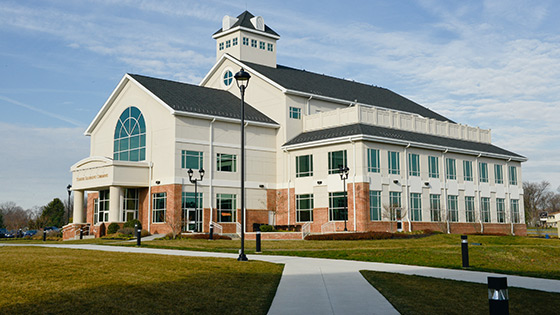
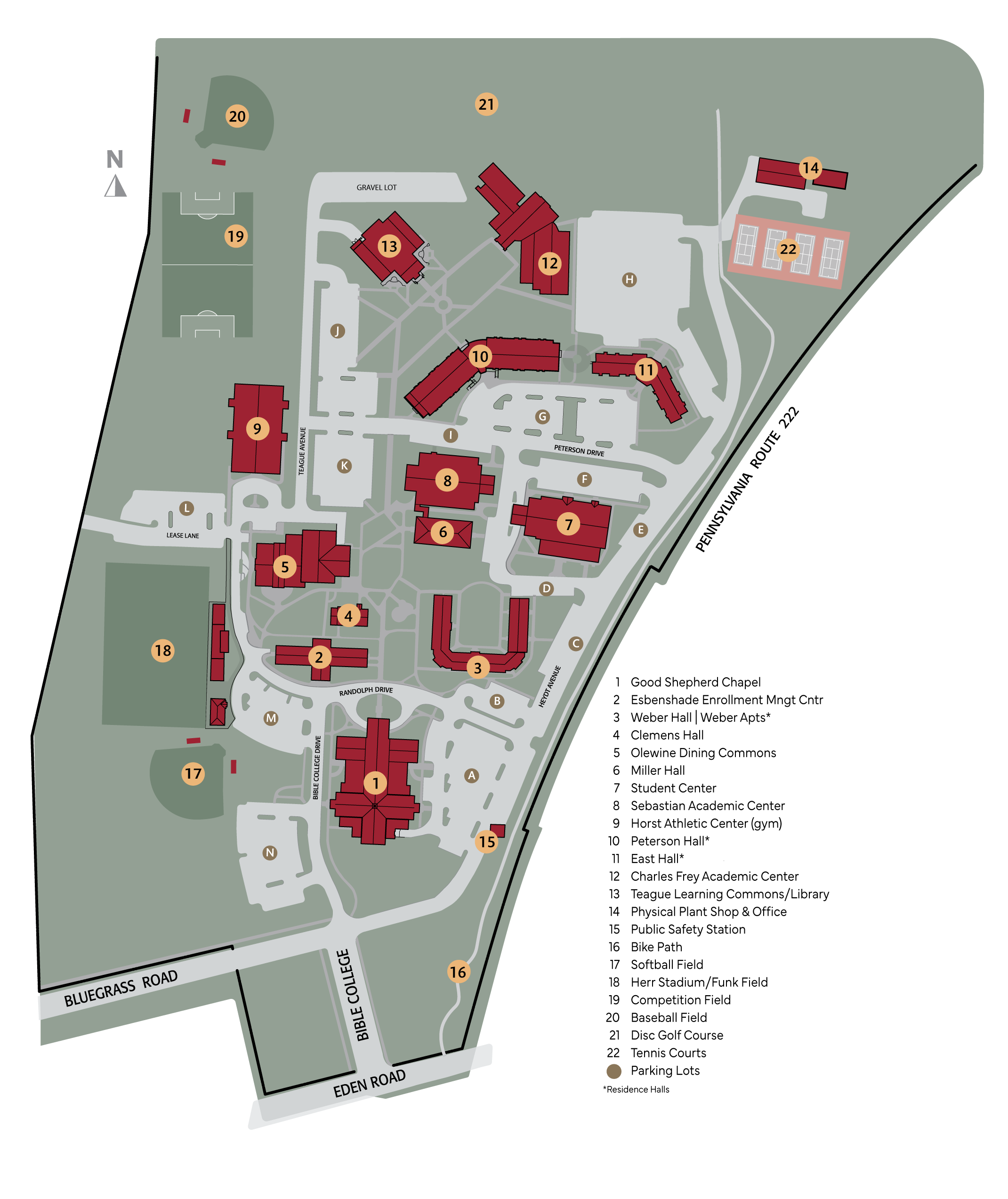
Lancaster Bible College seal · sourceFacilities - Lancaster Bible College Athletics · sourceLancaster, PA Campus - Lancaster Bible College · sourceLancaster, PA Campus - Lancaster Bible College · source