Admit rate has ranged 62%–75% over the last 5 years — notably volatile. Source: IPEDS via Urban Institute.
Acceptance & SAT from Common Data Set / IPEDS; net price, earnings & graduation from the U.S. Dept. of Education College Scorecard. Figures lag ~1–2 years — verify with the school.
Lawrence University is a distinctive liberal arts college in Appleton, Wisconsin, defined by its rare and intimate fusion of a rigorous College of Liberal Arts and Sciences with a world-class Conservatory of Music. This creates a campus culture where intellectual curiosity and artistic passion are not siloed but constantly cross-pollinate, fostering a student body known for its creative, 'busy' intensity. While selective, its admissions process is more accessible than many peers, and it is actively working toward a pioneering commitment to meet the full demonstrated financial need of all admitted students.
Admission requirements
Test-optional — scores considered if submitted
Required
High school transcript
TOEFL (non-native English)
Considered (not required)
Grade point average
Class rank
Letters of recommendation
Test scores (SAT/ACT)
College-prep program
Demonstrated competencies
Source: IPEDS Admissions survey (2022) via Urban Institute. Covers formal factors only — it does not reflect essays, extracurriculars, or other holistic criteria.
More details
Undergrad enrollment
1,396
In-state tuition
$56,982
Out-of-state tuition
$56,982
Campus Housing
Vast majority of students live on campus
No-Loan Policy
Information not provided in sources
Graduation Rate
77%
Meets Full Need
Working toward goal for all admits (currently 90-95% of need)
First-Year Retention
Information not provided in sources
Demonstrated Interest
Not considered
Student-Faculty Ratio
Information not provided in sources
Median Earnings (10yr)
$55,789
Outcomes & value
Outcomes & value
Median earnings (10 yr)
$55,789
Value (earnings ÷ net price)
2.4×
Median debt at graduation
$26,000
Graduation rate
77%
First-year retention
87%
Reducing loan balance (3 yr)
79%
Pell (lower-income) share
22%
First-gen share (among federal-aid recipients)
17%
Financial health
2.3 / 3.0Meets the federal financial-responsibility standard
U.S. Dept. of Education Financial Responsibility Composite Score (FY2022-23). Scale −1.0 to 3.0; ≥1.5 meets the standard. Reported for private nonprofit & for-profit institutions only — public universities are state-backed and not scored, so this is a stability signal, not a ranking.
Top-earning majors
Median earnings by field of study (highest credential), ~2 years after completion.
Economics$54,035
Political Science and Government$29,685
Biochemistry, Biophysics and Molecular Biology$28,960
History$28,019
Biology, General$25,194
Drama/Theatre Arts and Stagecraft$23,113
Campus & location
Campus safety
On-campus violent crimes (2024)
10
On-campus criminal offenses classed as violent (murder/non-negligent manslaughter, rape, robbery, aggravated assault) for the most recent reported year. Source: U.S. Dept. of Education Campus Safety and Security (Clery Act). Counts reflect what’s reported to the school, and urban campuses often report more partly due to non-student incidents nearby — read alongside campus size and setting, not as a standalone safety verdict.
Climate
Pleasant days / yr
95
Summer high
80°F
Winter low
16°F
Annual rain
36.3"
Annual snow
41.2"
Natural-hazard risk
Relatively Low
Pleasant days counts days per year with a mean temperature of 55–75°F, a high at or below 90°F, a low at or above 45°F, and little precipitation — a transparent comfort measure, not a weighting we invented. Computed from Open-Meteo ERA5 daily history (2019–2023). Natural-hazard risk is the county’s composite rating from the FEMA National Risk Index.
Deep dive — research, future-scholar output & economic mobility▾
Research output
Institutional h-index
137
Scholarly works
3,037
Institutional research volume and impact from OpenAlex. The h-index reflects large research universities and will be low for teaching-focused liberal-arts colleges — not a measure of undergraduate quality.
Share of this school’s graduates who go on to earn research doctorates (2010–20), by national rank and per-capita yield (NSF institutional-yield ratio). A signal of a research-oriented student culture — not a causal promise, since it partly reflects who enrolls. Only top producers appear. Source: NSF NCSES, Baccalaureate Origins of U.S. Research Doctorate Recipients.
Quick answers
What is the acceptance rate at Lawrence University?
Lawrence University's acceptance rate is approximately 64% (Appleton, WI), based on the most recent figures we compiled from public and primary sources.
What SAT score do you need for Lawrence University?
Admitted students at Lawrence University typically score 1200–1420 on the SAT (the middle-50% range). Scores outside this band are still admitted, especially with strong applications.
How much does Lawrence University cost?
At Lawrence University, the average net price (after aid) is about $23,401 per year. Actual cost varies with financial aid and residency.
How many undergraduates attend Lawrence University?
Lawrence University enrolls approximately 1,396 undergraduate students.
Where is Lawrence University located?
Lawrence University is located in Appleton, WI.
Admissions
Lawrence University operates a selective but accessible admissions process, admitting a majority of its applicants. The university considers a student's academic record to be the most important factor in admissions decisions. This includes the rigor of secondary school coursework, class rank, GPA, and standardized test scores, though it maintains a policy. For those who submit scores, the middle 50% range is competitive. The admissions office also weighs application essays, recommendations, extracurricular activities, and character/personal qualities as important factors in building a class. Notably, demonstrated interest—how much a student engages with the university before applying—is not considered in the evaluation process, a policy that levels the playing field for all applicants regardless of their ability to visit campus or connect with admissions officers. For students certain Lawrence is their first choice, applying Early Decision can be advantageous, with a significantly higher compared to the regular decision pool. The university receives thousands of applications each year, with the majority of admitted students coming from within the Midwest, though it draws a national and international applicant pool as well.
Most Important Factors: Academic rigor, class rank, GPA, standardized test scores (test-optional).
Important Factors: Essay, recommendations, extracurriculars, character/personal qualities.
Not Considered: Demonstrated interest.
Application Options: Early Decision (with a higher acceptance rate) and Regular Decision.
Earnings = median of students working ~10 years after entry; debt = median of graduates. Value divides 10-yr earnings by one year’s net price — read it as earnings per dollar of annual cost, not a full lifetime ROI; it favors lower-cost schools. Source: U.S. Dept. of Education College Scorecard. Figures lag ~2 years and reflect all students, not your intended major.
English Language and Literature, General
$22,667
Psychology, General$22,329
Source: U.S. Dept. of Education College Scorecard (field-of-study earnings). Figures cover graduates who received federal aid and lag ~2 years; not all programs report data.
The academic heart of Lawrence is its unique, intertwined structure: the College of Liberal Arts and Sciences and the Conservatory of Music. Students are not forced to choose between them; they can pursue a Bachelor of Arts, a Bachelor of Music, or even a rare double-degree (B.A. and B.Mus.) in five years. This fusion is more than administrative—it shapes the campus intellectual vibe, where a biology major might share a dorm with a cellist and a philosophy seminar might debate aesthetics with a composer. The College of Liberal Arts and Sciences offers 36 majors, emphasizing the classic liberal arts skills of critical thinking, clear communication, and creative problem-solving. Popular majors include Biology, Psychology, English, and Economics. However, music permeates the campus; Music Performance is the single most popular major, and the Conservatory's reputation draws serious musicians from across the country. With over 100 student clubs and organizations, many academic interests find extracurricular outlets. The curriculum is designed for exploration and combination, encouraging students to build an academic experience that is uniquely theirs through majors, minors, and interdisciplinary programs.
Life at Lawrence is characterized by a self-described 'busy culture'—students are deeply involved, highly motivated, and constantly seeking new ways to engage. The residential campus, where the vast majority of students live, fosters tight-knit communities in residence halls that become hubs for social and intellectual connection. With more than 100 student-run clubs and organizations, alongside NCAA Division III athletics (the Lawrence Vikings), music ensembles, and theater productions, there is no shortage of ways to get involved. The campus culture is profoundly informed by the blend of academics, athletics, and the arts, which inspires creativity across all endeavors. Traditions, service opportunities, and everyday interactions in dining halls or on the campus green build a strong sense of community. This is not a school of passive spectators; it's a place where students lead, create, and participate actively in shaping their environment. The Office of Student Life explicitly focuses on fostering leadership development through community living, student employment, student government, and clubs.
Lawrence graduates leave with a strong liberal arts foundation that serves them well in diverse career paths and graduate studies. The university's graduation rate significantly outpaces the national midpoint for four-year colleges. Outcomes data shows variation in graduation rates by demographic, with strong performance among students who receive federal Pell Grants. In terms of career earnings, Lawrence has received recognition for its return on investment, with median mid-career salaries for graduates reported as strong. The university tracks and shares these student outcomes transparently, highlighting the long-term value of a Lawrence education. The combination of high-touch academics, research opportunities, and career preparation through the liberal arts model equips graduates with adaptable skills for a changing workforce.
Lawrence University is a private institution with a high published tuition, but it is committed to making that education affordable through substantial financial aid. The university meets a high percentage of demonstrated financial need for admitted students, typically covering 90-95% of need through a package of scholarships, grants, loans, and student employment opportunities. This commitment is central to its Lawrence Advantage initiative, which aims to meet 100% of the demonstrated financial need for all admitted students—a goal it is actively working toward to become a 'full-need' institution. For families with lower incomes, the can be dramatically reduced; for example, the average cost after aid for families with an income between $0-$39,999 is significantly lower than the sticker price. The vast majority of full-time students receive some form of grant or scholarship aid. This aggressive aid policy reflects a mission-driven focus on access and ensuring that admitted students can attend regardless of financial circumstances.
Lawrence University stands out for its authentic and seamless integration of a top-tier liberal arts college with a premier conservatory of music. This isn't a marketing gimmick; it's the defining feature of campus life, creating a student body of intellectually curious scientists, writers, and economists who live and learn alongside intensely dedicated artists. The resulting culture is one of creative cross-pollination and a 'busy' energy where interdisciplinary thinking is the norm, not the exception. Furthermore, Lawrence distinguishes itself through its forward-looking financial aid ambition. While many elite schools claim to meet full need, Lawrence is publicly and actively campaigning to build the endowment required to become a 'full-need' institution for all admits, not just early decision applicants or a select few. This combination—a unique, vibrant academic model paired with a deep commitment to accessibility—makes Lawrence a singular option for students seeking a rigorous, participatory, and creatively charged undergraduate experience in the Midwest.
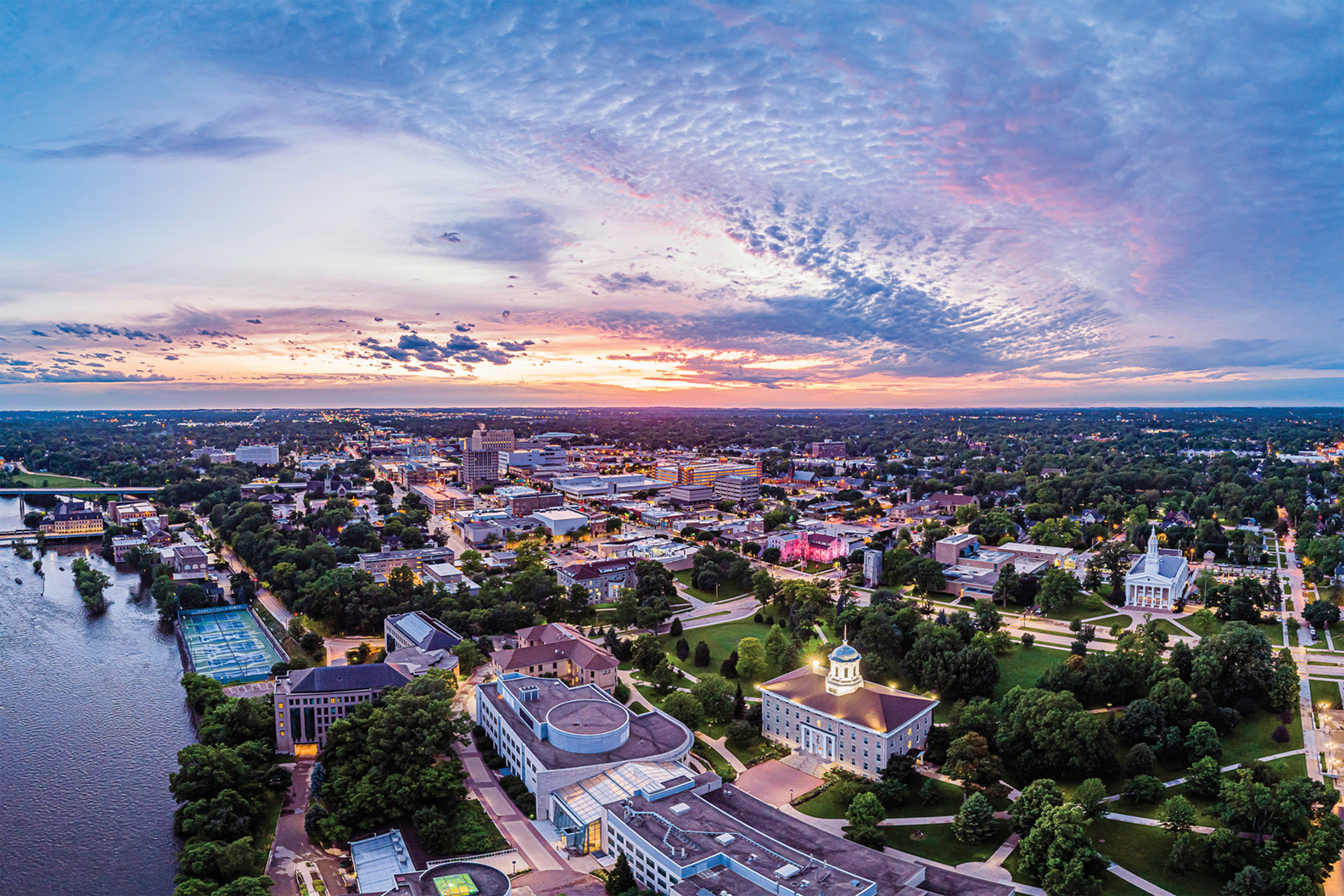
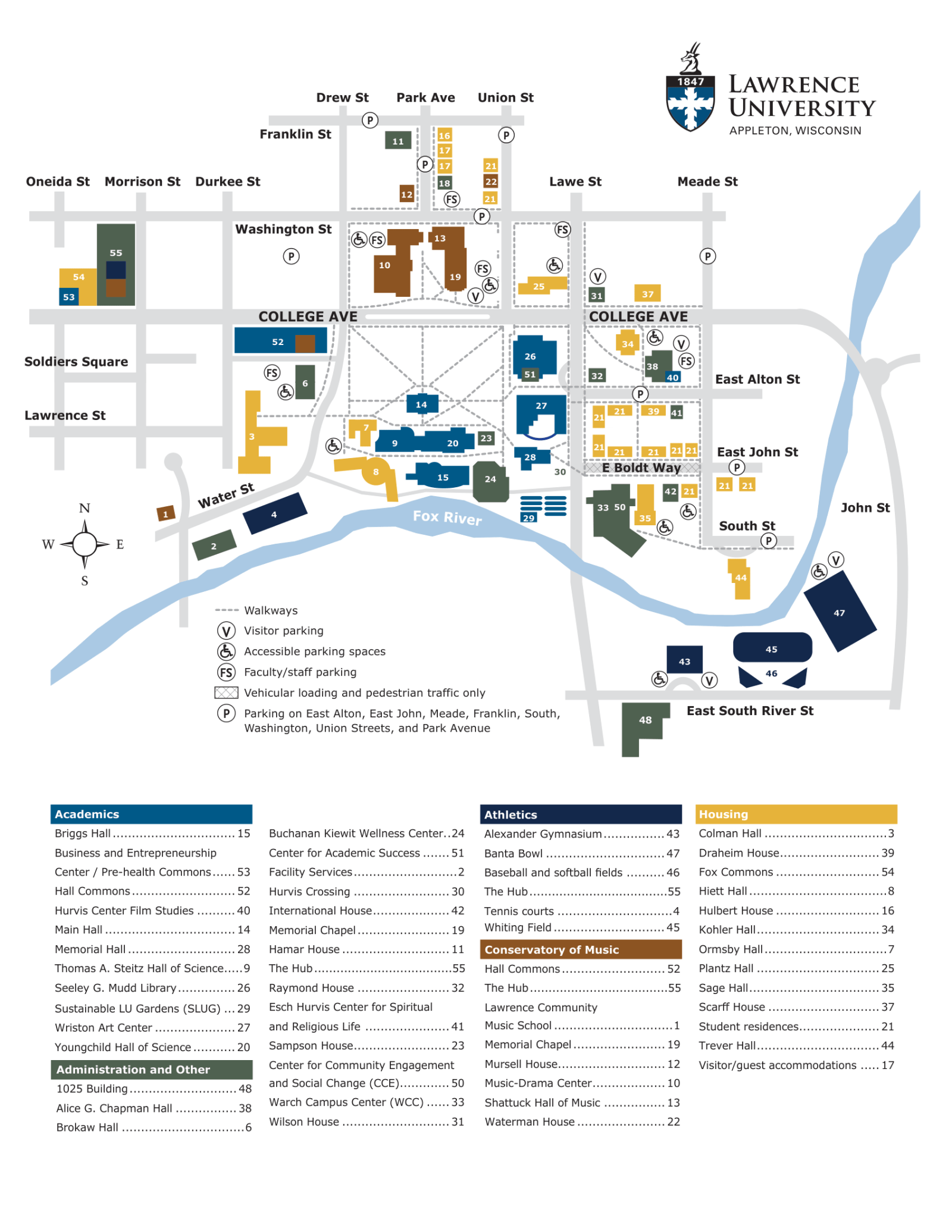
Lawrence University seal · sourceA Campus on a River With a Mile-Long Downtown - Lawrence University · sourceLawrence University – Colleges That Change Lives · sourceCampus Maps | Lawrence University · source