Admit rate has ranged 72%–83% over the last 5 years — notably volatile, though the latest figure above (71%) falls outside that window. Source: IPEDS via Urban Institute.
Acceptance & SAT from Common Data Set / IPEDS; net price, earnings & graduation from the U.S. Dept. of Education College Scorecard. Figures lag ~1–2 years — verify with the school.
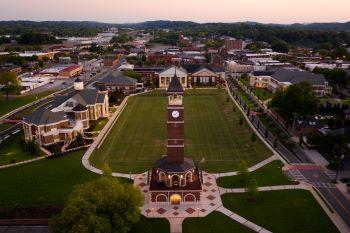
Lee University is a Christ-centered liberal arts institution in Cleveland, Tennessee, where faith and learning are intentionally intertwined. It offers a notably accessible admissions process and a campus culture built around spiritual development, community, and over 100 student organizations. The university's identity is defined by its focus on service learning, global perspectives, and popular majors in theology, business, and health professions.
Admission requirements
Test-optional — scores considered if submitted
Required
High school transcript
Grade point average
TOEFL (non-native English)
Considered (not required)
Letters of recommendation
Test scores (SAT/ACT)
College-prep program
Source: IPEDS Admissions survey (2022) via Urban Institute. Covers formal factors only — it does not reflect essays, extracurriculars, or other holistic criteria.
More details
Undergrad enrollment
2,617
In-state tuition
$23,790
Out-of-state tuition
$23,790
Popular Majors
Theology, Business, Health Professions
Application Fee
$25
Graduation Rate
63%
On-Campus Housing
50%
First-Year Retention
82%
Student-Faculty Ratio
12:1
Median Earnings (10yr)
$43,222
Outcomes & value
Outcomes & value
Median earnings (10 yr)
$43,222
Value (earnings ÷ net price)
2.3×
Median debt at graduation
$25,750
Graduation rate
63%
First-year retention
82%
Reducing loan balance (3 yr)
58%
Pell (lower-income) share
29%
First-gen share (among federal-aid recipients)
31%
Financial health
2.4 / 3.0Meets the federal financial-responsibility standard
U.S. Dept. of Education Financial Responsibility Composite Score (FY2022-23). Scale −1.0 to 3.0; ≥1.5 meets the standard. Reported for private nonprofit & for-profit institutions only — public universities are state-backed and not scored, so this is a stability signal, not a ranking.
Top-earning majors
Median earnings by field of study (highest credential), ~2 years after completion.
Accounting and Related Services$55,625
Special Education and Teaching$39,099
English Language and Literature, General$39,009
Business Administration, Management and Operations$38,122
Teacher Education and Professional Development, Specific Subject Areas$36,282
Teacher Education and Professional Development, Specific Levels and Methods
Campus & location
Campus safety
On-campus violent crimes (2024)
3
Per 1,000 students
0.98
On-campus criminal offenses classed as violent (murder/non-negligent manslaughter, rape, robbery, aggravated assault) for the most recent reported year. Source: U.S. Dept. of Education Campus Safety and Security (Clery Act). Counts reflect what’s reported to the school, and urban campuses often report more partly due to non-student incidents nearby — read alongside campus size and setting, not as a standalone safety verdict.
Climate
Pleasant days / yr
94
Summer high
87°F
Winter low
36°F
Annual rain
59.3"
Annual snow
3.6"
Natural-hazard risk
Relatively Low
Pleasant days counts days per year with a mean temperature of 55–75°F, a high at or below 90°F, a low at or above 45°F, and little precipitation — a transparent comfort measure, not a weighting we invented. Computed from Open-Meteo ERA5 daily history (2019–2023). Natural-hazard risk is the county’s composite rating from the FEMA National Risk Index.
Deep dive — research, future-scholar output & economic mobility▾
Research output
Institutional h-index
117
Scholarly works
1,941
Institutional research volume and impact from OpenAlex. The h-index reflects large research universities and will be low for teaching-focused liberal-arts colleges — not a measure of undergraduate quality.
Economic mobility
Mobility rate
1.4%
Bottom → top quintile
16%
From bottom quintile
9%
Mobility rate = the share of students who both start in the bottom household-income quintile and reach the top quintile; bottom → top is that chance conditional on starting at the bottom. Source: Opportunity Insights Mobility Report Cards (Chetty, Friedman, Saez, Turner & Yagan). Reflects 1980–82 birth cohorts, so it’s directional, not current.
Quick answers
What is the acceptance rate at Lee University?
Lee University's acceptance rate is approximately 71% (Cleveland, TN), based on the most recent figures we compiled from public and primary sources.
What SAT score do you need for Lee University?
Admitted students at Lee University typically score 1040–1230 on the SAT (the middle-50% range). Scores outside this band are still admitted, especially with strong applications.
How much does Lee University cost?
At Lee University, the average net price (after aid) is about $18,878 per year. Actual cost varies with financial aid and residency.
How many undergraduates attend Lee University?
Lee University enrolls approximately 2,617 undergraduate students.
Where is Lee University located?
Lee University is located in Cleveland, TN.
Admissions
Lee University operates with a notably accessible admissions process, admitting a significant majority of its applicants. The university is characterized as "less selective." For the middle 50% of admitted students who submit scores, standardized test ranges are 1040–1230 on the SAT. The application fee is $25. While the initiative outlines the framework for admissions data collection, the specific importance Lee places on factors like demonstrated interest is not detailed in the provided sources. There is no mention of an Early Decision program or a waitlist at Lee University; one source explicitly states, "No waitlist exists, so every decision is final."
Lee University provides a liberal arts and professional education through residential and distance programs at both undergraduate and graduate levels. The academic structure is anchored by a College of Arts and Sciences, which is described as comprising "excellent faculty members" and "a wide range of outstanding academic programs." The university boasts a wide curricular selection with over 100 programs of study and more than 50 different majors. Its academic reputation is noted for "personal attention" and strength in specific fields: popular majors include Theology and Religious Vocations; Business, Management, Marketing, and Related Support Services; and Health Professions. Programs in biology and exercise science are particularly highlighted, with faculty praised for having real-world experience that provides strong academic preparation. The university's MBA program has received external recognition, ranking in the top 20% of the 2024 Research.com Best MBA Programs.
Earnings = median of students working ~10 years after entry; debt = median of graduates. Value divides 10-yr earnings by one year’s net price — read it as earnings per dollar of annual cost, not a full lifetime ROI; it favors lower-cost schools. Source: U.S. Dept. of Education College Scorecard. Figures lag ~2 years and reflect all students, not your intended major.
$35,843
Sociology$35,060
Public Relations, Advertising, and Applied Communication$29,374
Source: U.S. Dept. of Education College Scorecard (field-of-study earnings). Figures cover graduates who received federal aid and lag ~2 years; not all programs report data.
Life at Lee is explicitly "Christ-centered" and "student-focused," with a pronounced emphasis on spiritual, intellectual, and social development. The campus environment is residential, with a roughly even split in housing: 50% of students live in college-owned, -operated, or -affiliated housing, while the other 50% live off-campus. Student engagement is fostered through a vast array of more than 100 clubs and organizations. The university's mission extends beyond the classroom, teaching "meaningful life skills" with an "emphasis on community." This ethos is supported by acclaimed programs in service learning and cultivating global perspectives, integral parts of the student experience.
Lee University evaluates student success through metrics like graduation and retention rates, job placement statistics, and performance on standardized tests. The first-year retention rate is reported at 82%. The six-year graduation rate is 56%. Post-graduation earnings data shows progression: alumni report median earnings of $35,892 one year after graduation, which increases to $46,004 five years after graduation. Data on earnings by specific major shows variation, with music graduates earning around $28,791. The university tracks these outcomes as part of its student achievement profile.
For the 2026-2027 academic year, Lee University's tuition is set at $1,060 per credit hour. The university provides a Calculator to help prospective students estimate their actual cost after aid. Financial aid is administered through an office that can be contacted via email or phone. Scholarship deadlines are a factor, as most endowment scholarships are awarded by March 1st. The average net price after aid—the cost a student typically pays—is a key figure for affordability. The provided sources do not indicate that Lee University has a policy of meeting 100% of demonstrated financial need or a no-loan policy for low-income students; such policies are discussed in the sources only in reference to other institutions.
Lee University carves out a distinct identity as a Christ-centered liberal arts campus where faith is the explicit foundation of both academic and community life. It stands apart not through cutthroat selectivity, but through its commitment to accessibility and a student-focused environment that prioritizes spiritual development alongside intellectual growth. Its signature combination includes a robust offering of over 100 majors and programs—with particular strength in theology, business, and health fields—paired with a deeply ingrained culture of service learning and global engagement. The campus vibe is active and communal, supported by a vast network of student organizations and a residential experience that balances on- and off-campus living. For students seeking an education where personal values and academic preparation are intentionally interwoven, Lee provides a comprehensive and supportive environment designed to equip them "to make a difference in the world."
Lee University seal · sourceLee University - Profile, Rankings and Data | US News Best Colleges · sourceLee University - College Profile · sourceUndergraduate Admissions - Lee University · source