Admit rate has ranged 55%–81% over the last 5 years — notably volatile. Source: IPEDS via Urban Institute.
Acceptance & SAT from Common Data Set / IPEDS; net price, earnings & graduation from the U.S. Dept. of Education College Scorecard. Figures lag ~1–2 years — verify with the school.
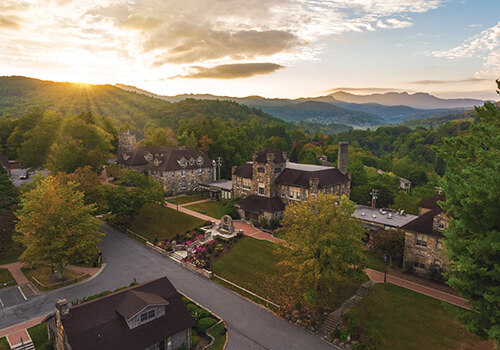
Lees-McRae College is a small, mountainside liberal arts school in Banner Elk, North Carolina, where experiential learning and outdoor adventure blend with a tight-knit community. Known for its test-blind admissions and strong programs in exercise science and outdoor recreation, the college attracts students who thrive in a hands-on, nature-adjacent academic environment—though its graduation rates lag behind national averages.
Admission requirements
Test-optional — scores considered if submitted
Required
High school transcript
Grade point average
College-prep program
TOEFL (non-native English)
Considered (not required)
Class rank
Letters of recommendation
Test scores (SAT/ACT)
Source: IPEDS Admissions survey (2022) via Urban Institute. Covers formal factors only — it does not reflect essays, extracurriculars, or other holistic criteria.
More details
Undergrad enrollment
873
In-state tuition
$33,250
Out-of-state tuition
$33,250
Location
Banner Elk, NC
Popular Majors
Exercise Science, Biology, Outdoor Rec
6-Year Grad Rate
44%
On-Campus Housing
74% of students
Outcomes & value
Outcomes & value
Median earnings (10 yr)
$43,415
Value (earnings ÷ net price)
1.5×
Median debt at graduation
$17,375
Graduation rate
42%
First-year retention
69%
Reducing loan balance (3 yr)
55%
Pell (lower-income) share
37%
First-gen share (among federal-aid recipients)
40%
Financial health
3.0 / 3.0Meets the federal financial-responsibility standard
U.S. Dept. of Education Financial Responsibility Composite Score (FY2022-23). Scale −1.0 to 3.0; ≥1.5 meets the standard. Reported for private nonprofit & for-profit institutions only — public universities are state-backed and not scored, so this is a stability signal, not a ranking.
Top-earning majors
Median earnings by field of study (highest credential), ~2 years after completion.
Registered Nursing, Nursing Administration, Nursing Research and Clinical Nursing$63,935
Business Administration, Management and Operations$44,649
Teacher Education and Professional Development, Specific Levels and Methods$34,393
Criminal Justice and Corrections$28,816
Psychology, General$23,456
Communication and Media Studies
Campus & location
Campus safety
On-campus violent crimes (2024)
0
Per 1,000 students
0.00
On-campus criminal offenses classed as violent (murder/non-negligent manslaughter, rape, robbery, aggravated assault) for the most recent reported year. Source: U.S. Dept. of Education Campus Safety and Security (Clery Act). Counts reflect what’s reported to the school, and urban campuses often report more partly due to non-student incidents nearby — read alongside campus size and setting, not as a standalone safety verdict.
Climate
Pleasant days / yr
107
Summer high
75°F
Winter low
28°F
Annual rain
55.3"
Annual snow
18.9"
Natural-hazard risk
Relatively Low
Pleasant days counts days per year with a mean temperature of 55–75°F, a high at or below 90°F, a low at or above 45°F, and little precipitation — a transparent comfort measure, not a weighting we invented. Computed from Open-Meteo ERA5 daily history (2019–2023). Natural-hazard risk is the county’s composite rating from the FEMA National Risk Index.
Deep dive — research, future-scholar output & economic mobility▾
Research output
Institutional h-index
13
Scholarly works
87
Institutional research volume and impact from OpenAlex. The h-index reflects large research universities and will be low for teaching-focused liberal-arts colleges — not a measure of undergraduate quality.
Economic mobility
Mobility rate
0.3%
Bottom → top quintile
4%
From bottom quintile
8%
Mobility rate = the share of students who both start in the bottom household-income quintile and reach the top quintile; bottom → top is that chance conditional on starting at the bottom. Source: Opportunity Insights Mobility Report Cards (Chetty, Friedman, Saez, Turner & Yagan). Reflects 1980–82 birth cohorts, so it’s directional, not current.
Quick answers
What is the acceptance rate at Lees-McRae College?
Lees-McRae College's acceptance rate is approximately 77% (Banner Elk, NC), based on the most recent figures we compiled from public and primary sources.
How much does Lees-McRae College cost?
At Lees-McRae College, the average net price (after aid) is about $28,340 per year. Actual cost varies with financial aid and residency.
How many undergraduates attend Lees-McRae College?
Lees-McRae College enrolls approximately 873 undergraduate students.
Where is Lees-McRae College located?
Lees-McRae College is located in Banner Elk, NC.
Admissions
Lees-McRae operates with a 77% acceptance rate (per U.S. News and Niche), making it accessible but not open-admission. The college is test-blind, meaning SAT/ACT scores aren’t required—though submitted scores (middle 50%: SAT 930–1260, ACT 21–26) can bolster scholarship applications. Nearly half of admitted students have GPAs of 3.75+, but the college emphasizes . Rolling deadlines and the Common Application simplify the process, with 75% of students receiving financial aid.
The college leans heavily into experiential learning, with popular majors in , biology, and outdoor recreation (per U.S. News). The curriculum blends liberal arts with hands-on training—like fieldwork in the nearby Blue Ridge Mountains. Small class sizes are the norm, and programs like the Honors College offer added rigor. Notably, the exercise science degree integrates foundational science courses with applied kinesiology, preparing students for healthcare or athletic training careers.
Earnings = median of students working ~10 years after entry; debt = median of graduates. Value divides 10-yr earnings by one year’s net price — read it as earnings per dollar of annual cost, not a full lifetime ROI; it favors lower-cost schools. Source: U.S. Dept. of Education College Scorecard. Figures lag ~2 years and reflect all students, not your intended major.
$21,052
Zoology/Animal Biology$20,596
Source: U.S. Dept. of Education College Scorecard (field-of-study earnings). Figures cover graduates who received federal aid and lag ~2 years; not all programs report data.
Life at Lees-McRae revolves around its residential community (74% live on campus) and mountain setting. Traditions like the Order of the Tower ambassadors foster school spirit, while clubs range from outdoor adventure groups to faith-based organizations. The vibe is familiarly small—Niche reviews describe a 'family-like atmosphere'—with hiking, skiing, and rock climbing just minutes away. Campus events emphasize social responsibility, like service projects coordinated by student organizations.
Graduation rates are a mixed bag: 44% graduate within six years (per EDsmart and Research.com), though the college claims an 80% career-outcome threshold for alumni. Median earnings hover around $38,074–$43,415 early-career (Money.com, Varsity Tutors), with 70% earning more than high school graduates. Retention rates are modest (62–69%), suggesting some students transfer or leave before completing degrees. The college highlights success in healthcare and education fields, but concrete job-placement data is sparse.
Tuition sits at $35,390 (U.S. News), but the average —after aid—drops to $25,277 (BigFuture). Three-quarters of students receive financial aid, with typical packages covering $25,939 via grants and scholarships. The FAFSA-driven process emphasizes federal and state aid, though merit scholarships are available. The net price calculator suggests costs can vary widely; contacting the Financial Aid Office directly is recommended for personalized estimates.
Lees-McRae’s mountain-campus identity is its defining trait—a place where biology students study local ecosystems and exercise science majors train on ski slopes. The test-blind policy and rolling admissions make it accessible, while the tight-knit community appeals to students seeking close faculty mentorship. However, its lower graduation rates signal that it may best suit self-motivated learners who capitalize on its outdoor-focused academics. For those who thrive here, the college offers a rare blend of adventure and personalized education.
Lees-McRae College logo · sourceVisit Our Campus | Admissions | Lees-McRae College · sourceFacts and Recognitions | Lees-McRae College · sourceVisit Our Campus | Admissions | Lees-McRae College · source