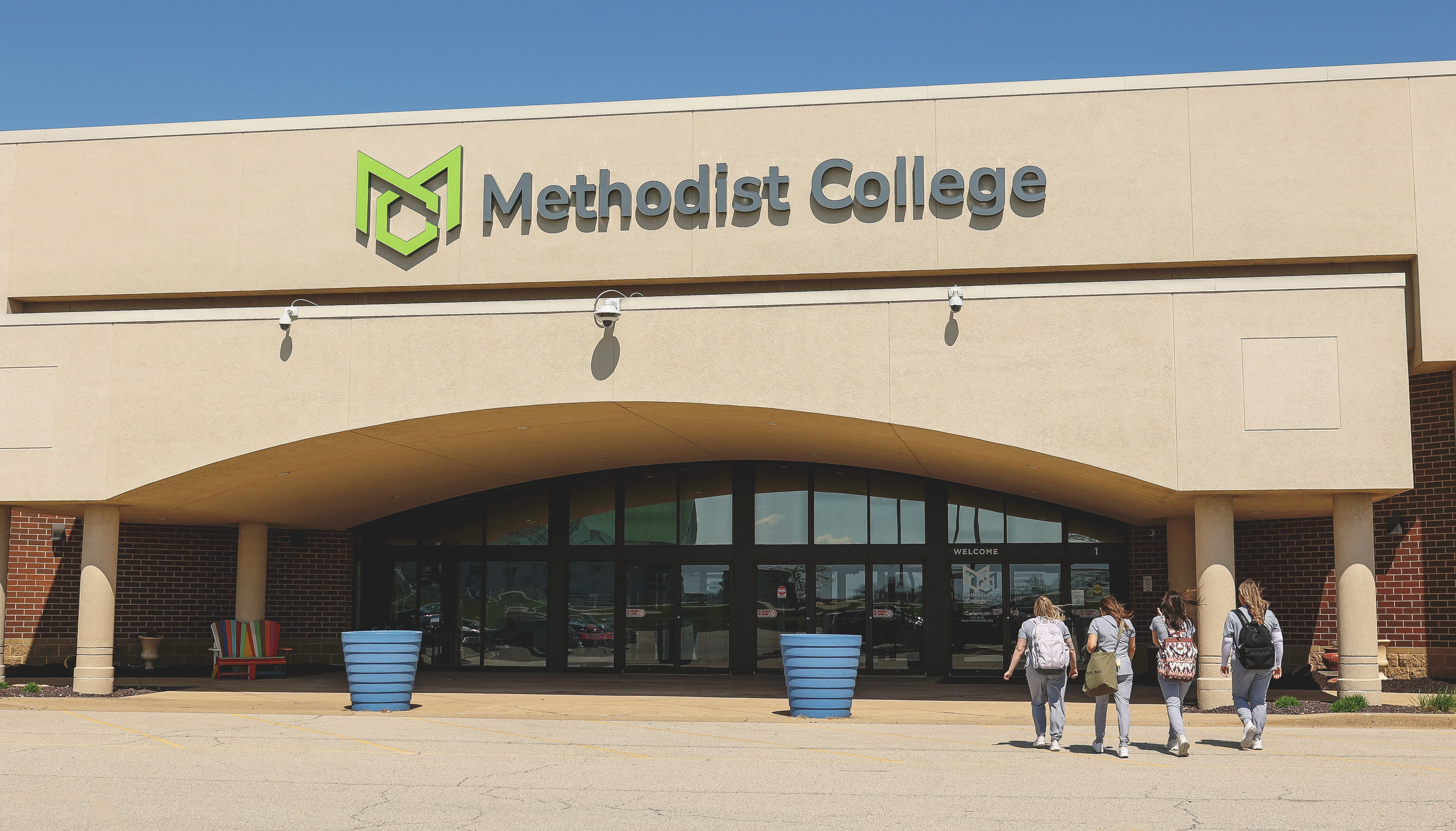
Admit rate has ranged 31%–100% over the last 5 years — notably volatile. Source: IPEDS via Urban Institute.
Acceptance & SAT from Common Data Set / IPEDS; net price, earnings & graduation from the U.S. Dept. of Education College Scorecard. Figures lag ~1–2 years — verify with the school.
Methodist College in Peoria, Illinois, is a small, private institution laser-focused on nursing and human services. Its defining character is one of intense specialization, offering a tight-knit, clinically-oriented education with a student-to-faculty ratio of 8:1, but it demands careful financial planning from its students. The college's culture is explicitly built around principles of human dignity and integrity, aiming to produce graduates for direct entry into high-demand healthcare fields.
Admission requirements
Test-optional — scores considered if submitted
Required
High school transcript
Grade point average
Considered (not required)
Letters of recommendation
Test scores (SAT/ACT)
Source: IPEDS Admissions survey (2022) via Urban Institute. Covers formal factors only — it does not reflect essays, extracurriculars, or other holistic criteria.
More details
Undergrad enrollment
245
In-state tuition
$18,008
Out-of-state tuition
$18,008
Academic Focus
Nursing & Human Services
Majors Offered
9
Application Fee
$25
Graduation Rate
20%
Median Earnings (10yr)
$69,800
Student-to-Faculty Ratio
8:1
Outcomes & value
Outcomes & value
Median earnings (10 yr)
$69,800
Value (earnings ÷ net price)
1.7×
Median debt at graduation
$31,250
Graduation rate
20%
Reducing loan balance (3 yr)
61%
Pell (lower-income) share
51%
First-gen share (among federal-aid recipients)
35%
Endowment / student
$10,819
Earnings = median of students working ~10 years after entry; debt = median of graduates. divides 10-yr earnings by net price — read it as earnings per dollar of annual cost, not a full lifetime ROI; it favors lower-cost schools. Source: U.S. Dept. of Education College Scorecard. Figures lag ~2 years and reflect all students, not your intended major.
Financial health
2.2 / 3.0Meets the federal financial-responsibility standard
U.S. Dept. of Education Financial Responsibility Composite Score (FY2022-23). Scale −1.0 to 3.0; ≥1.5 meets the standard. Reported for private nonprofit & for-profit institutions only — public universities are state-backed and not scored, so this is a stability signal, not a ranking.
Top-earning majors
Median earnings by field of study (highest credential), ~2 years after completion.
Registered Nursing, Nursing Administration, Nursing Research and Clinical Nursing$57,619
Source: U.S. Dept. of Education College Scorecard (field-of-study earnings). Figures cover graduates who received federal aid and lag ~2 years; not all programs report data.
On-campus criminal offenses classed as violent (murder/non-negligent manslaughter, rape, robbery, aggravated assault) for the most recent reported year. Source: U.S. Dept. of Education Campus Safety and Security (Clery Act). Counts reflect what’s reported to the school, and urban campuses often report more partly due to non-student incidents nearby — read alongside campus size and setting, not as a standalone safety verdict.
Climate
Pleasant days / yr
87
Summer high
83°F
Winter low
22°F
Annual rain
40"
Annual snow
23.5"
Natural-hazard risk
Relatively Moderate
Pleasant days counts days per year with a mean temperature of 55–75°F, a high at or below 90°F, a low at or above 45°F, and little precipitation — a transparent comfort measure, not a weighting we invented. Computed from Open-Meteo ERA5 daily history (2019–2023). Natural-hazard risk is the county’s composite rating from the FEMA National Risk Index.
Quick answers
What is the acceptance rate at Methodist College?
Methodist College's acceptance rate is approximately 39% (Peoria, IL), based on the most recent figures we compiled from public and primary sources.
How much does Methodist College cost?
At Methodist College, the average net price (after aid) is about $41,787 per year. Actual cost varies with financial aid and residency.
How many undergraduates attend Methodist College?
Methodist College enrolls approximately 245 undergraduate students.
Where is Methodist College located?
Methodist College is located in Peoria, IL.
Admissions
Methodist College operates with a selective admissions process, though reported vary significantly across sources, from 31.11% to 38.9%. The college received a relatively small number of applications in recent cycles—18 in one report, 45 in another—with a correspondingly small number of admitted and enrolled students (e.g., 7 admitted and 4 enrolled from the 18 applicants). This suggests a highly personalized review of a limited applicant pool. The application fee is $25. While sources discuss the as a critical resource for understanding admissions factors like demonstrated interest and early decision policies, no specific CDS for Methodist College, Peoria, is provided in the source list to detail the exact weight given to factors like test scores, GPA, or interviews. Applicants should note the variance in reported selectivity and seek the most current data directly from the institution.
Academic life at Methodist College is singularly concentrated. It is a private, four-year institution offering certificate, baccalaureate, and master's degree programs exclusively in nursing and human services. The college offers a total of 9 majors. This hyper-focus creates a curriculum where every student is on a pre-professional track for the healthcare and social services sectors. The intimate scale is underscored by an exceptionally low student-to-faculty ratio of 8:1, promising highly individualized attention and direct access to instructors—a significant advantage for hands-on, clinical training. For comparison, at another institution named Methodist University (a different school), the most popular majors for graduates were Business (27%) and Health Professions, but this data point does not apply to Methodist College in Peoria, which does not offer business degrees.
The college promotes a campus-centric experience, explicitly recommending that students live on campus as "a big part of the college experience" and a prime opportunity for bonding. The institutional culture is formally articulated around core values of Human Dignity ("unconditional respect for the inherent worth, uniqueness, and autonomy of individuals") and Integrity ("displaying strong moral character"), suggesting a community ethos geared towards the caring professions it serves. While details on specific clubs, Greek life, or intramural sports at this particular campus are not provided in the sources, the college's blog emphasizes the relational benefits of residential life. The small size and specialized focus likely foster a close, cohort-based community where academic and social spheres heavily overlap.
Outcome data for Methodist College presents a complex picture with notable discrepancies between sources. One source reports a graduation rate of 56%, while another lists a six-year graduation rate of 65.1% for first-time, full-time freshmen at a similarly named institution (not necessarily the Peoria campus). The provided canonical figure overrides these with a graduation rate of 20%. Post-graduate earnings are a highlighted strength; one source reports that graduates earn a median of $69,800 ten years after entry, a figure that aligns with the canonical data and suggests strong returns from its specialized degrees. Another source notes an undergraduate course completion rate of 43.5%. The variance in graduation statistics underscores the importance of prospective students verifying the most current and specific data for the Peoria campus.
The —the cost after scholarships and grants—is a critical figure, and estimates vary. One source calculates Methodist College's net price at $35,461 per year, with an average financial aid package of $9,426. Another source mentions an average financial aid award for incoming freshmen of $16,605. The canonical figure overrides these with an average net price of $41,787. The college offers a comprehensive range of need-based and , including scholarships, grants, loans, and student employment. Completing the FAFSA is the primary step to apply for aid. The college provides a net price calculator to help families estimate their individual cost. Notably, the sources do not indicate that Methodist College has a "no-loan" policy or that it meets 100% of demonstrated financial need for all admitted students; federal loan programs are part of the aid portfolio.
Methodist College distinguishes itself through unwavering specialization and scale. It is not a liberal arts college with a nursing program; it is a dedicated nursing and human services institute. This focus eliminates curricular distractions and immerses every student in the language, skills, and ethics of healthcare from day one. The 8:1 student-to-faculty ratio is exceptionally low, even for a small college, facilitating a level of mentorship and hands-on guidance crucial for clinical training. The reported median graduate earnings of $69,800 a decade out signal that this focused investment can translate into strong financial outcomes. However, this comes with trade-offs: a limited social and extracurricular scope relative to larger universities, and a cost that requires diligent navigation of financial aid. It's a college for the decisive student who knows they want a career in healthcare and thrives in an intense, intimate, and values-driven environment.