Loading…
← All schools
Mid-EastCTC-Adult Education
Zanesville, OHpublicadulted.mideastctc.org
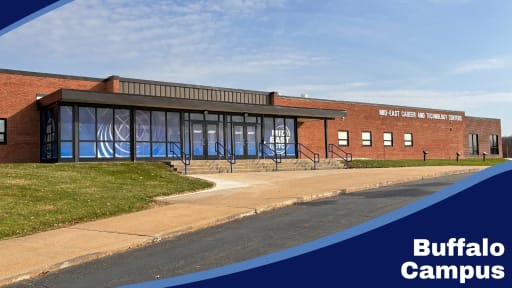
Mid-East CTC - Adult Education is a no-nonsense, open-access career training center in Zanesville, Ohio, built for speed and practicality. It operates less like a traditional college and more like a direct pipeline to the regional workforce, offering short-term, hands-on credentials in fields from nursing to skilled trades. The model is starkly utilitarian: if you're an adult looking to pivot into a job quickly, this is the place—academic prestige is swapped for industry accreditation, campus life for a 7:30 AM to 4:00 PM schedule, and a broad liberal arts curriculum for the specific skills that lead directly to a paycheck.
More details
- Undergrad enrollment
- 356
- Total Placement Rate
- 70%
- Average Federal Grant
- $4,099
- Total Completion Rate
- 60%
- Median Earnings (10yr)
- $40,416
- Federal Grant Recipients
- 41%
- Licensure Exam Pass Rate
- 70%
- Three-Year Graduation Rate
- 73%
Outcomes & value
Outcomes & value
- Median earnings (10 yr)
- $40,416
- Median debt at graduation
- $7,600
- Reducing loan balance (3 yr)
- 37%
- Pell (lower-income) share
- 32%
- First-gen share (among federal-aid recipients)
- 58%
Earnings = median of students working ~10 years after entry; debt = median of graduates. Value divides 10-yr earnings by one year’s net price — read it as earnings per dollar of annual cost, not a full lifetime ROI; it favors lower-cost schools. Source: U.S. Dept. of Education College Scorecard. Figures lag ~2 years and reflect all students, not your intended major.
Campus & location
Campus safety
- On-campus violent crimes (2024)
- 0
On-campus criminal offenses classed as violent (murder/non-negligent manslaughter, rape, robbery, aggravated assault) for the most recent reported year. Source: U.S. Dept. of Education Campus Safety and Security (Clery Act). Counts reflect what’s reported to the school, and urban campuses often report more partly due to non-student incidents nearby — read alongside campus size and setting, not as a standalone safety verdict.
Climate
- Pleasant days / yr
- 97
- Summer high
- 83°F
- Winter low
- 28°F
- Annual rain
- 37.2"
- Annual snow
- 18.5"
- Natural-hazard risk
- Relatively Low
Pleasant days counts days per year with a mean temperature of 55–75°F, a high at or below 90°F, a low at or above 45°F, and little precipitation — a transparent comfort measure, not a weighting we invented. Computed from Open-Meteo ERA5 daily history (2019–2023). Natural-hazard risk is the county’s composite rating from the FEMA National Risk Index.
Quick answers
- How many undergraduates attend Mid-EastCTC-Adult Education?
- Mid-EastCTC-Adult Education enrolls approximately 356 undergraduate students.
- Where is Mid-EastCTC-Adult Education located?
- Mid-EastCTC-Adult Education is located in Zanesville, OH.
Admissions
The admissions process at Mid-East CTC - Adult Education is defined by its accessibility and focus on workforce readiness, not competitive selection. The institution reports a 100% acceptance rate, positioning itself as an open door for adult learners seeking career training. There is no mention of standardized test scores (SAT/ACT) as a factor, nor is there a traditional early decision or early action process; admissions appear to be rolling and tied to program start dates. The primary gateway is a simple online registration to apply for a class or program. The process is administrative rather than evaluative: for programs like Practical Nursing, acceptance is followed by mandatory background checks. The office operates on a standard business-week schedule (Monday-Friday, 7:30 AM to 4:00 PM), underscoring its professional, non-residential nature. Demonstrated interest—a factor tracked in the (C7) for traditional colleges—is irrelevant here; what matters is an applicant's intent to enroll in a specific, workforce-aligned program.
Academics
Academics are singularly focused on career and technical education (CTE), with programs designed for rapid skill acquisition and credentialing. The curriculum is a portfolio of short-term, intensive training programs, many of which are . The stated mission is "the development of a more highly skilled workforce in our area," and instruction emphasizes . Programs vary in length, but to qualify for federal financial aid, they must be at least . The institution tracks key performance metrics that reflect this pragmatic focus: a , a , and a . There are no traditional majors, minors, or general education requirements in the liberal arts sense; instead, students enroll in discrete programs aimed at immediate job placement. The educational philosophy is captured in its own materials: "Success in today's business and industry requires a highly skilled workforce."
Compare Mid-EastCTC-Adult Education
vs Chicago State Universityvs University of Minnesota-Morrisvs Dickinson State Universityvs University of Science and Arts of Oklahoma
See colleges similar to Mid-EastCTC-Adult Education →Sources
- IR - Common Data Set
- Adult Education - Mid-East Career and Technology Centers
- CDS-2024-2025-TEMPLATE.pdf
- Admissions - Adult Education
- Common Data Set Explorer 2026: Compare 100 Colleges
- Common Data Set 2018-2019
- Accreditation - Adult Education
- Mid-East Career and Technology Center
- Practical Nursing - Adult Education
- Mid-East CTC - Adult Education | Zanesville OH
- Mid-EastCTC-Adult Education Student Distribution Statistics
- Financial Aid - Adult Education