Admit rate has ranged 55%–73% over the last 5 years — notably volatile, though the latest figure above (79%) falls outside that window. Source: IPEDS via Urban Institute.
Acceptance & SAT from Common Data Set / IPEDS; net price, earnings & graduation from the U.S. Dept. of Education College Scorecard. Figures lag ~1–2 years — verify with the school.
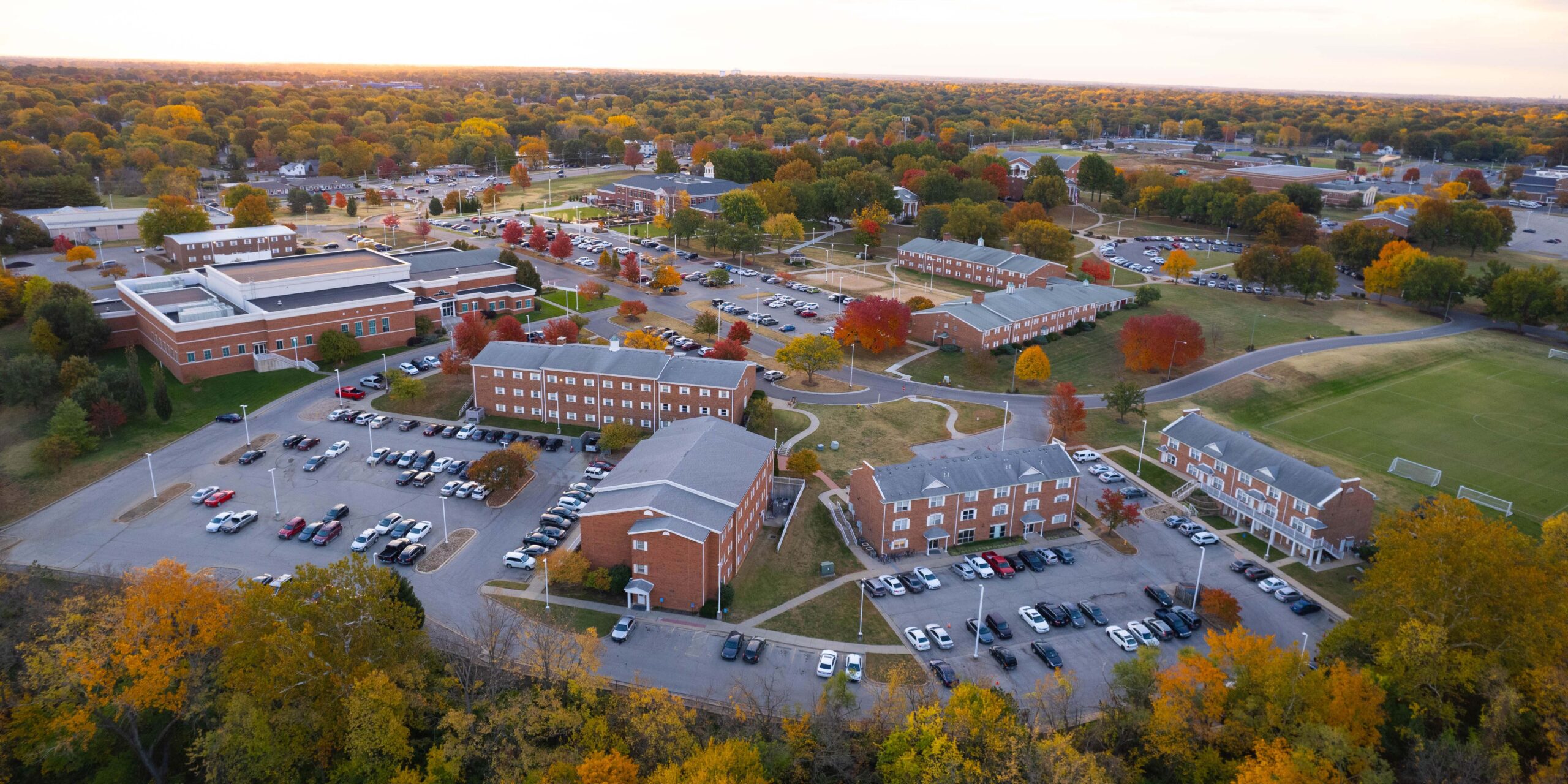
MidAmerica Nazarene University is a small, Christian liberal arts school in Olathe, Kansas, that operates with a distinctively practical, faith-forward ethos. It’s a place where nursing and business majors dominate the enrollment, campus life revolves around athletics and spiritual formation, and nearly every student receives some form of financial aid. While its graduation rate signals challenges, its accessible admissions and focus on career-ready programs attract students seeking a close-knit, values-driven education near Kansas City.
Admission requirements
Test-optional — scores considered if submitted
Required
High school transcript
TOEFL (non-native English)
Considered (not required)
Grade point average
Class rank
Test scores (SAT/ACT)
Source: IPEDS Admissions survey (2022) via Urban Institute. Covers formal factors only — it does not reflect essays, extracurriculars, or other holistic criteria.
More details
Undergrad enrollment
983
In-state tuition
$37,174
Out-of-state tuition
$37,174
Graduation Rate
54%
First-Year Retention
70%
Median Earnings (10yr)
$62,972
Financial Aid Recipients
>98%
Outcomes & value
Outcomes & value
Median earnings (10 yr)
$62,972
Value (earnings ÷ net price)
2.0×
Median debt at graduation
$15,000
Graduation rate
54%
First-year retention
70%
Reducing loan balance (3 yr)
69%
Pell (lower-income) share
31%
First-gen share (among federal-aid recipients)
32%
Top-earning majors
Median earnings by field of study (highest credential), ~2 years after completion.
Registered Nursing, Nursing Administration, Nursing Research and Clinical Nursing$59,626
Business Administration, Management and Operations$51,106
Teacher Education and Professional Development, Specific Subject Areas$37,856
Teacher Education and Professional Development, Specific Levels and Methods$37,568
Psychology, General$28,960
Campus & location
Campus safety
On-campus violent crimes (2024)
0
Per 1,000 students
0.00
On-campus criminal offenses classed as violent (murder/non-negligent manslaughter, rape, robbery, aggravated assault) for the most recent reported year. Source: U.S. Dept. of Education Campus Safety and Security (Clery Act). Counts reflect what’s reported to the school, and urban campuses often report more partly due to non-student incidents nearby — read alongside campus size and setting, not as a standalone safety verdict.
Climate
Pleasant days / yr
77
Summer high
86°F
Winter low
26°F
Annual rain
45.9"
Annual snow
18.9"
Natural-hazard risk
Relatively High
Pleasant days counts days per year with a mean temperature of 55–75°F, a high at or below 90°F, a low at or above 45°F, and little precipitation — a transparent comfort measure, not a weighting we invented. Computed from Open-Meteo ERA5 daily history (2019–2023). Natural-hazard risk is the county’s composite rating from the FEMA National Risk Index.
Deep dive — research, future-scholar output & economic mobility▾
Research output
Institutional h-index
21
Scholarly works
138
Institutional research volume and impact from OpenAlex. The h-index reflects large research universities and will be low for teaching-focused liberal-arts colleges — not a measure of undergraduate quality.
Economic mobility
Mobility rate
0.8%
Bottom → top quintile
15%
From bottom quintile
5%
Mobility rate = the share of students who both start in the bottom household-income quintile and reach the top quintile; bottom → top is that chance conditional on starting at the bottom. Source: Opportunity Insights Mobility Report Cards (Chetty, Friedman, Saez, Turner & Yagan). Reflects 1980–82 birth cohorts, so it’s directional, not current.
Quick answers
What is the acceptance rate at MidAmerica Nazarene University?
MidAmerica Nazarene University's acceptance rate is approximately 79% (Olathe, KS), based on the most recent figures we compiled from public and primary sources.
What SAT score do you need for MidAmerica Nazarene University?
Admitted students at MidAmerica Nazarene University typically score 950–1090 on the SAT (the middle-50% range). Scores outside this band are still admitted, especially with strong applications.
How much does MidAmerica Nazarene University cost?
At MidAmerica Nazarene University, the average net price (after aid) is about $32,165 per year. Actual cost varies with financial aid and residency.
How many undergraduates attend MidAmerica Nazarene University?
MidAmerica Nazarene University enrolls approximately 983 undergraduate students.
Where is MidAmerica Nazarene University located?
MidAmerica Nazarene University is located in Olathe, KS.
Admissions
MidAmerica Nazarene’s admissions process is characterized by its accessibility. The university is described as "less selective" and "somewhat selective," with an that reflects a welcoming approach to a broad applicant pool. Standardized testing is not an absolute gatekeeper; the policy is "Required For Some," and admitted students who submit scores typically present an SAT range between 950–1090 or an ACT range of 17–23. The admissions office can be contacted at a provided phone number, and prospective students are directed to the university's website for application details. While sources discuss the as a tool for understanding admissions factors generally, no specific MNU Common Data Set document detailing the relative importance of factors like demonstrated interest, class rank, or recommendations is provided in the source list for citation.
Selectivity: The university is broadly accessible.
Testing Policy: Standardized tests are required for some applicants, not all.
Contact: Admissions inquiries can be made via phone.
Earnings = median of students working ~10 years after entry; debt = median of graduates. Value divides 10-yr earnings by one year’s net price — read it as earnings per dollar of annual cost, not a full lifetime ROI; it favors lower-cost schools. Source: U.S. Dept. of Education College Scorecard. Figures lag ~2 years and reflect all students, not your intended major.
Sports, Kinesiology, and Physical Education/Fitness
$22,485
Source: U.S. Dept. of Education College Scorecard (field-of-study earnings). Figures cover graduates who received federal aid and lag ~2 years; not all programs report data.
Academics at MNU are defined by a career-oriented, practical focus within a Christian liberal arts framework. The university offers over 40 academic programs, with a handful of majors accounting for a significant share of degrees. The most popular majors are Registered Nursing and Business Administration, which align with the institution's emphasis on professional preparation. Other notable areas of specialization include Psychology, Philosophy and Religious Studies, and Parks, Recreation, & Leisure. The education department promotes its "accredited education programs" that provide "hands-on training" for future teachers. The arts and humanities are also represented, with programs in history, music, theatre, English, and digital communications designed to foster critical thinking and creativity. This creates an academic environment where vocational training in high-demand fields exists alongside traditional liberal arts disciplines, all framed by the university's religious identity.
Life at MNU is deeply communal and actively engaged, split almost evenly between on-campus and off-campus housing. Just over half (51%) of students live in college-owned or affiliated housing, while 49% live off campus. The campus culture strongly emphasizes sports and athletics, generating a vibrant school spirit, particularly around men's teams. Beyond athletics, student life is built on traditions, clubs, and leveraging proximity to Kansas City for adventures. A central pillar of the experience is Spiritual Life, which offers structured programs for worship, service, and discipleship aimed at nurturing faith, purpose, and community. The university's Instagram presence highlights a culture that aims to equip students for "ministry, leadership, and life beyond graduation." This combination suggests a student experience that is socially active, intentionally faith-based, and connected to the wider region.
Student outcomes at MNU present a mixed picture of persistence and post-graduate earning potential. The six-year graduation rate for undergraduates is the standard federal metric, though specific rates cited in sources vary. One source notes a six-year graduation rate of 70%, while another university disclosure references a 150% completion rate (which signifies measurement within six years for a bachelor's degree). The four-year graduation rate is reported as 39%. Financially, the median salary for graduates six years after entry is reported as $57,433. A first-year retention rate of 70% indicates that a significant portion of the incoming class continues into their sophomore year. These figures suggest that while a substantial number of students may take longer than four years to graduate, those who persist reach a solid mid-career earning level.
Affordability is a major focus at MNU, with financial aid nearly universal among its student body. More than 98% of MNU students receive financial aid in the form of grants, scholarships, loans, or work-study. One source specifies that 99% of students get any aid, with an average school grant of $10,890. The university encourages families to use its Calculator to get a personalized estimate of cost after aid. Published net price figures vary, with one report listing it at $34,061 and another at $29,992 after scholarships and grants. The university's financial aid office provides resources, forms, and policies to help navigate the process. Notably, none of the provided sources indicate that MNU has a policy of meeting 100% of demonstrated financial need or a "no-loan" policy where aid packages exclude loans for qualifying students.
MidAmerica Nazarene University stands out for its unambiguous fusion of Christian mission, practical career preparation, and a tightly woven campus community. It is not a university that hides its religious identity; spiritual life is a programmed and central component of the student experience. Academically, it leans heavily into the fields that lead directly to jobs—nursing and business—while maintaining a liberal arts core. Its location in Olathe provides access to the Kansas City metro area without the cost or atmosphere of an urban campus. The admissions process is accessible, and the financial aid office works to make attendance feasible for most. The campus vibe is active and sports-centric, fostering a traditional collegiate spirit. For a student seeking a faith-based education with a clear path to a profession in a supportive, communal setting, MNU offers a distinct and focused alternative to larger, more secular institutions.
MidAmerica Nazarene University seal · sourceMNU Named a Carnegie Foundation School of Opportunity - MidAmerica Nazarene University · sourceMidAmerica Nazarene University | Olathe KS · sourceMidAmerica Nazarene University - Wikipedia · source