Admit rate has ranged 49%–70% over the last 5 years — notably volatile, though the latest figure above (43%) falls outside that window. Source: IPEDS via Urban Institute.
Acceptance & SAT from Common Data Set / IPEDS; net price, earnings & graduation from the U.S. Dept. of Education College Scorecard. Figures lag ~1–2 years — verify with the school.
Millsaps College is a small, residential liberal arts college in Jackson, Mississippi, that punches well above its weight in post-graduate earnings. With a tight-knit, on-campus community and a pragmatic academic focus on business and biology, it offers a distinctly Southern-flavored liberal arts experience where the intellectual rigor of the classroom is matched by a surprisingly strong return on investment.
Admission requirements
Test-optional — scores considered if submitted
Required
High school transcript
Grade point average
TOEFL (non-native English)
Considered (not required)
Class rank
Letters of recommendation
Test scores (SAT/ACT)
College-prep program
Demonstrated competencies
Source: IPEDS Admissions survey (2022) via Urban Institute. Covers formal factors only — it does not reflect essays, extracurriculars, or other holistic criteria.
More details
Undergrad enrollment
549
In-state tuition
$44,680
Out-of-state tuition
$44,680
Early Decision
Not offered
Graduation Rate
57%
On-Campus Housing
86%
Most Popular Major
Business (27%)
Demonstrated Interest
Considered
Student-Faculty Ratio
8:1
Median Earnings (10yr)
$53,848
Outcomes & value
Outcomes & value
Median earnings (10 yr)
$53,848
Value (earnings ÷ net price)
2.1×
Median debt at graduation
$27,000
Graduation rate
57%
First-year retention
58%
Reducing loan balance (3 yr)
75%
Pell (lower-income) share
37%
First-gen share (among federal-aid recipients)
17%
Financial health
3.0 / 3.0Meets the federal financial-responsibility standard
U.S. Dept. of Education Financial Responsibility Composite Score (FY2022-23). Scale −1.0 to 3.0; ≥1.5 meets the standard. Reported for private nonprofit & for-profit institutions only — public universities are state-backed and not scored, so this is a stability signal, not a ranking.
Top-earning majors
Median earnings by field of study (highest credential), ~2 years after completion.
Business Administration, Management and Operations$33,993
Psychology, General$29,685
Source: U.S. Dept. of Education College Scorecard (field-of-study earnings). Figures cover graduates who received federal aid and lag ~2 years; not all programs report data.
On-campus criminal offenses classed as violent (murder/non-negligent manslaughter, rape, robbery, aggravated assault) for the most recent reported year. Source: U.S. Dept. of Education Campus Safety and Security (Clery Act). Counts reflect what’s reported to the school, and urban campuses often report more partly due to non-student incidents nearby — read alongside campus size and setting, not as a standalone safety verdict.
Climate
Pleasant days / yr
93
Summer high
90°F
Winter low
41°F
Annual rain
62.5"
Annual snow
1.4"
Natural-hazard risk
Relatively Moderate
Pleasant days counts days per year with a mean temperature of 55–75°F, a high at or below 90°F, a low at or above 45°F, and little precipitation — a transparent comfort measure, not a weighting we invented. Computed from Open-Meteo ERA5 daily history (2019–2023). Natural-hazard risk is the county’s composite rating from the FEMA National Risk Index.
Deep dive — research, future-scholar output & economic mobility▾
Research output
Institutional h-index
79
Scholarly works
922
Institutional research volume and impact from OpenAlex. The h-index reflects large research universities and will be low for teaching-focused liberal-arts colleges — not a measure of undergraduate quality.
Share of this school’s graduates who go on to earn research doctorates (2010–20), by national rank and per-capita yield (NSF institutional-yield ratio). A signal of a research-oriented student culture — not a causal promise, since it partly reflects who enrolls. Only top producers appear. Source: NSF NCSES, Baccalaureate Origins of U.S. Research Doctorate Recipients.
Economic mobility
Mobility rate
1.8%
Bottom → top quintile
Quick answers
What is the acceptance rate at Millsaps College?
Millsaps College's acceptance rate is approximately 43% (Jackson, MS), based on the most recent figures we compiled from public and primary sources.
What SAT score do you need for Millsaps College?
Admitted students at Millsaps College typically score 1025–1150 on the SAT (the middle-50% range). Scores outside this band are still admitted, especially with strong applications.
How much does Millsaps College cost?
At Millsaps College, the average net price (after aid) is about $26,034 per year. Actual cost varies with financial aid and residency.
How many undergraduates attend Millsaps College?
Millsaps College enrolls approximately 549 undergraduate students.
Where is Millsaps College located?
Millsaps College is located in Jackson, MS.
Admissions
Millsaps is a selective but accessible liberal arts college, admitting about 43% of its applicants. The admissions process is test-flexible, with the middle 50% of admitted students who submitted scores posting SAT scores between 1025 and 1150 or an ACT score between 23 and 28. The average admitted student has a high school GPA of 3.58. Notably, the college does not offer a binding Early Decision program, only Early Action and Regular Decision options, both of which are free to apply. While the college tracks and considers an applicant's demonstrated interest—which can include campus visits, emails to admissions officers, or attending admissions events—its admissions policies are officially open to students of any race, color, national, and ethnic origin. Of those admitted, a relatively modest portion choose to enroll, with one source noting 124 (27%) of 459 admitted students enrolled in a given cycle.
Earnings = median of students working ~10 years after entry; debt = median of graduates. Value divides 10-yr earnings by one year’s net price — read it as earnings per dollar of annual cost, not a full lifetime ROI; it favors lower-cost schools. Source: U.S. Dept. of Education College Scorecard. Figures lag ~2 years and reflect all students, not your intended major.
31%
From bottom quintile
6%
Mobility rate = the share of students who both start in the bottom household-income quintile and reach the top quintile; bottom → top is that chance conditional on starting at the bottom. Source: Opportunity Insights Mobility Report Cards (Chetty, Friedman, Saez, Turner & Yagan). Reflects 1980–82 birth cohorts, so it’s directional, not current.
Millsaps offers an intimate, discussion-focused liberal arts education with a student-to-faculty ratio of 8:1. The college encourages intellectual curiosity and independent thinking within its academic programs. The curriculum is anchored by a few dominant, career-oriented majors. Business Administration and Management is by far the most popular, accounting for 27% of degrees conferred. Biology/Biological Sciences is a strong second at 16%, followed by Accounting (9%) and Neuroscience (8%). This focus is reflected in Niche's data, which lists Business, Biology, Accounting, and Neuroscience & Neurobiology as the most popular majors by number of graduates. The college offers 43 majors in total, spanning traditional liberal arts disciplines like Art & Design, Cultures, and Psychology to more contemporary fields like Computer & Data Science and Earth Sciences.
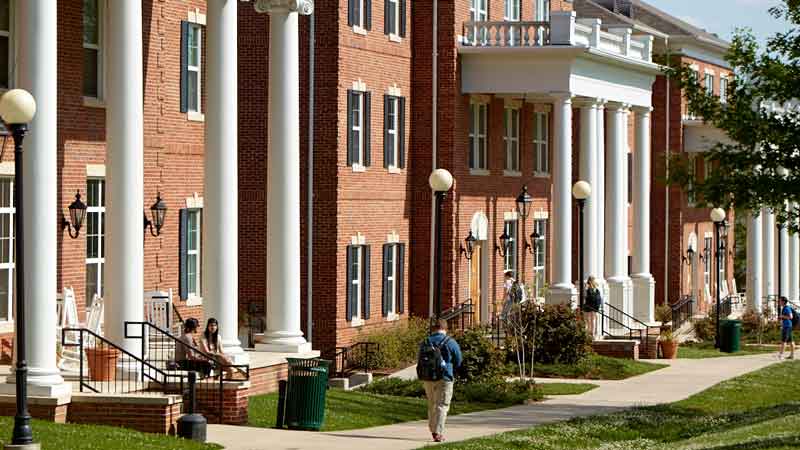
Life at Millsaps is overwhelmingly residential and self-contained, with 86% to 88% of students living on campus. This creates a close-knit community where the campus itself is the primary social hub. Weekend life revolves around Greek life events, student organization activities, intramural sports, and campus programming. Students describe the social scene as present but "more moderate and less intense compared to larger schools," with a "decent party scene" available for those who seek it. The college promotes itself as a supportive and welcoming environment that celebrates diversity and inclusion. While the campus is active, the location in Jackson, Mississippi, provides access to the amenities of the state capital, though the on-campus experience is clearly the dominant mode of student life.
Millsaps's most compelling selling point is the strong financial outcome for its graduates, which it aggressively promotes. According to federal data cited by the college, Millsaps graduates earn a median salary of $70,977 four years after graduation—nearly $24,000 more per year than the regional average. Within Mississippi, Millsaps ranks No. 1 among four-year colleges for this early-career earnings premium. The six-year graduation rate is reported between 62% and 68% across sources. The median earnings ten years after entry are $53,848. U.S. News rankings, which weigh outcomes heavily, note a 59% six-year graduation rate for the overall student body.
Millsaps is a private institution with a significant sticker price, but it uses substantial institutional aid to bring down the net cost for most students. The average after aid—the actual cost families pay—is $26,034. Other sources cite similar averages of $26,812 for students receiving federal aid and $26,739 after scholarships and grants. A strong 68% of students receive financial aid, with the average aid package totaling $41,609. Merit scholarships can go as high as $34,000 annually. The college states that its need-based financial aid packages remain constant over a student's four years of eligibility, assuming demonstrated need continues. The college provides a Net Price Calculator for families to estimate their individual cost. Notably, the available sources do not indicate that Millsaps has a "no-loan" policy or that it meets 100% of demonstrated financial need for all admitted students; aid packages typically include a mix of grants, loans, and work-study.
Millsaps College stands out for delivering a high-value proposition in a specific, regional context. It is not a nationally famous liberal arts college, but within the South—and particularly in Mississippi—it carves a unique niche. It combines the intimate, discussion-based classroom experience (8:1 student-faculty ratio) and residential community (86%+ on campus) of a classic liberal arts college with a fiercely pragmatic focus on outcomes. The curriculum is heavily tilted toward high-earning, in-demand fields like business, accounting, and biology, which directly fuels its remarkable post-graduate earnings story. This creates a distinctive culture: intellectually serious but not overly esoteric, deeply communal but with a clear eye on career preparation. The result is a college whose graduates, just four years out, earn a median salary nearly $24,000 above their regional peers—a tangible return on investment that is the centerpiece of the Millsaps identity and its most powerful differentiator.
Millsaps College seal · sourceVibrant Campus Life at Millsaps College · sourceMillsaps College | Visit Jackson · sourceWelcome Week - Millsaps College · source