Admit rate has ranged 83%–89% over the last 5 years, though the latest figure above (71%) falls outside that window. Source: IPEDS via Urban Institute.
Acceptance & SAT from Common Data Set / IPEDS; net price, earnings & graduation from the U.S. Dept. of Education College Scorecard. Figures lag ~1–2 years — verify with the school.
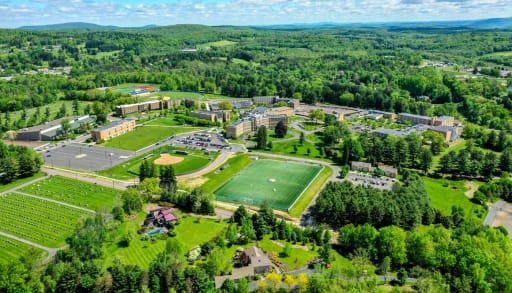
Misericordia University, a small Catholic liberal arts school in Pennsylvania's Wyoming Valley, punches above its weight in health sciences—especially nursing, occupational therapy, and speech pathology—with clinical outcomes that rival larger universities. Its tight-knit, service-oriented community (rooted in Mercy values) and rolling admissions policy make it accessible, though its strongest programs fill quickly. Don't let the 71% acceptance rate fool you: its 10:1 student-faculty ratio and 94% OT program graduation rate reveal a scrappy institution that delivers.
Admission requirements
Test-blind — scores not considered
Required
High school transcript
Grade point average
TOEFL (non-native English)
Considered (not required)
Class rank
Letters of recommendation
College-prep program
Demonstrated competencies
Source: IPEDS Admissions survey (2022) via Urban Institute. Covers formal factors only — it does not reflect essays, extracurriculars, or other holistic criteria.
More details
Undergrad enrollment
1,672
In-state tuition
$40,370
Out-of-state tuition
$40,370
Top Majors
Nursing, OT, Health Sciences
Total Cost
$59,780
Median Salary
$75,000
Student-Faculty Ratio
10:1
6-Year Graduation Rate
72%
Outcomes & value
Outcomes & value
Median earnings (10 yr)
$64,313
Value (earnings ÷ net price)
1.7×
Median debt at graduation
$26,973
Graduation rate
72%
First-year retention
78%
Reducing loan balance (3 yr)
70%
Pell (lower-income) share
27%
First-gen share (among federal-aid recipients)
30%
Financial health
2.7 / 3.0Meets the federal financial-responsibility standard
U.S. Dept. of Education Financial Responsibility Composite Score (FY2022-23). Scale −1.0 to 3.0; ≥1.5 meets the standard. Reported for private nonprofit & for-profit institutions only — public universities are state-backed and not scored, so this is a stability signal, not a ranking.
Top-earning majors
Median earnings by field of study (highest credential), ~2 years after completion.
Registered Nursing, Nursing Administration, Nursing Research and Clinical Nursing$63,377
Allied Health Diagnostic, Intervention, and Treatment Professions$55,338
Accounting and Related Services$41,565
Business Administration, Management and Operations$41,007
Liberal Arts and Sciences, General Studies and Humanities$38,289
Campus & location
Campus safety
On-campus violent crimes (2024)
2
Per 1,000 students
0.93
On-campus criminal offenses classed as violent (murder/non-negligent manslaughter, rape, robbery, aggravated assault) for the most recent reported year. Source: U.S. Dept. of Education Campus Safety and Security (Clery Act). Counts reflect what’s reported to the school, and urban campuses often report more partly due to non-student incidents nearby — read alongside campus size and setting, not as a standalone safety verdict.
Climate
Pleasant days / yr
97
Summer high
80°F
Winter low
24°F
Annual rain
48.4"
Annual snow
33.6"
Natural-hazard risk
Relatively Moderate
Pleasant days counts days per year with a mean temperature of 55–75°F, a high at or below 90°F, a low at or above 45°F, and little precipitation — a transparent comfort measure, not a weighting we invented. Computed from Open-Meteo ERA5 daily history (2019–2023). Natural-hazard risk is the county’s composite rating from the FEMA National Risk Index.
Deep dive — research, future-scholar output & economic mobility▾
Research output
Institutional h-index
117
Scholarly works
2,387
Institutional research volume and impact from OpenAlex. The h-index reflects large research universities and will be low for teaching-focused liberal-arts colleges — not a measure of undergraduate quality.
Economic mobility
Mobility rate
2.0%
Bottom → top quintile
27%
From bottom quintile
8%
Mobility rate = the share of students who both start in the bottom household-income quintile and reach the top quintile; bottom → top is that chance conditional on starting at the bottom. Source: Opportunity Insights Mobility Report Cards (Chetty, Friedman, Saez, Turner & Yagan). Reflects 1980–82 birth cohorts, so it’s directional, not current.
Quick answers
What is the acceptance rate at Misericordia University?
Misericordia University's acceptance rate is approximately 71% (Dallas, PA), based on the most recent figures we compiled from public and primary sources.
How much does Misericordia University cost?
At Misericordia University, the average net price (after aid) is about $37,485 per year. Actual cost varies with financial aid and residency.
How many undergraduates attend Misericordia University?
Misericordia University enrolls approximately 1,672 undergraduate students.
Where is Misericordia University located?
Misericordia University is located in Dallas, PA.
Admissions
Misericordia operates on rolling admissions but advises applying early (especially for competitive health science programs) as space fills fast. hover between 71-88% depending on the source, with admitted students typically having:
SAT scores between 1060–1220 (CollegeBoard) or 850+ for Critical Reading/Math (MU's minimum)
ACT scores of 22–27
A 3.46 average GPA and top-half high school class rank
While , the university emphasizes a minimum 2.5 GPA for consideration. Notably, 88.7% of applicants were admitted in 2023 (PrepScholar), though US News reports 71% selectivity—suggesting rising competitiveness for flagship programs.
Earnings = median of students working ~10 years after entry; debt = median of graduates. Value divides 10-yr earnings by one year’s net price — read it as earnings per dollar of annual cost, not a full lifetime ROI; it favors lower-cost schools. Source: U.S. Dept. of Education College Scorecard. Figures lag ~2 years and reflect all students, not your intended major.
Teacher Education and Professional Development, Specific Levels and Methods
$31,038
Political Science and Government$29,685
Communication and Media Studies$27,439
Source: U.S. Dept. of Education College Scorecard (field-of-study earnings). Figures cover graduates who received federal aid and lag ~2 years; not all programs report data.
Health sciences dominate at Misericordia, with nursing, occupational therapy, and speech pathology consistently cited as standouts (Princeton Review). The university offers 50+ programs anchored by a liberal arts core, featuring:
Top 3 majors: Health Services (101 graduates), Nursing (75), Business (40) (Niche)
A 10:1 student-faculty ratio (Sallie)
94% graduation rate for OT students over three years—with 100% in 2024 (MU data)
Hands-on learning is the norm: the university’s clinical placement rates and small cohorts (e.g., 22 OT graduates in 2024) ensure personalized attention. While strong in STEM, it maintains humanities offerings like psychology (28 graduates) and liberal arts (Niche).
Rooted in Mercy, Service, Justice, and Hospitality, campus life balances community and competition:
51% live on campus (US News) in a residential system that fosters tight bonds
Recreational/intramural activities are emphasized, though varsity athletes compete in DIII (MU catalog)
Students praise the "supportive faculty" and "small class sizes" (Niche)
The vibe is service-oriented: the university’s YouTube channel showcases traditions like "Mission Week" and clinical outreach, while the 2024 CDS highlights a 78% retention rate—suggesting students feel at home.
Misericordia’s 88.5% placement rate (57.7% employed, 30.4% in grad school) reflects its career-ready focus. Key metrics:
Median salary: $75,000 (173 respondents), though 11.5% earn under $40k (MU data)
6-year graduation rate: 72% (US News), outperforming its 57% 150% rate (Data USA)
OT program: 97.5% graduation in 2025 (MU)
While 52% graduate in 4 years (Varsity Tutors), the 78% retention rate suggests students who stay thrive. The $64,313 median 10-year earnings outpace many regional peers.
Net price: Unspecified, but US News notes aid "discounts" significantly reduce costs
The university’s Shopping Sheet calculator helps estimate aid eligibility, emphasizing Pennsylvania state grants and federal options. While pricey, its health science ROI (e.g., $75k median salary) justifies costs for many.
Misericordia’s niche is its health sciences punch: its OT program’s 94% graduation rate and nursing pipeline (75 grads/year) offer Ivy-level outcomes at a regional price. The 10:1 ratio ensures mentorship rare at similarly priced schools, while its Mercy mission—evident in service requirements and 51% on-campus residency—creates a community that retains 78% of students. For pre-professional students seeking small classes, clinical access, and a values-driven ethos, it’s a hidden gem.
Misericordia University logo · sourceInteractive Campus Map - Misericordia University · sourceAbout | details - Misericordia University · sourceMisericordia University | Liberal Arts University | Pennsylvania · source