Loading…
← All schools
More Tech Institute
Hialeah, FLprivate forprofitmoretechinstitute.edu/
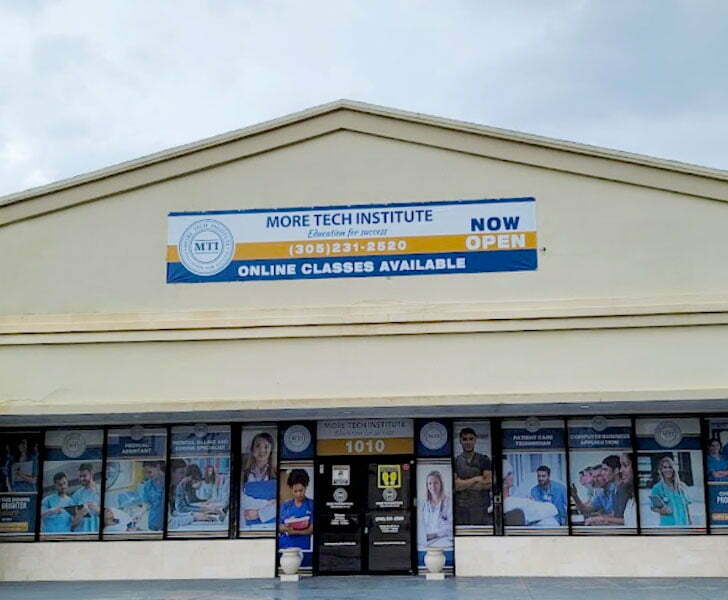
More Tech Institute is a hyper-focused vocational school in Hialeah, Florida, that operates on a completely different wavelength from traditional colleges. It’s a single-purpose machine: funneling students directly into skilled trades, primarily healthcare, through an intensive, practical curriculum. With an open admissions policy and a laser focus on job placement, it’s designed for those seeking a fast, no-frills track to a paycheck, not a broad residential college experience.
More details
- Undergrad enrollment
- 102
- Median Earnings (5yr)
- $45,519
- Dominant Field of Study
- Health
- On-Time Graduation Rate
- 96.2%
Outcomes & value
Outcomes & value
- Pell (lower-income) share
- 80%
Earnings = median of students working ~10 years after entry; debt = median of graduates. Value divides 10-yr earnings by one year’s net price — read it as earnings per dollar of annual cost, not a full lifetime ROI; it favors lower-cost schools. Source: U.S. Dept. of Education College Scorecard. Figures lag ~2 years and reflect all students, not your intended major.
Campus & location
Campus safety
- On-campus violent crimes (2024)
- 0
On-campus criminal offenses classed as violent (murder/non-negligent manslaughter, rape, robbery, aggravated assault) for the most recent reported year. Source: U.S. Dept. of Education Campus Safety and Security (Clery Act). Counts reflect what’s reported to the school, and urban campuses often report more partly due to non-student incidents nearby — read alongside campus size and setting, not as a standalone safety verdict.
Climate
- Pleasant days / yr
- 99
- Summer high
- 88°F
- Winter low
- 64°F
- Annual rain
- 57.6"
- Natural-hazard risk
- Very High
Pleasant days counts days per year with a mean temperature of 55–75°F, a high at or below 90°F, a low at or above 45°F, and little precipitation — a transparent comfort measure, not a weighting we invented. Computed from Open-Meteo ERA5 daily history (2019–2023). Natural-hazard risk is the county’s composite rating from the FEMA National Risk Index.
Quick answers
- How much does More Tech Institute cost?
- At More Tech Institute, the average net price (after aid) is about $35,398 per year. Actual cost varies with financial aid and residency.
- How many undergraduates attend More Tech Institute?
- More Tech Institute enrolls approximately 102 undergraduate students.
- Where is More Tech Institute located?
- More Tech Institute is located in Hialeah, FL.
Admissions
Admissions at More Tech Institute is a straightforward, non-selective process, starkly different from the competitive gatekeeping of traditional universities. The institute reports a 100% , indicating an open-access mission geared toward workforce training rather than academic selection. The process is guided by Student Admissions Advisers who explain programs of interest and shepherd applicants through enrollment. Unlike schools that heavily weigh standardized tests, high school GPA, or class rank, More Tech's publicly available admissions profiles list these factors as 'Not available,' suggesting they are not primary criteria. The institute's model aligns with vocational and technical education pathways designed to improve outcomes for students seeking direct career entry.
Academics
The academic offering is ruthlessly specialized. More Tech Institute is, at its core, a trade school. It offers a tightly focused curriculum designed for immediate job readiness in high-demand skilled careers, with a dominant emphasis on healthcare. According to major-specific data, the only formally listed major is Medical Office Assistant/Specialist, with typically 96 degrees awarded. Broader data profiles confirm health is the most specialized field, awarding 117 degrees, while other areas like Computer and Information Sciences show zero awards. The pedagogy is explicitly practical: the institute emphasizes hands-on lab work, an industry-aligned curriculum, small class sizes, and real-world training. Faculty and staff are dedicated to job placement support, framing education as a direct pathway to equipment operation, safety protocols, and sector-specific processes. This is education as apprenticeship, stripped of general education requirements.
Compare More Tech Institute
vs Emory University-Oxford Collegevs Fisk Universityvs Queens University of Charlottevs Hampden-Sydney College
See colleges similar to More Tech Institute →Sources
- Common Data Set: Home
- How To Use a Common Data Set - The College Solution
- [PDF] Common Data Set 2024-2025
- IR - Common Data Set | Marietta College
- What is the Common Data Set? | College Raptor
- Common Data Set - Analytics & Institutional Effectiveness
- More Tech Institute - Niche
- Student Admissions - More Tech Institute
- More Tech Institute - School Profile - College & Career Data
- More Tech Institute Admissions - BigFuture College Search
- SAT and ACT Policies and Score Ranges for Popular Colleges and ...